When it comes to both Hollywood and the media ecosystem writ large, originality can be hard to find these days: we’re relentlessly barraged with sequels, cinematic universes, remakes, retellings, rehashes, and anything else the suits can think of to avoid greenlighting something new. That makes it all the more impressive that the latest take on the Japanese light novel All You Need Is Kill—previously adapted into the Tom Cruise sci-fi Edge Of Tomorrow—justifies yet another trip to its looping battlefield, breaking from the gunmetal grays of the original to deliver kaleidoscopic carnage with some genuine emotional recoil.
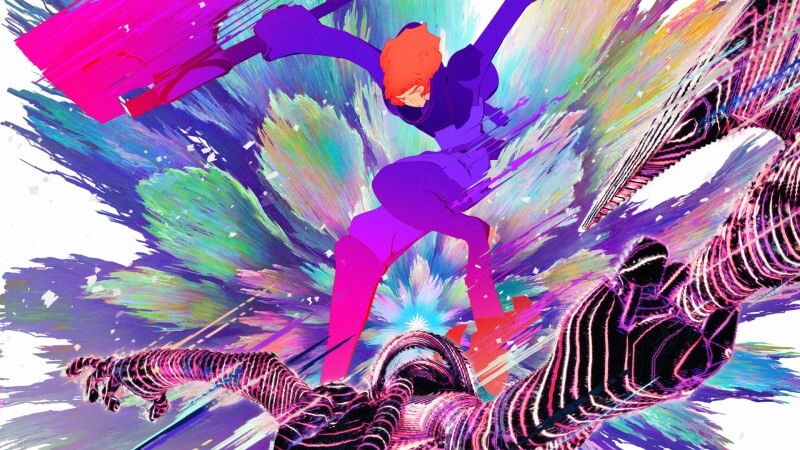
Kenichiro Akimoto’s animated film quickly establishes its own identity through an iridescent color palette and evocative flashes of memory that contrast against the grisly aftermath of hostile space invaders, lending a sense of pathos missing from the guns-blazing, intestine-spilling original. In short, this version isn’t afraid to take a step forward instead of simply repeating yesterday.
For those unfamiliar with the story’s lineage, Hiroshi Sakurazaka’s light novel and its previous adaptations follow a soldier who becomes stuck in a time loop on the day when he and his unit are slaughtered by extraterrestrials. His only way out is to internalize every detail of this battle and master his high-tech exoskeleton to beat the impossible odds.
By contrast, this latest take centers on Rita (Ai Mikami), the deuteragonist in previous tellings, a listless young woman who signs up to help prune the branches of a massive tree-like alien organism that crash-landed on Earth. After an unremarkable year as a member of this cleaning crew, this extraterrestrial sprouts an army of murder plants that gruesomely slaughter everyone in sight. Rita watches in horror as her co-workers are killed, unable to do anything but run. But when she also meets her end, she wakes up at the start of that same day before things went horribly wrong—hey, she’s stuck in one of those time loops. From here, she learns how to wield a cartoonishly oversized fire axe in hopes of hacking and slashing her way to tomorrow alongside an ally who shares her predicament.
However, while there are plot specifics, both big and small, that directly reference the original story, All You Need Is Kill is a very different spin on the material, starting with its more varied tone that whips between relatively reserved and outright panic. The original novel and manga are steeped in relentlessly grimdark storytelling: An unstoppable, unsightly alien menace eviscerates humanity in droves, conquering much of the planet while leaving little room for hope. However, despite a strong central conceit, the original’s execution can be a bit tedious and one-note, as if it’s in a race to one-up itself with lurid details of unrecognizably mangled corpses and other atrocities.
This version is much more contemplative and nuanced, less relentlessly pounding the viewer like they’re under artillery fire and more showing them something pleasant before swerving into horrors. Instead of the aliens being grotesque and terrifying, there’s an odd beauty to their rainbow neons, especially when it comes to the massive world tree that acts as their motherbase, spreading roots that turn everything into a feast of otherworldly colors. It makes it all the more uncomfortable when this outwardly pleasant flora turns out to be malicious fauna that crushes, tears, and consumes its prey with impunity. While this world is similarly deadly, you probably couldn’t get further from the grays and browns of a pulverized no man’s land that the original story evokes.
This colorful pivot underlines an aesthetic eccentricity that very much works in the film’s favor: Izumi Murakami’s exaggerated character designs immediately imbue the cast with personality, which is essential given that only two characters, Rita and her time loop partner Keiji (Natsuki Hanae), get any real screentime. Anyone familiar with some of STUDIO 4℃’s more experimental work from the aughts, like the visually exuberant Tekkonkinkreet and Mind Game, will feel quite at home, even if most of the key staff from those projects didn’t work on All You Need Is Kill.
More than just being visually interesting, though, this clean break from the source material matches an adaptive approach that invests in the concerns of Rita. She’s isolated and discontent, so much so that she seems morbidly pleased when the dormant alien invaders first arrive, simply because something could finally change. Her fragmentary memories artfully provide context for her troubles, which go much further back than her present living hell. Much like countless other examples of time-loop fiction, the story is as much about her overcoming a fundamental feeling of “stuckness” as it is about overcoming some external threat (in this case, hacking through alien hordes). It’s a significant departure, considering the original protagonist’s growth is almost entirely centered around becoming a modern-day samurai by embodying the bushido saying “kiri-oboeru,” which means “strike down your enemy and learn.”
It isn’t that this version completely shies away from people in robot suits battling extraterrestrials—it still features well-chorographed, exciting skirmishes that detail Rita’s progress towards badassery. However, instead of the narrative being built around becoming the ultimate warrior, it takes a more thoughtful tack, following Rita and Keiji (the main character of the original), as they grow into more than just alien-killing experts. While their arcs are brief, Akimoto’s direction ensures that Yuichiro Kido’s script lands as it should, delivering imagery that succinctly captures their moods, pasts, and worldviews, as they make an effort to move past stagnation, inside and out. This growth comes across in rapidfire montages of the many unsuccessful loops, conveying the brutal repetition of this living nightmare without making it feel monotonous, before ultimately leading into a positively psychedelic final battle that neatly ties together both characters’ journeys.
Admittedly, there are a few hitches, one of which is a bit literal: the 3D character animation can look choppy, a common problem across many anime that use CGI. While the compositing work is quite smooth, and it’s frequently hard to tell what’s hand-animated and what isn’t, the occasional framerate dips on background characters prove a distraction in an otherwise visually exuberant film. Less literally, while the movie’s conclusion is a major improvement over the live-action version, this denouement still falls short due to an unearned fake-out.
However, judged both in a vacuum and against its source material, All You Need Is Kill is a rare retelling that finds its own tenor. If most modern remakes aim to repeatedly squeeze every drop of existing magic out of a beloved property, this one at least escapes that unfortunate loop.
Director: Kenichiro Akimoto
Writer: Yuichiro Kido
Starring: Natsuki Hanae, Ai Mikami
Release Date: January 16, 2026


 Keep scrolling for more great stories.