Welcome to The Backlist, where The A.V. Club dives into recent older book releases that deserve their moment in the sun.
In the world of fantasy publishing, more is definitely more. Especially these days. The genre has been awash with trilogies, duologies, and interconnected series over the past few years, all of which ask readers to make a big commitment to the stories they’re reading. This can—and often does—run into thousands of pages and several years’ worth of wait time between installments.
But sometimes, all you want is simply to read a really good book—without having to worry about a devastating cliffhanger or lingering unanswered questions you won’t find out the answers to until a second installment is published. This week’s The Backlist dives into some excellent standalone fantasy reads that stand on their own.
Nettle & Bone by T. Kingfisher (2022)
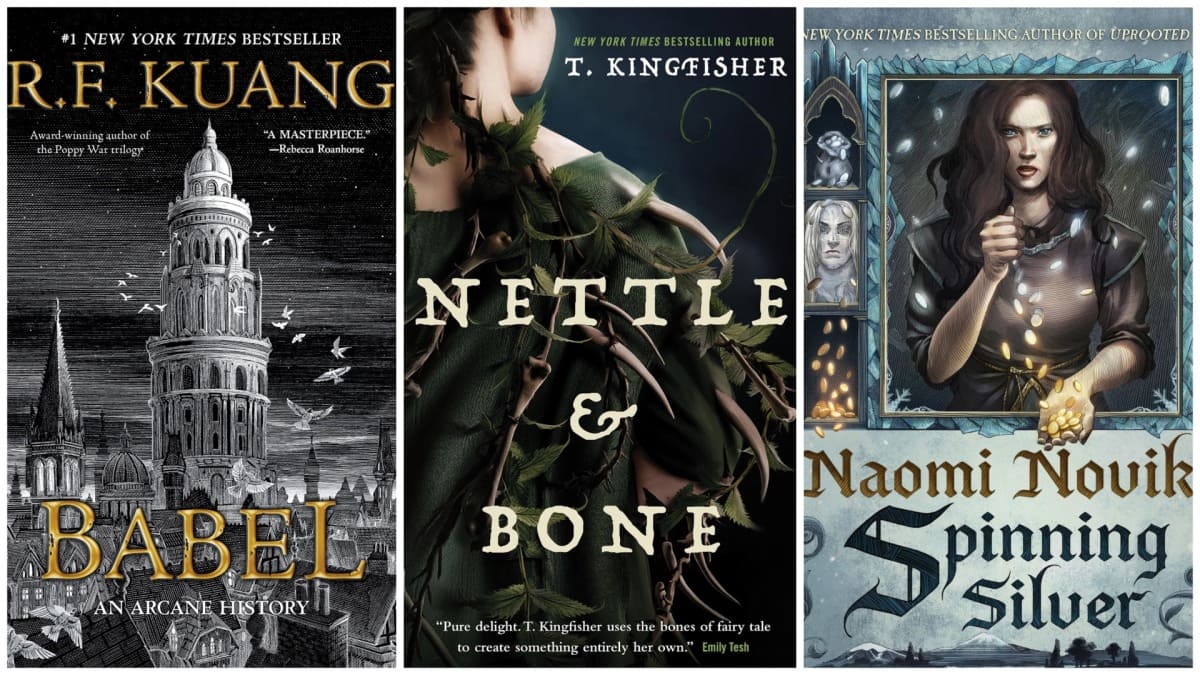
Not only am I taking the opportunity to recommend yet another T. Kingfisher book, but I’m also recommending my absolute favorite T. Kingfisher book: Nettle & Bone. Clocking in at just under three hundred pages, this novel is not just a fantastic story in its own right; it’s an excellent introduction to everything great about this particular author’s work: A heartfelt but slightly bittersweet tone, a delightfully ragtag group of main characters that run the gamut from witches to resurrected bone animals, and an unflinching, straightforward honesty about the misogyny and other dark elements that make its (and many) fantasy worlds go ’round.
The story follows Marra, a third-born princess in a tiny kingdom who discovers the wicked Prince Vorling of the Northern Kingdom is abusing his wife—her sister Kania—and most likely killed his first, who was Marra’s other sister, Damia. Disturbed by Kania’s visible injuries and the constant pregnancies she seems to be using as a shield against her husband’s violence, Marra decides she must take matters into her own hands and kill the prince once and for all. In order to do so she is set a trio of strange tasks by a dust-wife, who can speak with the souls of the dead: Weave a cloak of nettles, build a dog of bones, and capture moonlight in a jar. But that’s only where her quest begins. Simultaneously bleak, heartfelt, and lyrical, Nettle & Bone calls to mind some of the best kinds of classical fantasy writers like Peter S. Beagle, seasoned with a sort of righteous female fury.
Spinning Silver by Naomi Novik (2018)
It was a real toss-up as to whether this book or Novik’s Uprooted was going to be part of this list, but Spinning Silver is such an incredibly confident, satisfying example of fairytale reimaginings at their absolute best that it had to be here. Loosely based on the story of Rumpelstiltskin, it’s set in an imaginary medieval Eastern European kingdom called Lithvas that’s been experiencing a series of brutally cold winters. Spinning Silver follows Miryem Mandelstam, the daughter of Jewish moneylenders who takes over her father’s business in an attempt to collect the money they’re seemingly always owed but never paid.
Driven by fury over the way she and her family are treated for providing a necessary service—not to mention the antisemitism they experience—Miryem becomes wildly successful and earns a reputation for being able to turn silver into gold. This catches the attention of the Staryk, a race of fae creatures who raid human villages every winter, and draws Miryem into an uncomfortable bargain with their nameless, gold-loving king. (It requires him to make her his queen if she can transform a vast pile of silver for him.) Immersive and beautifully written, the story sees their relationship grow increasingly complicated as the human world and the fae realm become steadily more entangled.
The Poet Empress by Shen Tao (2026)
Don’t be fooled by the familiar trappings and pretty cover of The Poet Empress. Yes, it’s a story about a peasant girl who volunteers to become a concubine to a cruel prince to help her family and their starving village. But this isn’t a romantasy, and nothing about this book’s story goes the way you think it will.
Set in a world where female literacy is illegal but the written word holds literal magic, The Poet Empress follows Yin Wei, who is drawn into a complex game of politics and betrayal as she struggles to keep the unstable Terran from ascending to the throne. (This is an incredibly basic description, but it’s worth it not to know too much about this particular book’s story going into it.) Tackling themes of grief, destiny, tragedy, and ambition, The Poet Empress is both a fascinatingly dark political saga and an unexpected love letter to the power of language and literacy in all its forms. (Not kidding about the darker elements, though. This isn’t always an easy read.)
Babel, Or The Necessity Of Violence: An Arcane History Of The Oxford Translators’ Revolution by R.F. Kuang (2022)
A dense, meticulously researched novel that reimagines language as a kind of magic, Babel is a fantasy about translation in all its forms. The story follows Robin Swift, a Chinese orphan brought to England by a wealthy British scholar who spends years learning languages to join Oxford’s prestigious Royal Institute of Translation, colloquially known as Babel. Home of Britain’s most powerful magic, the tower holds silver bars imbued with power created using the gaps of meaning in language lost over time. These are used to help keep the country’s industry and war machines running, and Kuang’s tale is unflinching about the ways that foreign students are mined for the resources of their minds as brutally as their homelands are for their silver.
As Robin finds himself drawn into a reactionary student organization meant to push back against Oxford’s–and, by extension, England’s—imperialism, he and his fellow marginalized classmates must decide where their loyalties lie. Kuang’s prose can occasionally feel heavy-handed when it comes to the story’s broader themes of racism and colonialism, but it’s hard to fault the sheer ambition of her tale, which swings for the fences even if it doesn’t always land.
Jonathan Strange & Mr Norrell by Susanna Clarke (2004)
A slightly older title, but one that still feels as fresh as anything written today, this doorstopper of a novel about two rival magicians in a version of 19th-century England where magic no longer exists. (Though historians and theoreticians in the subject abound.) It is brought back into the world by both the separate and combined efforts of the bookish, cautious Norrell, who hoards textbooks and lives as a recluse, and the sociable, occasionally reckless Strange who becomes his pupil. The two differ greatly in their approach to magic—Norrell thinks it must be controlled, while Strange is more willing to take risks and experiment with the limits of his abilities. The rift that forms between them drives much of the story, though it certainly takes its sweet time playing out in a variety of different ways. (This is also vague on purpose, sorry.)
The story’s sprawling tale clocks in at over 1,000 pages, which is deepened and expanded upon through Clarke’s extensive use of footnotes, which add both historical context and character depth. A blend of fantasy and Regency-era social satire, it features delightful supporting characters and a deft blend of literary styles that range from Gothic to Dickensian.
The Isle In The Silver Sea by Tasha Suri (2025)
A standalone fantasy from the author of the excellent The Burning Kingdoms trilogy, The Isle In The Silver Sea is set in an alternate Britain known as the Isle, whose existence is held together by the power of stories told and retold via reincarnation. One of these stories is that of the Knight and the Witch, who are fated to fall in love and doom one another to what is essentially star-crossed suicide over and over through hundreds of lifetimes. Vina, a knight of the queen’s court, and Simran, a forest witch, are the latest versions of these Incarnates, who are determined to break the cycle and forge a different destiny for themselves. But thanks to a mysterious assassin who’s busy killing off Incarnates and threatening the Isle’s very existence, they don’t have all that long to come up with an answer.
Suri’s world-building is second to none, and she’s at the absolute top of her game here, blending medieval folklore and fairytale traditions with a thoughtful examination of British legends from Arthuriana to the concept of Empire. Lyrical prose adds to the overall magical feel.
The Spear Cuts Through Water by Simon Jimenez (2022)
An evocative high fantasy novel that mixes genres, perspectives, timelines, and tones to create something wholly original, The Spear Cuts Through Water isn’t a particularly easy read. But the experience of reading it is wildly singular, and Jimenez uses its meandering story of a Moon goddess who enlists help in killing her sons (known as The Terrors, if that tells you anything) and returning her bones to the ocean to explore themes of trauma, power, destiny, and the act of storytelling itself.
This book is a surprisingly active experience, as its story shifts between voices and directly involves the reader in its framework narrative in surprising and unexpected ways. Plus, Jimenze’s prose is beautiful, and the story’s cinematic feel is bolstered by rich visual descriptions and incredibly complex and inventive world-building. Not for everyone—the book’s pace is so slow as to border on tedious in the early going—but there are rich rewards for those who stick with it. (And those who love it will love it.)




 Keep scrolling for more great stories.