There were plenty of reasons to be skeptical of the Bicentennial celebrations in 1976. How to mark the 200th anniversary of the Declaration Of Independence was debated for years, all while the country was rocked with a series of tough truths and scandals. The end of the Vietnam War, a major recession with millions unemployed, and the 1974 resignation of President Nixon—this all felt at odds with an expensive celebration of American pride and legacy. Surely a new legacy was being formed in real time, one of corruption, civil neglect, and democratic erosion?
A Bicentennial-themed Super Bowl, a period-accurate reenactment of the Delaware Crossing, a new Liberty Bell, a touring “Freedom Train” museum, a Washington D.C. parade Grand Marshalled by Johnny Cash—these events and more contributed to the Ford Administration’s nostalgic celebrations, a nostalgia that historian David Ryan said was intended to “provide a sense of security that the nation and the individual within the nation can move forward, get over recent disruptions, and regain what they thought they had lost.”
For many, the Bicentennial was an opportunity for institutional and commercial exploitation; in the fall of 1975, Time ran a piece on the aggressive merchandising effort, remarking that, “Like a sudden swarm of 200-year locusts, commemorative kitsch is appearing everywhere.” But as the magazine noted in 1984, the garishness seemed to have worked. “Between June and September 1976, the surveys showed a 10% jump in the ‘state of the nation index.'” It’s not extremely scientific, but it does indicate that, should mass cultural efforts to influence America’s mood and myth present themselves, they could prove effective.
Where else could Americans in 1976 see national mood and myth reflected? The ’76 movie calendar offers a compelling counterexample of how popular entertainment met the moment. Some filmmakers cashed in on what they reckoned audiences wanted to hear, while others tried to articulate the complicated moment that 200 years of America had led to.
Look first to 1976’s biggest success: Rocky, a Rust Belt Cinderella story that shot dirt-broke screenwriter and star Sylvester Stallone to stardom. The Bicentennial factors into Rocky‘s plot; it’s why Apollo Creed (Carl Weathers) arranges a title bout in Philadelphia. As filmmaker Sam Katz told Philly Mag, Philadelphia was a “bitterly divided city along political and racial lines” at the time, with a corrupt mayor and a flailing baseball team. Rocky‘s blend of grit and heart have a medicinal effect; working-class, heart-of-gold Rocky Balboa took on an immediate and potent symbolic quality as someone dedicated to rising above his crummy conditions. He is the eternal everyman—bitter but romantic, dumb but with convictions, able to clock the odds against him and go the distance regardless. These contradictions give Rocky the necessary dimensions to feel like he belonged to the current moment. It wasn’t just Hollywood wish-fulfilment with a new coat of paint, but a self-actualization fantasy centered on a classic American virtue: integrity. It’s not a million miles away from the message of Ford’s Bicentennial, but because the film’s themes of rejuvenation and pride were (slightly) divorced from nationalist images and messages, they felt a lot more convincing.
Rocky didn’t win his match against Apollo, but Rocky was victorious against a handful of heavyweight Oscar nominees, snagging Best Picture from two acclaimed dramas commenting on the intersections of politics and media. With its unstable newscaster-preacher Howard Beale (Peter Finch), Network attacked television, its producers, and viewers, lancing its capacity to excite illusory, populist political critiques that enrich the cynical capitalists behind the scenes. All The President’s Men went after Nixon—both a hot-button issue and a sore subject in 1976—dramatizing with a blend of naturalistic process and gasps of neo-noir style the first months of the investigation by Washington Post reporters Bob Woodward (Robert Redford) and Carl Bernstein (Dustin Hoffman).
Both films ask: What do Americans want to hear about their country? Beale’s televised, radicalizing, ultimately vacuous refrain, “I’m mad as hell and I’m not going to take it anymore!” is contrasted with Ben Bradlee, editor of the Post, standing in his dark driveway with Woodward and Bernstein after they discover that it goes all the way to the top: Regarding Watergate, “Nobody gives a shit.” Beale’s sermons invite passive audiences to vent their frustration, attracting televangelist-tier revenue in the process. Where Network‘s top brass shrug at the moral cost of their vapid programming, the Post’s editorial team reveals an enviable backbone, scoring copy with a scrutinous red pen and rallying for their reporters with the stubbornness of any of Rocky’s trainers.
If Network and All The President’s Men, in their own cloudy way, are appealing to a better country, then they know the deck is stacked against them. As a bitter, absurdist satire, Network has free rein to show the cultural nosedive that politics merged with mass communication will lead us to; as a finely tuned, propulsive docudrama, All The President’s Men rails against letting political rot sweep an entire country along with it. In Network, cynicism and corruption can infect everyone; in All The President’s Men, you can draw a thin but clear moral line.
Both films were hits, although not comparable with Rocky‘s box office returns. Still, their political weight and Oscar-winning legacy made them more memorable than the second- and third-highest grossing films of 1976, both of them remakes of Classic Hollywood stories: King Kong and A Star Is Born. The blockbuster had just been born with Jaws, and Dino De Laurentiis eyed Kong as the follow-up to Spielberg’s success, announcing the ape’s comeback with a poster of him standing astride the recently completed World Trade Center. While it’s the worst of the four versions of A Star Is Born, the Barbra Streisand and Kris Kristofferson romance was notable for smartly changing its Hollywood setting to the music industry, and for Streisand acting as the project’s de facto author. But as critics noted, both films’ appeal to classic high-key escapism—be it larger-than-life adventure or doomed romantic melodrama—were ill-fitting and strained. America bought a ticket to see the familiar reprinted in a modern font, but these updated throwbacks merely belonged to their cultural moment rather than responded to it.
In retrospect, three smaller films from the Bicentennial pursued a more miserable but honest tone, and underperformed as a result. John Cassavetes’ The Killing Of A Chinese Bookie, Elaine May’s Mikey & Nicky, and John Carpenter’s Assault On Precinct 13 are crime films with different tiers of realism—Chinese Bookie and Mikey & Nicky are more grounded and melancholy mob stories, while Precinct 13 is a grungy, pulpy siege movie—but they’re memorable for long stretches taking place under the shadow of night, with sweaty, paranoid men clinging to survival. The films are united by feeling—How will you fight when the walls close in?—and unfold with subdued, patient tension. They all bombed, but their decidedly non-escapist mood resonates as an implicit observation about Americans. There’s a sense of being trapped within a locale, trying to imagine an escape that might not come, fending off failure.
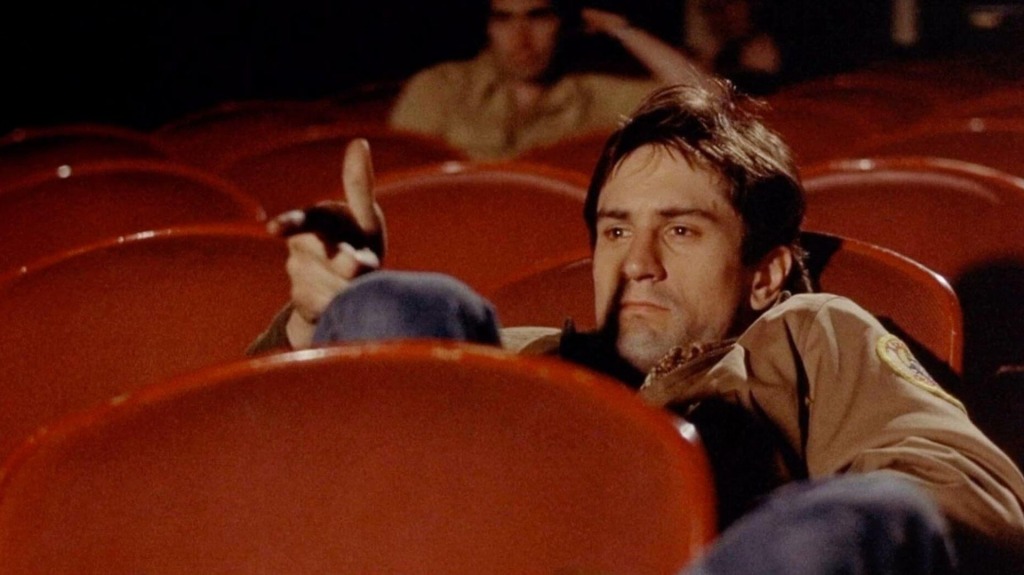
Taxi Driver and The Outlaw Josey Wales were more explicit attempts to mark the turbulent and conflicted moment in America. Both films were the fifth features by their household-name directors, Martin Scorsese and Clint Eastwood, and marked a significant step up for their directing talents. While Travis Bickle (Robert De Niro) is closer in ideology to Dirty Harry—an urban vigilante who’s certain he’s diagnosed the rot that needs expunged from society—his growing resentment with what he perceives as the filth and folly of a bankrupt New York City, observed through the lonely windows of his yellow cab, reeks of antisocial bigotry.
After a series of failed attempts at connection—talking politics with Presidential candidate Charles Palantine, a date to the porno theater with campaign worker Betsy (Cybill Shepherd), confessing his violent urges to his colleague Wizard (Peter Boyle)—Bickle turns full fascist, disciplining his body in solitude and searching for violent outlets for his rage. When he shoots his way through a brothel to rescue a child prostitute (Jodie Foster), a reverie-like epilogue shows Bickle hailed by the press as an urban hero and praised by the woman who once humiliated him. Whether the final scene of Taxi Driver is a hallucination or not, it still chills as a damning fantasy—that the modern American can cure his neuroses, make a bigger impact on society than any politicians, and increase his personal status through cleansing violence. This was not nostalgia; this was an off-putting confessional on behalf of America’s disturbed and dispossessed, and Bickle’s proximity to large crowds and pageants is an uncomfortable counterpoint to the Bicentennial’s elaborate celebrations.
By putting the archetype of the lone gunman into its original historical context—in the most American genre, the Western—Eastwood’s Josey Wales argued for the American vigilante’s enduring appeal. Josey Wales‘ relation to America’s birthday was no accident: it had a Bicentennial weekend release of June 30, and Eastwood later said that the story of Josey Wales—the Confederate guerrilla soldier who turned outlaw after refusing to pledge loyalty to the Union—needed to be told because of America’s dissatisfaction with Vietnam (a war that also traumatized Travis Bickle). Wales’ honor stinks of “Lost Cause” revisionism, painting the Union forces as dishonorable and murderous and showing the titular Confederate “gray rider” as a taciturn libertarian with dignity—spitting tobacco to express his displeasure and gunning down rapists—who picks up a diverse range of stragglers and survivors he’ll ultimately feel responsible for and attached to. The film concludes with his former friend-turned-Union-soldier agreeing to pretend Wales is dead so he can live a peaceful, secluded life.
Josey Wales is a film that comments on myth while also accepting it, a fitting and appealing form of Bicentennial nostalgia. In one scene, Wales meets Comanche chief Ten Bears (Will Sampson) to discuss a truce between them and his new commune, both agreeing on their distaste for American governance. The didacticism of this moment contributes to Josey Wales feeling like the key Bicentennial Western—more than Don Siegel’s The Shootist, starring John Wayne in his final role, or Robert Altman’s satirical Buffalo Bill And The Indians from the same year. Josey Wales declares the rejuvenation and relevance of the Western without ignoring the present condition of the country, just as the Bicentennial sought to do the same.
Fifty years later, what films, if any, are commemorating or critiquing America’s Semiquincentennial? It’s the explicit aim of the second Trump administration to tie America’s 250th birthday to his own kitschy iconography and fascistic worship of iconography, which may explain both the general aversion to partake in any visible celebration and why The Great American State Fair is such a funny spectacle of failure. Independent Christian studio Angel has the epic war film Young Washington, and if you squint, Johnny Knoxville’s merry band of fools captures the pride and agony of the American project. From earlier in the year, box office hit Project Hail Mary is an American exceptionalist narrative with all the nationalist details—and a potentially sharp climate change allegory—dialed down, just as the author intended. But little has been released this year with the same edge as the ultra-current satires of 2025—One Battle After Another, Eddington, Bugonia—and even those films had a hard time making their mark on a dissolved monoculture. What made Bicentennial cinema so compelling is that its most successful films resolved their critiques of American society by finding faith in the flawed project. They changed the mood more than the myth, speaking both to the ideals of a nation and the reality of its citizens.


 Keep scrolling for more great stories.