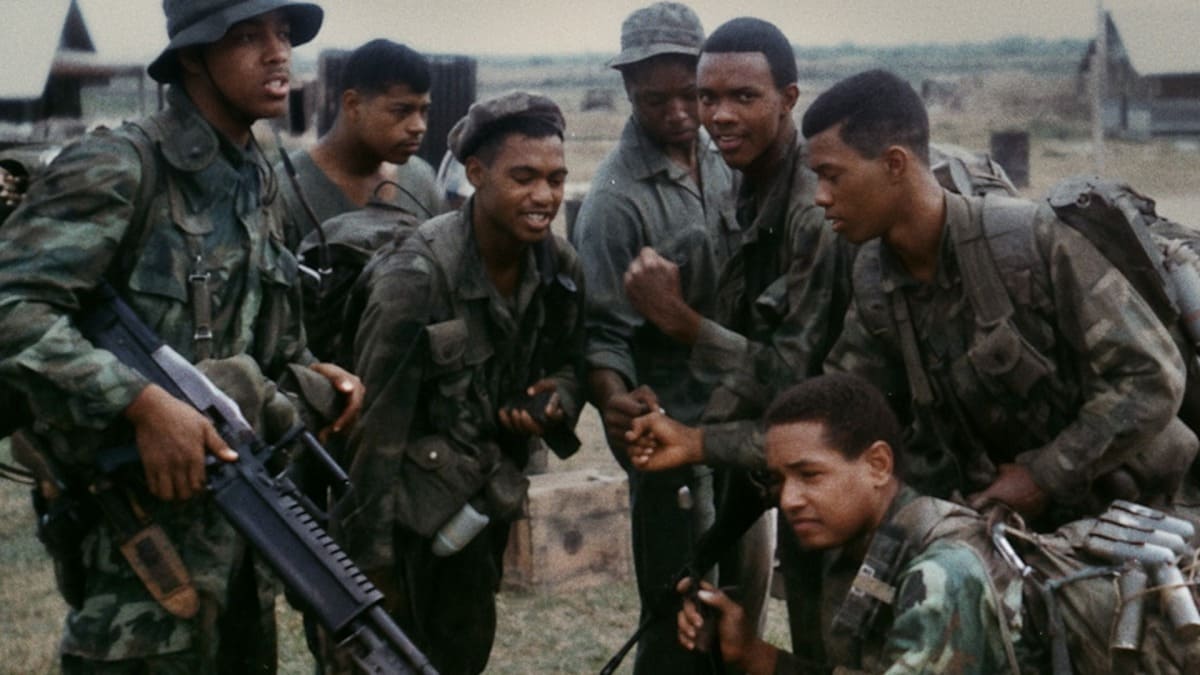
The Black Vietnam War experience is finally making its way into movies, decades late

Soul Patrol and Brothers In Blood: Black In Vietnam rectify the big-screen's white-centric depiction of the war.

The Black Vietnam War experience is finally making its way into movies, decades late

After Oscar-winning moneymakers like The Deer Hunter, Coming Home, and Apocalypse Now collectively tested out the waters in the late ’70s, the multiplexes would become inundated with Vietnam War stories in the ’80s. (Though, technically, uber-patriotic star John Wayne was the first to bring Vietnam to the big screen, with the critically reviled 1968 hit The Green Berets.) But while Sylvester Stallone and Chuck Norris used the war to create their own jingoistic action franchises, others created rough-but-earnest tales of soldiers going through hell in combat and at home. Oliver Stone directed a trio—the semi-autobiographical Platoon, Born On The Fourth of July, and Heaven And Earth—while Stanley Kubrick came out of hiding to drop Full Metal Jacket and Robin Williams scored his first Oscar nomination in Good Morning, Vietnam. While many of the aforementioned films featured veterans of color, to show how Vietnam was the first war where Black and white servicemen fought side by side, the attention wasn’t generally focused on them. The protagonists of these films were always white boys. 

The fact of the matter is, apart from ensemble flicks like Hamburger Hill (which featured Don Cheadle and Courtney B. Vance as military men dealing with racial discrimination), the Black experience in Vietnam was rarely discussed on the big screen during the super-pale, super-conservative Reagan ’80s. It wasn’t until 1995—one year after Oscar-winning hit Forrest Gump saw Tom Hanks’ titular simpleton sweetheart go through Vietnam unscathed—when not one, but two movies about Black soldiers in Vietnam (directed by Black filmmakers) finally hit the scene. 

First was The Walking Dead, not to be confused with the zombie franchise. Written and directed by first-timer Preston A. Whitmore II, it featured a mostly dark-skinned crew of Marines (including Joe Morton, Allen Payne, and comedian Eddie Griffin) on a suicide mission to evacuate a POW camp. This was followed by Dead Presidents, from brothers Allen and Albert Hughes (Menace II Society), where some frustrated vets (including Menace star Larenz Tate and Chris Tucker) come together to pull off a heist. (Spike Lee would pull a similar caper with Da 5 Bloods, where vets returned to Vietnam to retrieve gold they discovered during battle.)

But those movies (which weren’t big draws at the box office) were more like genre pictures than authentic portraits of brothas in the war. Both films were greeted with criticism from both vets and historians for their inaccuracy and lurid sensationalism. “None of it would have happened,” ex-Marine Lawrence Smith said about The Walking Dead. “You wouldn’t have had talking in the bush… Hell, if you talked out there and jeopardized my life, I would shoot you myself.”

Wallace Terry, whose 1984 book Bloods: An Oral History Of The Vietnam War By Black Veterans served as inspiration for both The Walking Dead and Dead Presidents, said those films didn’t address what he calls “the war within the war.” “What I found when I was there (as a Time correspondent from 1967-69) was a replay of the civil rights movement going on in the rear,” he explained. “It was not unusual to see Confederate flags or experience cross-burnings or riots among Black and white troops.”

It’s not until now that two recent documentaries have finally given Black Vietnam vets their long-overdue flowers on the big screen. Soul Patrol, directed by J.M. Harper, adapts Ed Emanuel’s 2003 memoir of the same name, where he lays out his time as a member of the only Black Long Range Reconnaissance Patrol unit in Vietnam. While Soul Patrol debuted at this year’s Sundance and is now making its way onto screens across the country, Joseph Puleo’s Brothers In Blood: Black In Vietnam is still playing at various film festivals.

Both films have different methods of saluting the troops. Soul Patrol is woozy and dreamlike, with Harper rounding up interviews with Emanuel and other surviving members of his unit, as well as archival footage, Super 8 home movies, and actual recreations of the men in battle. Harper’s hybrid doc practically puts the viewer in the POV of these mentally and physically damaged men who are still haunted by their experiences. One running bit has Emanuel being followed around by his fellow soldiers in a supermarket, giving monologues near the checkout lines.  

Brothers In Blood is more like an updated version of The Bloods Of ‘Nam, the 1986 Frontline doc (written and reported by Wallace Terry) that focused on Black vets. Over an hour and a half, Puleo makes an acceptably comprehensive chronicle of the Black experience in Vietnam, getting interviews from veterans as well as authors and historians. Both films have vets giving harrowing testimonials about the terror and racism they faced on the battlefield, dealing with both racist good ol’ boys and merciless Viet Cong soldiers. (They do learn to respect their enemies, who seem to grasp that these Black men aren’t the real problem.)

Ultimately, both films show how Vietnam left Black men just as bruised and broken as the white guys—maybe even more so. Over 300,000 Black men served in Vietnam, with 7,000 not making it back. In 1967, they represented 23 percent of all combat troops. Two years prior, they represented a quarter of all U.S. combat deaths. Once they came home, not only were they saddled with PTSD and illnesses brought on by Agent Orange, they dealt with a country (which wasn’t ever that keen on them in the first place) that neglected and shunned them. Unlike the popcorn pulpiness of The Walking Dead and Dead Presidents, Soul Patrol and Brothers In Blood finally take the time for something that’s been long overdue: They thank Black men for their service by giving time and attention to what they went through.

 
Join the discussion...
Keep scrolling for more great stories.