An Oscar-winning film is a tough act to follow, but Ashley Robinson has found a way to adapt Annie Proulx’s Brokeback Mountain to make it feel just as vital as it did in 2005 and in 1997, when the novella was first published. The actor-playwright first staged his Brokeback Mountain in 2023 in London’s West End, where Mike Faist and Lucas Hedges played the ill-fated lovers and cowboys Jack Twist and Ennis Del Mar, respectively. Now the adaptation has come to Chicago in time for Pride Month, beckoning audiences back to the open range to witness a star-crossed romance and all the prejudices and socioeconomic constraints that tried to douse the flame.
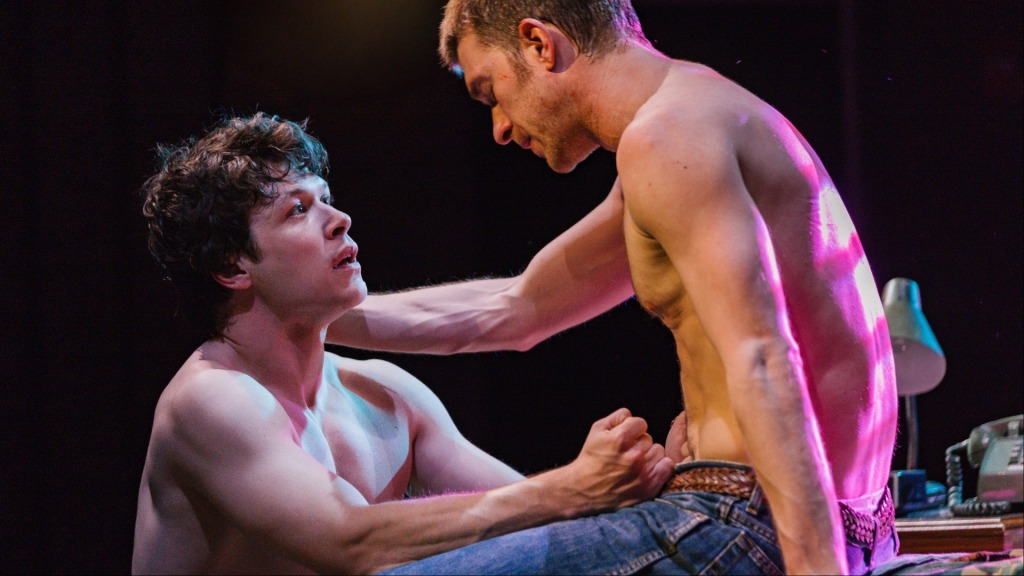
The Chicago Shakespeare Theater‘s Courtyard Theater has been transformed into part Wyoming wilderness, part romantic hideaway, and part oppressive home, with former New York City Ballet principal dancer Harrison Ball and Boots breakout Jack Cameron Kay taking over for Hedges and Faist as the taciturn Ennis and the loquacious Jack. The new leads are following in the footsteps of not just Hedges and Faist, but of Jake Gyllenhaal and Heath Ledger, who was nominated for an Oscar for his devastating turn as Ennis in Ang Lee’s gorgeous character study. But Ball and Kay are eager to chart their own paths, making them ideal collaborators for Robinson, who adds more humor into the mix—because he believes levity is needed to make tragedy land—as well as original country Western songs from composer Dan Gillespie Sells. The A.V. Club spoke to Robinson and his two leads about getting Annie Proulx’s blessing, connecting with Chicago’s gay community, and why Brokeback Mountain is both an important piece of queer media and a quintessentially American story.
The A.V. Club: Annie Proulx turned down previous treatments of her novella, but she’s given a ringing endorsement for this production. Ashley, how does it feel to launch your show with that kind of vocal support from the originator of this story?
Ashley Robinson: Yeah, [Annie] liked the first draft and then we met and we got along because she’s a pretty amazing human. You don’t want to be on her bad side, but she’s a pretty amazing human. I went up to visit her in New Hampshire and we talked a lot. She sent me to UCross, and I got to go up with sheep. I didn’t camp, but I got to be in the landscape and meet people and I took a road trip all over the country there. It was really informative.
It felt great for her to choose me to do it because she had many other, what I would consider much better options. But for some reason she was like, “Nope, this is our guy.” And I have no fucking clue why, but she did and I’m glad because I’ve had a great time with this piece.
AVC: Harrison and Jack, you previously moved in similar circles in New York. What’s it like to be working on this type of show together as you’re both entering different chapters in your careers?
Jack Cameron Kay: It felt very fateful and serendipitous. I sometimes look back at my time at Juilliard as maybe a misalignment or right place, wrong time. I was studying opera and I just didn’t really want to be there. But now as a result of having been there at that point in time, I’m here doing this work, which is some of the most fulfilling and expansive work that I’ve ever been involved in. So it really restores my faith in this concept that all things happen for a reason. And I’m really grateful for that because it really puts to rest some of my regret about…. [laughs] It’s kind of hysterical for me to sit here and talk about regret for going to Juilliard, but it still exists within me. So it’s been a really poetic series of events for me.
Harrison Ball: We’re both somewhat embryonic in this era of our careers, but at the same time, this is no small production. It’s something quite large. We’re really cradled by it, and with Ashley and Jonathan [Butterell] and Dan [Gillespie Sells] and everybody who’s involved, I think we feel really comfortable as much as we can be in embarking on something different and new. But what’s interesting for me is that whilst Jack and I didn’t know each other, we have a shared scape. There’s some sort of tether there, a likemindedness that just derives from being in the same kind of atmosphere in our youth. I think we’re both pretty serious people when it comes to performance, so getting an opportunity to share this chapter, this first chapter really with somebody who I align with in that regard has been really amazing. Of course we’re really lucky that we get along. This would be a bit of a different experience if we didn’t. So it’s just been heaven.
AVC: With any work of adaptation, there’s some reimagining, and when you’re staging this live multiple times a week over a certain stretch of time, there’s bound to be continued revisions. Ashley, how has the show changed since bringing it to the States from London, and also just in the time that you’ve been working with this cast and putting it on in a place like Chicago?
AR: The larger thing is we took out is a character, which was an older Ennis, which really gave us a container and a beginning and an end. But that meant I got to reinstate a lot of things that kind of got crunched together or for me; I lost a lot of power in London and I got to put that stuff back in and I got to tailor the suit. I always call it “tailoring the suit.” I’ve got these two brilliant men, and the rest of the cast is stunning as well and you start to learn their rhythms and their voices and you’re able to go, how can I make this clearer? Oh, I can write this new thing for Jack. I can just make things clearer on these particular actors in this particular production, which is always really fun to do. And that goes for [working] with Dan and Jonathan as well. It’s special.
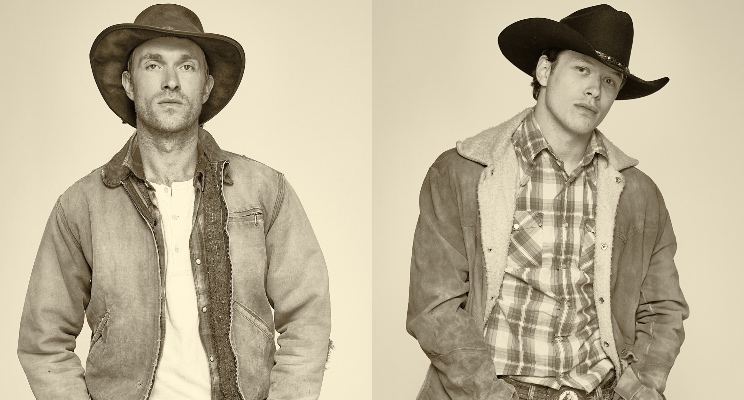
Left: Harrison Ball; Right: Jack Cameron Kay (Photos: Kyle Flubacker)
AVC: Harrison and Jack, there’s a lot of research you could have done, a lot of inspiration you could have drawn from, whether you’re looking at the short story, the previous live production, or obviously the Ang Lee film. What balance did you try to strike between what’s come before and, as Ashley put it, tailoring the roles to yourselves?
JCK: I watched the film the night before my audition and I almost think that did a disservice to myself because I was operating with a different vision of this character and the story. Obviously, there are certain qualities of this character that are going to be represented by the film and the previous production because this character just exists a certain way. But all the information that you need to discern that about this character is in the text. So once I really started working on this role, I didn’t really consult anything else. It was just gleaning as much information as I possibly could from what Ashley has created and then just trying to get as much historical visual reference points as possible to fill up all of these different landscapes and settings that this person has in their life. Beyond a couple clips from the other production giving me a sense of maybe some physicality things and whatnot, I didn’t really consult anything else because I think it’s an inhibiting factor to reference other people.
AR: James Dean didn’t during Giant. He relied on George Stevens the whole time. It’s smart.
HB: I think because this is my first go, it’s been a discovery of what works and what doesn’t, and I’m still very much in that process of figuring out what works and what doesn’t. Ashley and I had met prior to coming to Chicago, where we sat down at a table with Jonathan for a week and just talked about what was on the page and why things were happening and the environment being a really key part of this; the class structure of everything within focusing more on those dynamics and less of sexuality, which I think is always what people want to point at when they look at this [story].
So I came in with ideas and perhaps still am clinging to a few, but it’s like you’re constantly discovering things. I think it comes even in just a sentence from Ashley, or a sentence from Jonathan, or just being with Jack or [Cordelia Dewdney], who plays Alma, or listening to the band, which is a huge component of the production that we didn’t even realize until we got them in the studio where it was like, wow. I mean, this is a whole other world within the world that really sets the tone in the environment and kind of fills the gaps where my character, for example, is so short-worded. There’s that dialogue that can be created through sound. Once we got into the space, it’s pretty expansive and it’s even larger than it was in the West End, so we’ve got scenery and we have stars and there’s land and there’s water, literal water pools on stage. Every day we do this, I’m finding new things and I find that I’m getting further and further away from what we concocted earlier in the process and now it’s kind of like being there.
Of course, text is king, and Annie’s story was a big draw for all of us; it’s such a masterpiece. When I met Ashley, he had given me a copy of the book that was actually signed by Annie, which was really beautiful. Once I got that in my hand, I just used that as a bible. But every day is a new day——you never know what you’re going to find on that page or in the work.
AVC: Can you talk about what it’s like to work with your director Jonathan Butterell, as a writer and as performers?
AR: We did our first reading in 2017 with another producer and then the pandemic happened and we moved producers…so we’ve been going with this a long time. We have a shorthand and it’s like any director and writer: We have our ups and downs and we collaborate, but I love Jonathan, trust him with my life. He’s built this beautiful production that is so elemental. I think Harrison was hitting on the point that we got real earth on stage. We got real earth that you can hear real boots scattering through and there’s fire and there’s snow and there’s water.
I don’t think I can think of another production, not of this, or of anything that makes me feel like I’m outdoors without doing a stupid backdrop or something. And that’s why music was very important because it helps us literally take Annie’s prose about the land, which you cannot put on stage unless you’re doing a shitty production of Oklahoma or something. Dan pulled the text verbatim in many cases, and it’s stunning because there’s so many moments of stillness and silence because the script, like the book, is just tiny. I think the script is about 60 pages because they just don’t say a lot. So the music and the transitions and the minutiae of storytelling that Johnny is able to do with just a person on stage, with just one of them or Alma on stage sitting at a table after she’s seen them kiss and just playing with her scarf…it’s so beautiful and human.
JCK: When I first showed up to do this production and started rehearsals, I was genuinely terrified. I was so convinced that I was completely out of my depths and I was going to really eff this up. But the way Jonathan set the tone for the process was so safe and so nurturing; he really sets the precedent for me and the standard that profound and expansive work can occur in a really safe and supportive environment. Working under him has really just been one of the great creative experiences of my life, and not to sound hyperbolic, he’s definitely changed the way I work as an actor, so I’m extraordinarily grateful.
HB: Jonathan’s becoming [like] a dad. [Laughs.] I love Jonathan and I think what’s more interesting for me is now that we’ve done so much of the character work, it’s becoming more of the people work and he really sees us for the people that we are. From day one, he has always been saying, “I just want to hold the space for you to do this work.” And without getting too woo-woo, it’s just brilliantly spiritual being in a room with him and having that privacy that we had in the earlier part of the work was just so special. And it went so fast and it’ll probably forever be in my mind as one of the most special weeks of my life as a performer. I think he’s just so skilled and experienced and really just a pure, pure soul, and this work together with Ashley really just lives in his body with his background.
It’s the same with Ashley. Ashley knows the grocery store where my dad shops in South Carolina. My dad lives on the border there, so there’s that tether for me. Jonathan’s from Sheffield, and my family’s from Doncaster. So there were all these kismet things and beyond that, spiritually, we’re all so aligned. Being together with Jack and Jonathan, this trifecta that we’ve created is just so comforting, but in a way where we can get a little dangerous. He really sets the tone and he is just a master at what he does. And he’s just no ego, he’s not above anything or any ideas and he’s just totally willing to give us the space to just splish and splash. We’re really lucky as a first go to have that opportunity to work with somebody that wonderful.
JCK: And it feels important to add that all of this is not without rigor and not without expectation and challenge. [Jonathan] so elegantly weaves that challenge and rigor into the space that feels very comfortable, but you know parts of yourself are being extracted. I just feel like the best is being shaped out of you and you don’t even really realize it’s happening, if that makes sense.
AR: He’s a magician, as a good director should be.
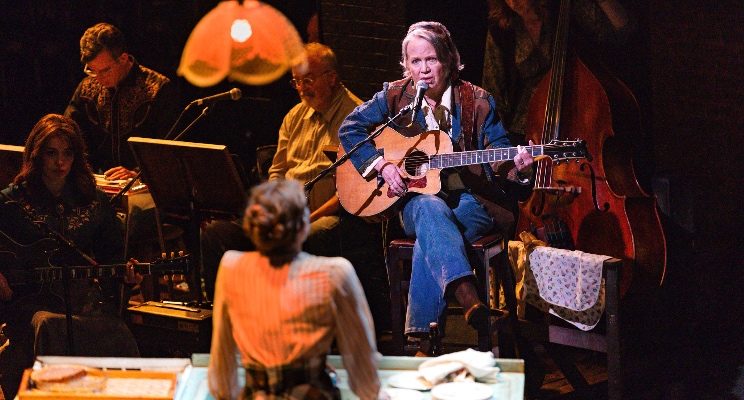
Kat Eggleston as the Balladeer (Photo: Kyle Flubacker)
AVC: You’ve all had different experiences with audiences, whether the in-person kind or the people at home watching shows like Boots. But with live performances, you have a much more immediate sense of how people are taking things in. What’s it been like in terms of processing any feedback either from your actors or from the audiences at previews, or adjusting to the more intimate setting compared to the New York City Ballet, or being in a room with people responding to your performance in the moment instead of becoming an online obsession months after filming ends?
JCK: Well, I’ll just say that in between shooting [Boots] and it coming out, I had a year to convince myself that I did a really bad job. [Laughs.] I don’t know if you can sense a theme coming here, but I’m a little hard on myself. But with this, it’s like you can sense in real time the way people are responding to something. It’s like nothing else. And I would say that up until I put myself in front of an audience, I really didn’t know how I felt about what I was doing until I was able to get that live response. I was like, Okay, I am making people laugh in this show. And so then it’s completely changed the way that I feel about what I’m doing. It just feels like acting is meant to be performed in front of people, and an elemental part of that, the tradition of performance, is the audience. For so many actors, the main form of acting we do is for self-taping with nobody around and it’s just like soul-sucking. So I’m so relishing every moment of getting to perform in front of an audience.
AR: God, the audiences here are responding in a way they did not in London, and I think it’s because of the colloquialisms that just went right over their heads in London. And I’ve been saying to the whole cast this whole time I’ve been, and they’ve been totally hearing it, but in the room, you can’t. But I was like, “No, this is funny and we need this joke to hit. So you have to take this pause” and da, da, da, the rhythm. Because here [in the U.S.] it is funny. The audience, they’re having a really fucking good time because you have to have levity for the tragedy to fully hit. You have to. You have to open your heart and think you’re safe for the fucking punch to go in as deep as it could go. And I think y’all are finding that. I’m like, ah, they hear it now. They hear it now. [Laughs.]
JCK: Well, of course I always knew it was funny, but it was like we have been working on it for so long. It’s like none of the actors are sitting around heaving over these jokes they’ve heard for the hundredth time. [Laughs.]
AR: Yeah, no, I’m delighted that the audience response is what it is. And I think that’s being in a working-class city and even just in the country.
HB: I was laughing with Jonathan the other day because I’ve quite literally done thousands of performances on stage and for audiences of 3,000 plus daily, but the difference being obviously is that I’m silent and there’s a different kind of etiquette within the theater in ballet and opera’s setting. So I’ve never been one to really consider [the] audience much because I’ve been doing it since I was four and I was always more focused and guarded on making sure that I was delivering what I had to deliver with the right amount of energy. But at one point I became a master of my craft, so it was just so second nature for me, and now I think having this exposure and the proximity in this theater is really raw for me. The level of concentration needed to oscillate between acknowledgement of the audience within your given dialogue, but whilst also trying to carry the show accurately and keeping the emotional scape that you have to be within while there’s a true interaction where people are actually part of the work. They’re involved, they’re participating, they’re responding, they’re laughing, they’re crying, you can’t not take in those givens that are within the room. So that’s a completely foreign body and experience, and one that I really look forward to continue honing.
But there’s something really beautiful where you feel really cradled by the audience, and that’s something totally different for me because in New York you finish your show and people are running to the 1 train and you don’t really get a moment. And we always said, “Do I bow here?” And my director used to always say “If they applaud.” Audiences are different everywhere you go. Chicago is a delicious audience and they’re so supportive and I think they’re really, really happy to be there. So it’s a constant discovery for me in regard to how to live beside an audience in such proximity.
AVC: This is essentially the third adaptation of Annie Proulx’s novella. What do you think might still be overlooked about the story, or what’s something you’d like to call attention to about this particular telling?
JCK: I just want to highlight how much of an honor and a privilege it is to be able to perform this piece during Pride Month and to get to share this story with so many queer men, especially elder queer men who I’ve had the privilege of getting to know a bit after the show, and just the privilege I feel I have to be able to tell this story in this place at this point in time and to hear these reflections from older members of our community who lived through the similar time period as that this play depicts. I really cherish that opportunity.
AB: I got nothing more than that. Literally, that was going to be my response, that we’re in a very privileged position to be able to put this on the main stage at Chicago Shakes and we have to be vigilant lest it become a cautionary tale.
HB: Yeah, there’s a vulnerability to it that I didn’t really clock. Having grown up in the South and Northern England, I’m not unfamiliar with this kind of tone and definitely, I think we all experience a degree of this torture that we have to go through. But then beyond that, I just keep harping that at face value, it really comes off as a homosexual love story but I think it’s wider than that. What I was mentioning earlier is just this emphasis on environment, because as much as we want to just cling to identities, I think you can look at today and see how environment is really dictating our identity. So it’s not just a thing that comes from within. Nurture, environment, exposure—love is complicated, it doesn’t discriminate in terms of where we go emotionally and things just take you by surprise.
So I just keep harping that I think it’s important for audiences to come even though there’s a cultural tether to the book or to the film, which is probably the primary tether for people. Come with an open mind. It’s not just Jack and Ennis: Alma is a powerful woman within this time period. And I think that there’s a lot to extrapolate through everyone’s narratives and even Lureen, who comes in at the end. But yeah, it’s really universal. These are everyday issues: Who am I? What am I? Where am I? What can I do? What can I not do? What do I want to do that I can’t do? It’s like we all deal with this constantly. What I’m discovering is even though it’s set in a time period where that was more pervasive in our minds, it really is still completely pervasive and it’s everywhere, even in New York City and people deal with this shit all the time.
To Jack’s point, I think there’s a bravery about the producers and Ashley and Jonathan really pushing to have this be shown and told now and perhaps the stars all aligned. And unfortunately we live in this chaotic moment in the world that feels even more swollen than normal, but I do think it’s really important queer media to be presenting work like this. I’m happy and so honored and feel very vulnerable and somewhat afraid sometimes telling the story too, so that kind of speaks to it. We’re very lucky, all of us. And to have the crew that we have, the team that we have in the theater, the Chicago Shakes, everybody involved, there is not one thread or ounce of tension. Everybody’s in this together, down to the people handing our bags to us backstage before we go on. It feels so communal and supported and that feels so unique and special. So it’s all-around good energy in this play. Come see.
Brokeback Mountainis playing at the Chicago Shakespeare Theatre through June 28.


 Keep scrolling for more great stories.