The latest online trend to cement itself on my Instagram feed is “10/10 bleed out spots.” People, primarily men, record their POV overlooking a lush scenery. A sea of alpine trees. The shore of a lake subdued by snowfall. Riverbanks so clear you can see the fish swimming underneath. You get the picture.
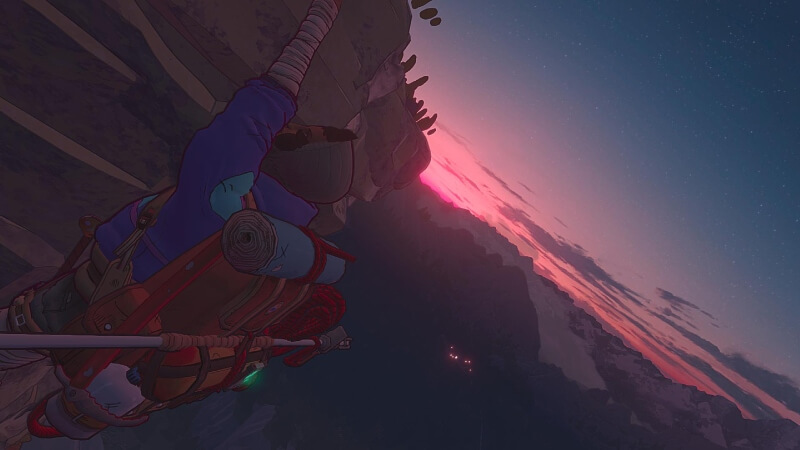
Every video has slight variations. The first few I came across showed the person’s feet slowly making their way to the edge of a cliff. They’d then sit down on the ground and adjust the camera’s exposure to show the sun in the distance, as “Nutshell” by Alice In Chains accompanied the scene in the background. But others have been taking the bit more seriously, acting out their deaths. Some cough while crawling, or spit fake blood before taking their hand to their chest, simulating a last breath. The acting usually ends the same way: The camera slowly falls to the side, and the frame ends up fixated on the sky or a mountain far away.
Aava, a famous mountain climber and protagonist of the survival climbing adventure Cairn, constantly touts this idea of performative sacrifice. The character is introduced as a devotee of hardships. It is, in her words, all she’s ever known—ever since her father put her in front of a climbing wall when she was three, lighting the spark for her lifelong passion. In a moment of seeming stardom after accruing several accolades, Aava sets herself on a journey to climb an expanse known as Mount Kami—a victory that has remained out of grasp for years.
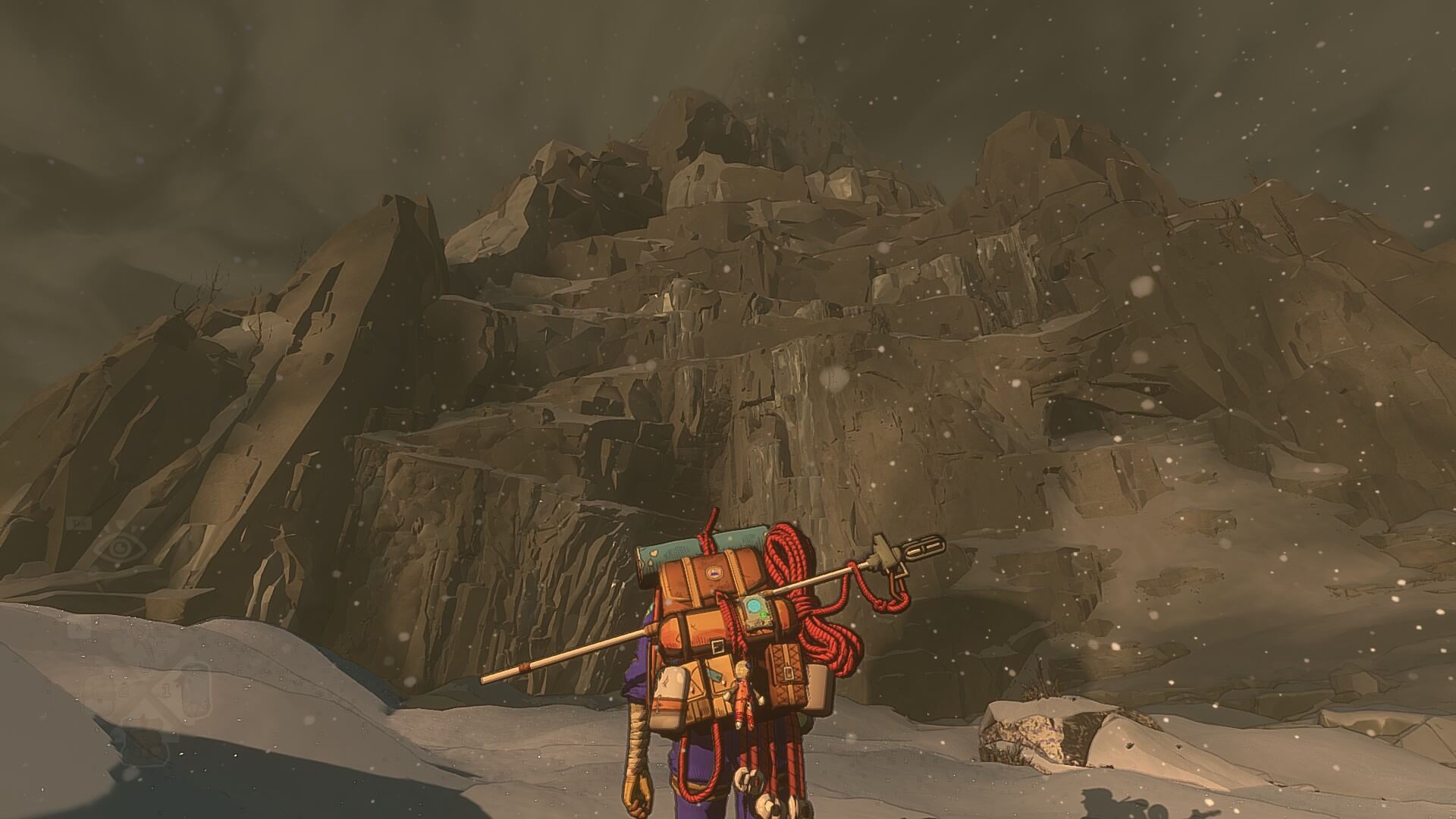
From the moment you leave Cairn’s training area, the goal is always in view. You walk on foot until a wall gets in your way, and then begin the ascent. This is done by moving and placing each of Aava’s extremities onto the nearest crevice or rock to hold onto, one at a time, with the option to manually do this by yourself or let the game make the selection for you. This repetition pattern is tied to weight and the character’s resistance. Grip onto rocks without a solid surface under your soles for long enough, and Aava will start to tremble, eventually losing her grip and falling down.
There are different tools meant to help prevent this outcome. You can place pitons on suitable surfaces, which provide a moment of rest to recover stamina and a checkpoint of sorts in case you do end up falling. When you reach certain areas, usually flat surfaces after a climb or the inside of a cavern, you’re likely to find a place to camp. Inside your tent, you can mix ingredients to cook recipes, add tape to Aava’s fingers, or sleep to both pass the time and recover health, among other survival-related activities to care for your hunger, thirst, and temperature levels. Depending on your difficulty of choice, interacting with camp sites is the only way to manually save the game, which makes them all the more tantalizing.
Aava’s character development occurs in and out of her tent. During particularly exerting climbs, the illusion of tension is almost tangible. Act promptly and correctly to find a stable surface to latch onto, and you can almost picture her muscles relaxing. But the opposite case also yields expression, as she gets audibly frustrated when she falls, proceeding to shout and cuss.
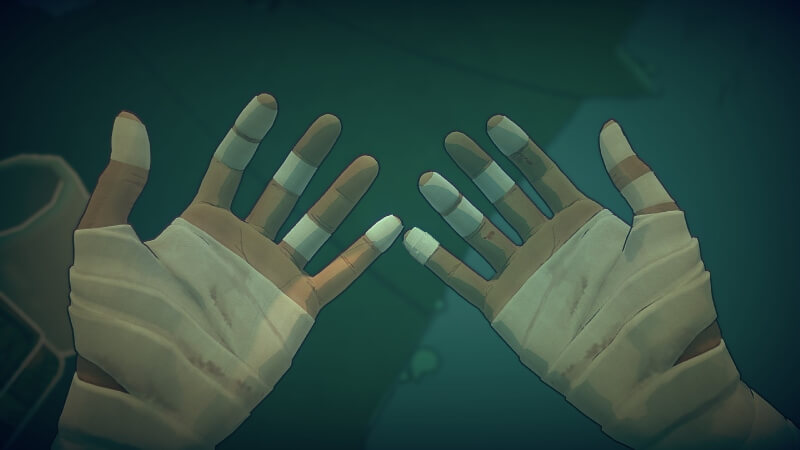
Changing the tape in Aava’s fingers in particular became a ritual for me. Half of the time, there wasn’t a practical need to do so, as her hands were already set for the most efficient grip. But if I saw just one finger missing tape, I addressed it on the spot. In these moments, the camera changes to first person, and you see the hands up close. You have to select each finger at a time and do a circle animation until it is covered. It’s repetitive, but it reveals the physical toll of Aava’s efforts, displayed as injuries on her hand.
This cycle represents Cairn as a whole. Once acclimated to the core mechanics, climbs become a series of puzzles to solve, rather than tests of might. Some sections are challenging enough to mirror Aava’s frustrations, with me cussing and shouting whenever a foot placement didn’t register properly and made me fall to the previous piton—if I had been smart enough to put one, that is. Despite the monotony, however, I remained determined to see it through.
The problem is that the foundation on which Cairn bases these hardships lacks not only a stronger stability, but purpose, as well. Aava periodically receives voice messages from people back on the surface via an accompanying robot, yet she doesn’t actively respond. Her agent asks for updates as sponsors promise deals. Her partner, on the other hand, progressively inquires more about Aava’s reasoning to “leave” people behind in order to attempt these dangerous climbs.
One of the first pieces of characterization around the character is a quote from a fictional magazine, in which Aava says, “The best feelings of freedom came to me when I exceeded my limitations.” As you plunge further into the story, it becomes clear that she also finds comfort in the solitude of the climb. Overcoming challenges is important, and it probably is everything she’s ever known. Yet, she also shows an impulse to get away from people and pursue an individualistic path, to the point of talking about the thrill of the climb as the only moment she can truly be herself.
My mind first ruminated about Firewatch, recalling protagonist Henry’s escapade of becoming a fire lookout after caring for his sick wife. Like Aava, it’s a (rather selfish, to put it mildly) attempt to run away from problems. Yet, the theme of death in Cairn becomes ever more pronounced, overshadowing every other lingering thread. Mount Kami has purgatory fame—a newspaper warns of 159 reported deaths on the mountain. Some of these you can confirm during your trek, with skeletons scattered around or people who’ve recently fallen to their deaths, their bodies dangling from a rock with only their climbing ropes keeping them suspended. You come across letters of people before you find their bodies a couple of hundred meters later.
These sights aren’t enough to stop Aava. She spouts a sentence or two before you’re given the option to loot a corpse (saying phrases like “you’d have wanted me to take this”). They’re less of a warning about a possible fate and more another element that’s mere backdrop for her.
But the theme is always a central piece in Cairn, inviting you to think about sacrifice and what it takes to overcome impossible odds. Why do we do things that are bound to cause suffering to us and others? What does it mean to find purpose? As I approached the end, it was clear that Aava didn’t know the answer to these questions, nor was Cairn invested in seeing through one of the many threads it unfolded. Instead, this performance of a hero’s journey ends just like the others before it, the frame fixated on Mount Kami as the camera slowly falls for the last time.
Cairn was developed and published by The Game Bakers. Our review is based on the PC version. It’s also available for PlayStation 5.


 Keep scrolling for more great stories.