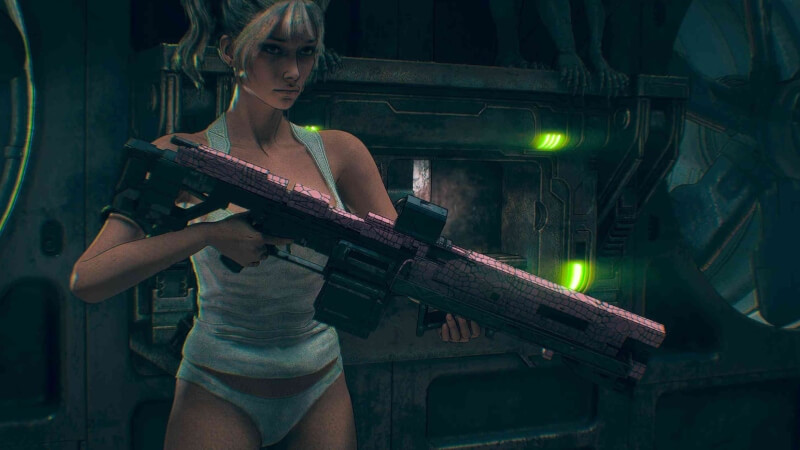
Violet is standing outside of yet another dull metal threshold. She’s in her underwear again, a dingy white, ribbed cotton panty and tank set. Not a single platinum blonde hair is out of place in her pigtails, her slutty-demure eye makeup perfectly set. With one slender hand presumably resting on a control panel, she’s waiting for an exact moment. Any second now. The vent that isn’t the same texture or color as the ones surrounding, like old cartoons, bursts open and out pops Dr. Alan Grant’s old nemesis: a velociraptor. It charges down the hallway.
Violet hits the button. Thick horizontal lasers light up the hazy corridor causing harsh, high-contrast, Unreal Engine 5 shadows to form suddenly, awkwardly on every surface that isn’t blown out by a glow of red. The velociraptor flails, shudders, vibrates as the conflict between geometries tries to resolve itself, whining as its unseen health meter hits zero. Then it breaks into clean halves on the floor. Violet turns off the laser fence, the low-key lighting resumes: Achievement Unlocked.
I want to tell you that Code Violet is the kind of game that supports inventive, systems-driven, stealth-action combat. That this laser fence was emblematic of the kind of play options that the game makes extensive use of. If luring rampaging raptors to their doom in the far future with sexy bimbo sweat was a real component of gameplay, or that environmental fatalities were a thing at all, we might actually have something. I want to say this is the heir to the Dino Crisis throne as claimed in nearly every scrap of the game’s marketing. That even when it’s this buggy, unpolished, and seemingly made-up of a patchwork of asset store plants and wall panels, it’s got juice like Thief or Metal Gear, or at the very least it can hang as the bimbofication of Turok. But I can’t. Code Violet costs 50 dollars, and it seems like an advanced student prototype or an also-ran full-conversion mod.
During my 22 hours with Code Violet, I tried to figure out just what TeamKill Media was aiming for with this game. Between the reviewer guide and their marketing material, Code Violet is supposed to be a terrifying apex chimera, the Jim Jensen’s Ultrasaurus of Genre. But surely it leans one way more than others. Is it a guns-blazing corridor shooter? A punishing survival stealth game? Does it want to be a narrative adventure? In what mode are we imperiling this make-believe woman in her underwear—horror, comedy, action? Am I just trapped in some developer’s truly boring sexual fantasy? Game critics, I’m told, are supposed to “meet a game on its level,” but what do you do when a game resists taxonomy, not because it’s deliberately playing with genre conventions, but because it just doesn’t know what they are or how they work?
In the 25th century of Code Violet, humanity is doomed. Earth is a barren wasteland after some cataclysmic event called—wait for it—“The Cataclysm.” But circling around the ultra-cool dwarf star TRAPPIST-1, some 40ish light-years away, is a new world: a very real, Earth-sized rocky exoplanet known as TRAPPIST-1e. Technicians, custodians, bioengineers, groundskeepers, doctors, caretakers, and a whole lot of fertile women are laying the groundwork for the future of humanity in the Aion colony. Violet is one of those fertile women. And somehow, she’s special (though you won’t find out why until close to the overdue-but-no-less-abrupt ending of the game).
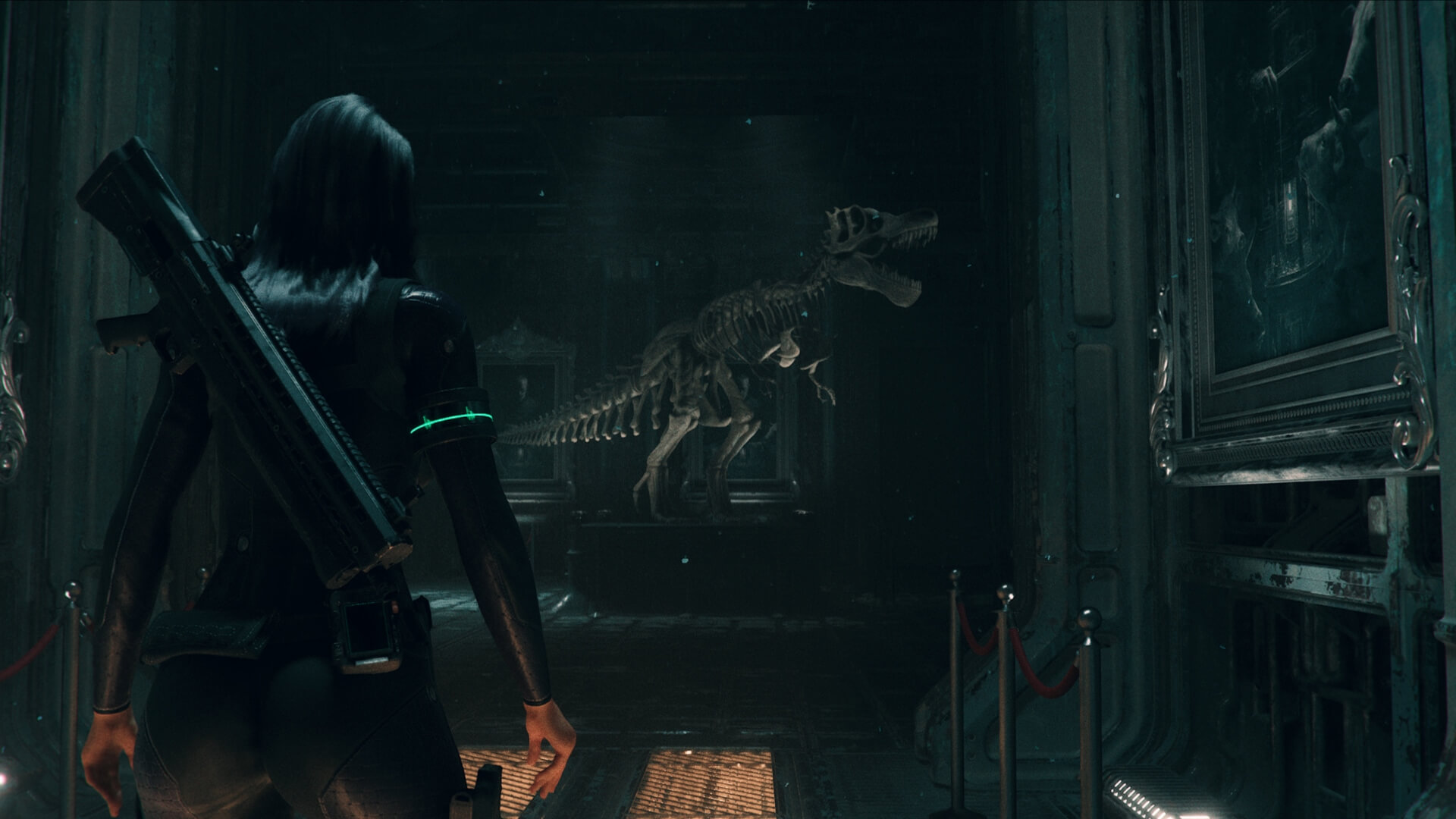
Shit promptly goes completely sideways for Aion and dinosaurs get loose in the very dark and high contrast facility, which is lined with Robocop 2 levels of “on the nose, but missing the mark” paintings that are simultaneously satirical and grimly sincere. (My favorite is one of a sinister “family” of creepypasta people holding a baby raptor breaking out of its egg.) The deeper into the game and the colony, the more Christian the visuals become, eventually culminating in many representations of beatific, pregnant white women. Is this game aware of the state of reproductive freedom in America? Probably. SCOTUS overturning nearly 50 years of precedent set by Roe v. Wade was hard to miss. Do the developers have anything interesting to say about it? Not one bit. Perhaps the actual horror at the heart of Code Violet is that it doesn’t seem to understand that its horror is entirely centered around reproductive control and the systemic menacing and terrorism levelled against people who can become pregnant. We could do a reading, but I promise you, Code Violet does not care, and it’s probably better if it doesn’t. Instead, it cares about how Violet jiggles and the ways she can be imperiled.
Violet has amnesia—a handy, overused device to ensure an outsider (the player) can be introduced to a world, its characters, and their motivations in digestible and impactful ways. Here, it’s used to hide a great deal of information about the world and Violet’s place in it. This amnesia enables a fully realized character like Violet to have revelations that go hand in hand with the player’s revelations. Except, despite the biblically apocalyptic imagery throughout the game, there’s very little in the way of revelation in Code Violet, until the very end. Even when a button prompt suggests “try to remember…” we don’t get a real sense of existence for Violet to remember. She has little commentary on the world around her. She has no interiority to speak of. She doesn’t have any barks. The best we get early on is a comment along the lines of “Did it have to be so tight?” when she dons a painted-on stealth suit that is so far up her perfectly globular ass cheeks that the textures do wild things when she crouches. Who is her family and how did she end up in Aion? How did she spend her time here? Why does she care about any of this—and, thus, why should we care about her? Sure, there’s the briefest possible flashback where her father delivers an unmemorable “Why do we fall, Master Bruce?”-style Yogi-ism. But in terms of the people she cares about? Other than a barely-there love interest and one doomed friend, no significant connection is created for her. It all makes it hard to care about the colony being thoroughly eviscerated like a Weland-Yutani franchise.
Emails on conspicuously-placed communication devices throughout the facilities are used to shoehorn a sense of life and a populace into this narrative. Unfortunately, they’re all in the same voice. They’re overly long, rarely feel grounded in the point of discovery, and often serve solely to yellow-paint an upcoming puzzle solution, neither conveying the bleak humor of Resident Evil’s “itchy, tasty” or pointing to darker, sinister mysteries like the clipboard report Bishop reads off in the colony lab in Aliens. And you’ll have to read every single one of them in Code Violet‘s microscopic font. A handful of “audio logs” appear as transcripts; originally devised as a game element to deliver worldbuilding and enhance the texture of a space, here they have the opposite effect, sliding off the brain instantly and leaving you with only a vague dissociation from the task at hand. Instead of proof of life, they make the space feel like no one has ever lived or worked in it at all. Despite the volume of root beer bottles left on workstation desks and a ludicrous amount of body parts that bounce around Violet’s feet like balloons on prom night in every room, the unlabeled tunnels and proper noun sections of the Aion colony are empty. It’s impossible to imagine them ever being anything but.
But don’t confuse that for me saying this game is quiet. It’s a “Sony PlayStation 5 Exclusive,” so it has to play up the 3D Audio the same way it hammers home the haptic feedback triggers (which half the time means your controller will rattle and provide resistance, but your guns won’t shoot). With any pair of headphones plugged into the DualSense controller, you’ll be able to hear the great galumphing breaths of T.rex over your shoulder (the miniscule amount of times he shows up as a set-piece pushover) and the turkey warbles of the poison-spitting Dilophosaurus (in every fucking room). Office chairs will slide, vents will break open, and water will splash, all giving you important in-the-moment strategic information about the Aion Bioengineering Complex’s many environments. Or at least, that’s how it should work. In an attempt at filling the dead space of no audio logs, no character dialogue, and what is both too much and not enough dinosaurs, the sound engineering of this game has decided to go for a heavily layered, often distorted series of random dinosaur sounds, mechanical scrapings and thunks, an incessant high-energy humming (which is different from the “you’re near radioactive writing or invisible laser fences” diegetic alert hum that often layers on top of the original humming, thus rendering it inaudible), and lots of old wet meat sounds.
To compensate for the soundtrack making positional awareness next to impossible, I did the next best thing. I pulled out my pistol, the most worthless of firearms, and fired a series of shots into every room before entering. I would immediately switch to the heaviest weapon I had too much ammo for and mow down every dinosaur that approached. Despite its obvious love of Jurassic Park, there are no Robert Muldoon moments to be had in Code Violet. You’ll never see a raptor get the drop on you and think “clever girl.” Make a noise, become death incarnate. That’s the way this game was meant to be played: shooting the shit out of every dinosaur you see.
There are three main types you’ll be shooting. In real life, Dilophosaurus is a 20-foot bad built, butch body badass with a bi-hawk. He doesn’t have frills, he doesn’t spit poison. Michael Crichton did him dirty, Spielberg cemented it, and Code Violet continues this slander. The Dilophosaurus problem is so bad that I ended up playing the entire final dungeon with a maxed gamma just so I could see when it spit. Nedry me once, shame on me. Nedry me 50 times when the nearest checkpoint is 15 minutes back? Fuck you. For yet another Jurassic Park reference, the Compsognathus are in this game, too. Compys are annoying little shits that will eat you alive in seconds like they did Peter Stormare in The Lost World. Also, they are impossible to kill with Code Violet‘s underperforming, frequently glitched-out shooting. For most of Code Violet, all you’ll ever really see are velociraptors and dilophosaurus, over and over. No set-piece with a Triceratops, no rowdy Ankylosaurus in the otherwise empty Greenhouse. We get a brief glimpse of a Pteranodon in flight leaving the first facility, but never again. Only the original, limited-by-the-CD-ROM-format Dino Crisis roster. Eventually something resembling miniature Deinosuchus will appear (think: basic beefy gator), but it’s too little, too late, and they’re entirely sleepy. The game just doesn’t seem to think the dinosaurs it does have are all that cool. They can’t open doors, they don’t coordinate, they won’t ambush (sometimes they’ll spawn in magically for scripted events, which is cheap and sucks), they won’t chase you from room to room unless you really mess up and let them in, repeatedly.
The marketing for Code Violet makes promises that aren’t delivered. As recently as February 2025, TeamKill was claiming that dinosaurs would track you by “blood” and “sweat.” This doesn’t seem to have made it into the game at all. Bleeding and sweating are two things that Violet Sinclair simply does not do. (She can barely cry like a human.) Even when eviscerated and in need of specific items like tourniquets and blood packs to treat her injuries, you’ll never see a scratch on her. She doesn’t sweat. Crawl around in raw sewage or dinosaur entrails and you’ll emerge as smooth and flawless as a Calgon Milk Bath ad. (TeamKill’s Facebook post, by the way, has a single reply: “I hope I’ll play as a male too.” This is the world that Violet Sinclair was born into.)
Code Violet begs a number of questions. Why make a game about dinosaurs if you don’t even like them? Why set a game on the real planet TRAPPIST-1e if you don’t care about exoplanetology? Why make a bimbo shooter if you don’t think bimbos should have fun? Why am I constantly tripping over ammo and healing items in a survival game? Is this all there is?
The answer to that last question, it turns out, is no—but not in a gratifying way.
90% of this game’s story happens in the final 10 minutes, but nothing is paid off, mostly because there’s nothing to pay off. New plot points are introduced to no real end. Revelations occur, delivered in a blur of expository dialogue by Violet’s main antagonist, but without a coherent and sustained set-up in the main narrative, they have no weight. We get nothing of the broader world, the threat, the stakes—nothing. Just a meaningless plot dump in a Kingdom Heart’s clone of Anor Londo that injects themes this game could have been actually employing all along if there was anything meatier than corridors and dinosaurs. After the credits, we’re told Violet’s journey has just begun. This is where Code Violet ends, setting up sequels that will never happen. The upcoming projects listed on TeamKill’s website doesn’t even hint at Code Violet 2. Perhaps her next chapter isn’t for us; it’s simply being a sexy Unreal Engine doll for her creators to entertain themselves with when and how they want, like Europa at the end of 2010: Odyssey Two. Attempt no landing here.
Code Violet was developed and published by TeamKill Media. It is available for PlayStation 5.


 Keep scrolling for more great stories.