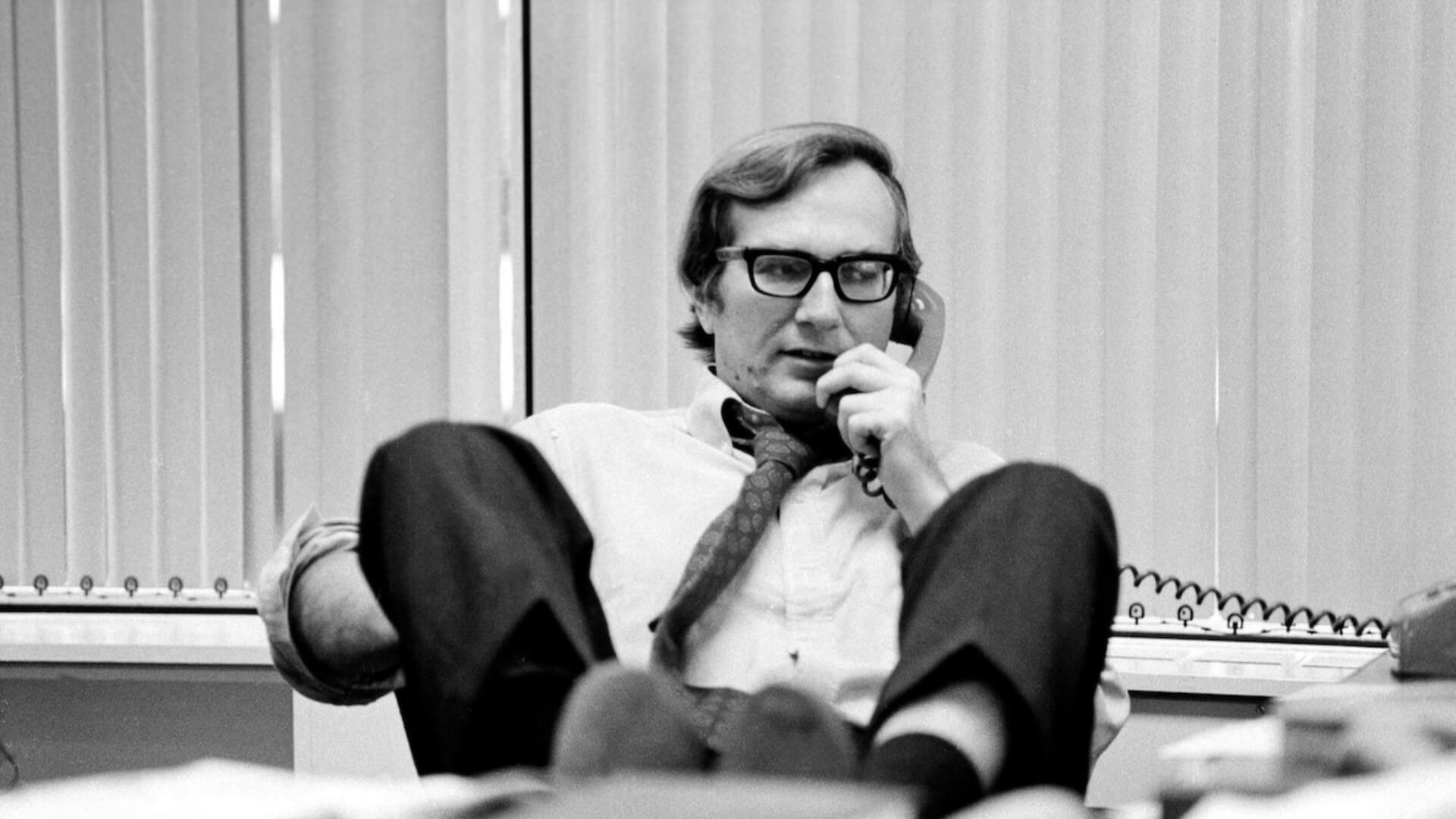
Cover-Up is the story of America’s shoddy excuses for its inexcusable history of violence, told through the perspective of the Pulitzer Prize-winning investigative journalist Seymour Hersh—now 88 years old—and further filtered through the lens of filmmakers Laura Poitras and Mark Obenhaus. Through archival materials and modern interviews, they are the first to translate Hersh’s storied career to film, which is both remarkable and not at all surprising. While Hersh’s life seems like a dramatic narrative meant for the screen, movie moguls rarely put up the money for glossy, feel-good biopics about complex, disruptive anti-establishment figures like Hersh.
Poitras and Obenhaus clearly look up to Hersh as someone who refuses to stop digging into the endless dark layers of America. The three seem to share a working ethos, summed by Hersh’s mantra: “You can’t have a country that does this and looks the other way.” It’s easy to see how that statement resonates with Poitras, director of Citizenfour and All The Beauty And The Bloodshed, both of which thoroughly investigate specific ways the American government has knowingly failed us (by routinely carrying out mass surveillance and allowing pharmaceutical companies to reap massive profits from our pain, respectively).
The son of Jewish Eastern European immigrants, Hersh worked at his father’s dry cleaning business as a teenager, where he quickly picked up on how to talk to people. These interpersonal skills, combined with his love of reading and writing, were what made him such an effective journalist as he was first beginning his career. In 1966, as he was first writing about the Vietnam War, Hersh developed his unorthodox but successful investigative method of eating lunch with high-ranking officials instead of his fellow journalists during breaks from Pentagon press briefings. In this more relaxed context, Hersh discovered that his potential sources opened up easier. Hersh learned to “get out of the way, and let their voice be the story.”
Through these details, Poitras and Obenhaus show an early example of his unconventional reporting style while characterizing Hersh as more down-to-earth than his peers (with just a little bit of “moxie,” to borrow Hersh’s own quippy self-descriptor). But this flattering characterization doesn’t quite mask the strain between the filmmakers and their subject. “I barely trust you guys,” Hersh tells the directors early in the film. This tense balance is hinted at, but never fully explored, perhaps in the interest of actually getting the film made.
What Hersh exactly means by not compromising his investigations into “a country that does this” is the throughline of Cover-Up, woven together by the threads of Hersh’s various investigations. Like Hersh, the filmmakers aren’t afraid of showing the audience sickening details for the sake of being truthful rather than sensational. The archival material—much of which is disturbing—illustrates Hersh’s dedication to looking directly at the ugly truth behind the American project instead of covering it up.
Hersh is perhaps best known for exposing the My Lai massacre, where the American military systematically gunned down innocent Vietnamese civilians—including infants—then immediately worked to bury the story. In these sections, the filmmakers use many photographs by the photographer Ronald Haeberle, both in color and black-and-white. After Hersh was hired by the New York Times a few years later, he broke several Watergate-related stories in an attempt to keep pace with Bob Woodward and Carl Bernstein at the Washington Post. He reported on Kissinger’s multimillion dollar plot to destabilize the Allende government in Chile, exposed the CIA’s efforts to spy on American anti-war groups (Operation CHAOS), and revealed the American Navy’s use of submarines to illegally spy on protected areas of the Soviet Union—and that was just during the first half of the ’70s.
Hersh’s decision to shift his focus to the private sector as he started snooping around the shady dealings of major conglomerate Gulf and Western Industries caused tensions within the Times. Hersh left the paper in 1979 to write his book The Price Of Power: Kissinger In The Nixon White House. And that doggedness continued for decades; not only was Hersh an early voice of dissent against the Bush administration’s false claims around Saddam Hussein’s weapons of mass destruction, he also was one of the first journalists to write stories exposing the torture and abuse at Abu Ghraib in 2004. Hersh admits that it would not have been possible to break this story without photographic evidence leaked by a whistleblower.
Cover-Up doesn’t completely shy away from Hersh’s mistakes during this long career, but the film doesn’t linger on them for too long, either. The egregiousness of his errors varies, from his failure to properly verify amorous letters between John F. Kennedy and Marilyn Monroe—which turned out to be forged—for his 1997 book The Dark Side Of Camelot to his faulty denial of Bashar Al-Assad’s use of the potent chemical weapon sarin in Syria in 2013. More recently, he faced backlash in 2023 for relying on a sole anonymous source when reporting on the sabotage of the Nord Stream 1 and 2 pipelines, which he claimed was carried out under the orders of President Joe Biden’s CIA.
In the filmmakers’ view, these examples call Hersh’s judgement into question, but don’t negate the vital investigative work he has done, and continues to do. Hersh’s contemporary interviews are often interrupted by phone calls from an anonymous witness to the genocide in Gaza. The most heartening experience of the film is watching the octogenarian journalist take her seriously, scribbling indecipherable notes on his yellow legal pad. You can read his current reporting on his Substack (tagline: “It’s worse than you think”).
That Substack sums up the dire state of contemporary American journalism, which is one reason Cover-Up demands close study. Truth and justice increasingly feel like standards from a distant past. In a disquieting new development, the Pentagon began requiring reporters to sign a 21-page form that restricts requests for sources in October 2025. Reporters who refuse to sign risk losing their press passes. The New York Times recently sued the Pentagon over this, citing freedom of speech violations, but the era of ambitious reporters attempting to find government officials with consciences at the Pentagon lunch hall is long gone, replaced by an environment that is altogether hostile to inquiry. At a time like this, Cover-Up is a vital reminder that demanding a better world is possible, straight from the people who have done the critical work required to confront America’s darkest forces.
Directors: Laura Poitras, Mark Obenhaus
Release Date: December 19, 2025; December 26, 2025 (Netflix)


 Keep scrolling for more great stories.