Casting men known for sympathetic monsters in the leads helps and hurts the cause. Bill Skarsgård plays Kiritsis and Dacre Montgomery plays Hall. Skarsgård is best known as Pennywise in the 2020s It movies and Welcome To Derry, while Montgomery had his breakout role as Stranger Things‘ Billy Hargrove, likewise a vessel for eldritch evil. Skarsgård plays Kiritsis taut and pursed, like a coilover ready to rebound. He’s justifiably upset by his ordeal, though he refuses to account for his own actions before taking any against Hall. Making an example of Hall, and consequently Meridian Mortgage, owned by Hall and by his father, M.L. (Al Pacino), is easier in Kiritsis’ calculus, and frankly it’s hard not to feel for him given that mortgage brokers aren’t generally sympathetic types.
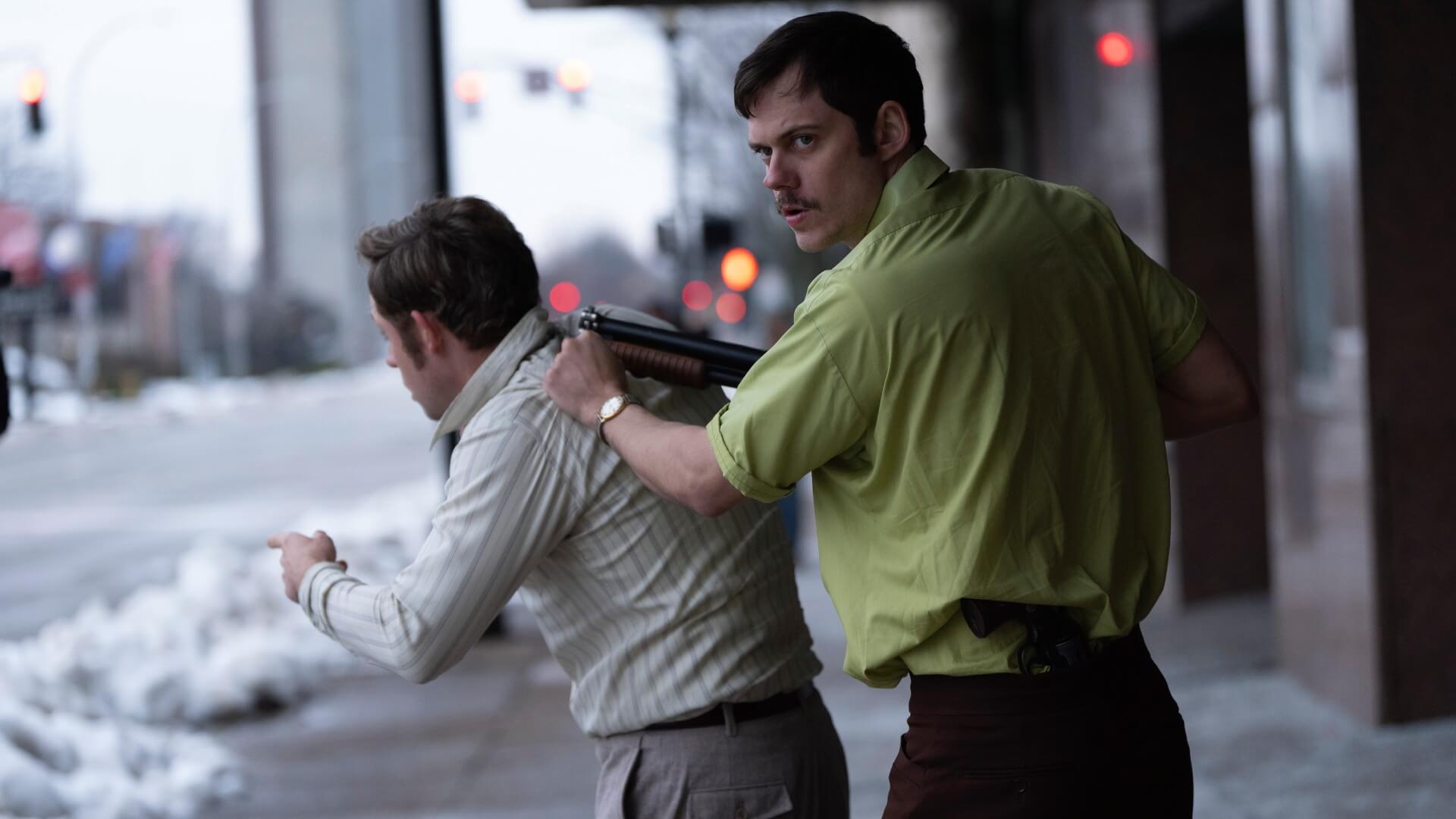
So he holds Hall at gunpoint and forces him to wrap a wire around his neck that’s also connected to the shotgun’s trigger—an insurance policy that keeps police from shooting Kiritsis and keeps Hall from fleeing. Dead Man’s Wire spends most of its 105 minutes with these dual protagonists, with material set aside for sideplots: Linda Page (Myha’la), a TV news reporter hungry to break a story with substance, picks up Kiritsis’ trail as he walks Hall out of his office building in broad daylight; local DJ Fred Temple (Colman Domingo), Van Sant’s narrator in the prologue and epilogue, gets pulled into the mess when Kiritsis calls into his show. The idea seems to be to give oxygen to viewpoints exterior to Kiritsis in order to paint a more complete mosaic of the man and the events of his hostage situation.
It doesn’t totally pay off. Because Kiritsis is Van Sant’s anchor, he gets the last word, which in this case isn’t a word but an eerily triumphant smile snapped in freeze-frame–a product of Skarsgård’s and Van Sant’s individual creative choices. And because those exterior viewpoints have their own biases and agendas, viewers are deprived of a sense of Indiana’s atmosphere writ large: Linda is in it for her career’s sake; Temple is in it because he’s roped into it; and Grable (Cary Elwes), the detective leading the operation to retrieve Hall from Kiritsis’ apartment, where the pair hunkered down for 63 hours after exiting Meridian Mortgage, is in it simply because it’s his job.
At least Dead Man’s Wire entertains the injustice of Kiritsis’ plight, and the notion that his is the stronger moral position—right up to the point where he decides that kidnapping Hall is a reasonable solution. But Kirtisis’ story isn’t resonant because of a DJ, a reporter, and a cop; it’s resonant because one man held another captive by the threat of violence, and everyday people applauded him. That’s powerful. So is Skarsgård’s performance; through him, Kiritsis is a wound-up man trying his best to maintain his humanity on the outside with jovial small talk, but who’s clearly cracked from desperation and unapologetic for it. This is Van Sant’s Dog Day Afternoon moment. Judged solely by Skarsgård’s scenes, Dead Man’s Wire makes for an insightful and tense portrait of its subject. But judged by the limits of its perspective, the film is narrow to the story’s detriment.
Director: Gus Van Sant
Writer: Austin Kolodney
Starring: Bill Skarsgård, Dacre Montgomery, Colman Domingo, Cary Elwes, Myha’la, Al Pacino
Release Date: January 16, 2026


 Keep scrolling for more great stories.