The mid-’90s into the aughts were a time of great experimentation in anime, an era that gave us many of the medium’s most memorable original series: Neon Genesis Evangelion, Cowboy Bebop, Serial Experiments Lain, Revolutionary Girl Utena, Kaiba, and Mononoke, just to name a few. But of these, there’s one in particular that doesn’t get the reputation it deserves, a show sometimes slapped with a particularly dismissive label. Ergo Proxy, which turns 20 this week, has been described by its detractors as “pretentious.” While this is a somewhat understandable reaction if you haven’t seen it through to the end, the series pulls a trick that reconextualizes everything, tying together its many digressions into an existentialist creed that argues for fighting back against perceived meaninglessness.
As for why the show has so frequently been hit with the p-word, the easy answer is that its story can seem scattershot at times, both in terms of plotting and its themes. Set in a post-apocalyptic future, it follows Re-l Mayer, a citizen of the domed city Romdo, and Vincent Law, an immigrant who doesn’t remember his past. The narrative initially centers on this dystopian community and the mysterious cogito computer virus, which causes the city’s robot servants to develop sentience and revolt (“cogito” means “I think” in Latin). Then, in a seemingly strange turn, the plot sidelines these developments as Re-l, Vincent, and a cogito-infected machine named Pino leave this place on a wider journey.
From this branching point, there are even more detours: One episode is a paranoid one-off involving dopplegangers and heavy allusions to Millais’ Ophelia, while another is about a Disneyworld-equivalent and the empty consumerism of theme parks. It introduces new ideas by the minute, name-dropping philosophers, fine art, and other classical references as it keeps its core truths close to its chest.
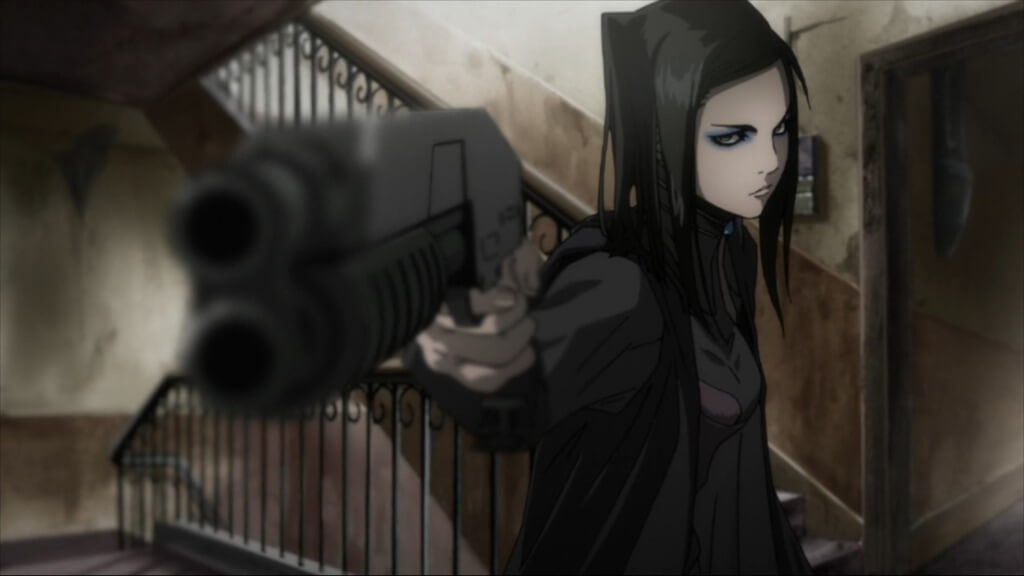
It also doesn’t help that aesthetically, the series is the embodiment of 2000s edginess, making it seem like it’s trying to invoke a gravitas that’s well beyond its grasp. The opening and ending sequences sum this up perfectly:The main theme delivers melodramatic, post-grunge angst and vague imagery behind a grainy filter. Meanwhile,the ending song is “Paranoid Android” by Radiohead, a choice that fits the vibe, but becomes increasingly strange as the narrative deviates from its initial focus on rebellious AI (the song isn’t literally about androids, but still). The main character, Re-l, is decked out in a trench coat and wears aggressively blue eye shadow that could only have been cool in that time period. And perhaps most importantly, the editing and shot compositions have a decidedly avant-garde tilt, a dreamy visual approach that is evocative but can be a little too coy at times. This style can be grating in repetitive segments that only feel meaningful in hindsight, such as episode 11, “Anamuneshisu.” The series takes far too many big swings both visually and thematically to be boring, but there are definitely a few whiffs along the way.
As you reach the final three-episode arc, it seems likely that the show won’t tie together all its ideas; many original anime have gone off the rails in their final act without an outline established by source material. This context makes it all the more surprising when you discover that screenwriter Dai Satō (Eureka Seven, Cowboy Bebop, Samurai Champloo, etc.) actually did know what he was doing all along. Despite focusing on robot rebellions, immigration politics, technocratic dictatorships, and at least one murderous game of Jeopardy!, the story ultimately centers on existentialist philosophy as its characters struggle with finding meaning after being stripped of their original purpose. The complicated machinations of the plot mirror humanity’s quest for meaning, especially outside the context of God.
To summarize this intricate sci-fi mystery, it turns out that the “original humans,” known as the Creators, accidentally destroyed Earth’s atmosphere, fled to space, and then enacted a complicated plan to rehabilitate the planet for their eventual return. The scheme centered on creating servants to carry out this work over millennia, only for intentional “flaws” to cause these groups to destroy each other, leaving an empty expanse for recolonization by the Creators. Our central characters are each from the groups that make up one layer of this plan: Re-l (a new human), Vincent (a proxy), and Pino (an auto-reiv android).
Essentially, the Creators sought to weave a specific kind of existential despair to wipe out the restorers of Earth. The proxies were cursed with both immortality and reason, doomed to eventually discover that their initially prescribed meaning of watching over the new humans, whom they were told would repopulate Earth, was a ruse. Similarly, the new humans lived in heavily controlled cities, like Romdo, where each citizen was given a specific goal, a raison d’être.
The intentional flaw to the situation is that the new humans were genetically engineered by the Creators to be sterile and could only be born via something called the artificial womb. Without the proxies, the artificial wombs couldn’t activate. The problem with this arrangement is that the proxies were engineered to die from sunlight, meaning when the atmosphere was eventually restored, the proxies would go extinct, and then the new humans after them. As an extra measure, the auto-reivs infected with the Creator’s cogito virus were there to finish off any stragglers. All of these beings were given an initial purpose, only to realize it was a lie. Most of the proxies, humans, and auto-reivs grappling with this reality couldn’t handle losing their raison d’être and either gave in to despair or accepted their destruction.
While Re-l, Vincent, and Pino’s journey to discover this truth is quite winding, as the group encounters various factions and places or people not-so-subtly named after philosophers, most of these digressions reflect a fundamental search for meaning beyond the roles they were born into. The many quotes and name-dropped figures are a stand-in for humanity’s long-running search to understand the nature of existence and why we’re here. It all leads to the oppressive realities that existentialist philosophers like Kierkegaard and Nietzsche confronted: Re-l, Vincent, and Pino learn that their gods are “dead,” in that these beings aren’t gods at all. Our protagonists discover they are the creations of one-percenter humans who fled the planet (that they themselves destroyed) before concocting a cruel plan to sacrifice others for their benefit all over again.
In the finale, our trio is forced to reconcile this existential dread. Re-l learns that her grandfather created her to draw back Ergo Proxy, who was the proxy keeping Romdo alive. Vincent, who learns he is Ergo Proxy after regaining his memory, rediscovers the plight of his peers. Pino faces her initial purpose as an android constructed to console a particular family when she learns that her “papa” is gone.
The resolution of this slow-building mystery falls on the audience almost as hard as it does on these characters, justifying long-delayed reveals as it evokes the feeling of suddenly being overwhelmed by impossible-to-stomach truths. It conjures the kind of gnawing meaninglessness that humans have long tried to fight off with ideology and theocracy. In some ways, the Creators’ plan does mostly work: the empty domes and unhinged proxies that our trio find on their long journey confirm that this despair worked as intended, and even Romdo ends up in ruins.
But what makes the climax so meaningful is how the protagonists respond. Despite the dread, each of the three rejects their original purpose. Re-l refuses to die with the city. Vincent spurns the fated end of proxies by surviving the sunlight. And Pino lives on past the family she was designed to comfort. They choose to keep going, embracing the absurdity and freedom of a “meaningless” existence.
This defiance is made very literal in the final moments. As Re-l keeps going even after her home is destroyed, a walkway gives out under her, leaving her dangling over a deadly fall. She hears Pino call out. The auto-reiv is on a glider below, but Re-l can’t see it due to a thick fog that obscures her vision (a stand-in for a now uncertain future). “I believe,” she says before making a leap of faith. It’s not faith in a pre-ordained purpose or a deity, but in her fellow rejects whose continued existence defies the “gods” themselves.



 Keep scrolling for more great stories.