The internet is filled with facts, both true and otherwise. In Film Trivia Fact Check, we’ll browse the depths of the web’s most user-generated trivia boards and wikis and put them under the microscope. How true are the IMDb Trivia pages? You want the truth? Can you handle the truth? We’re about to find out.
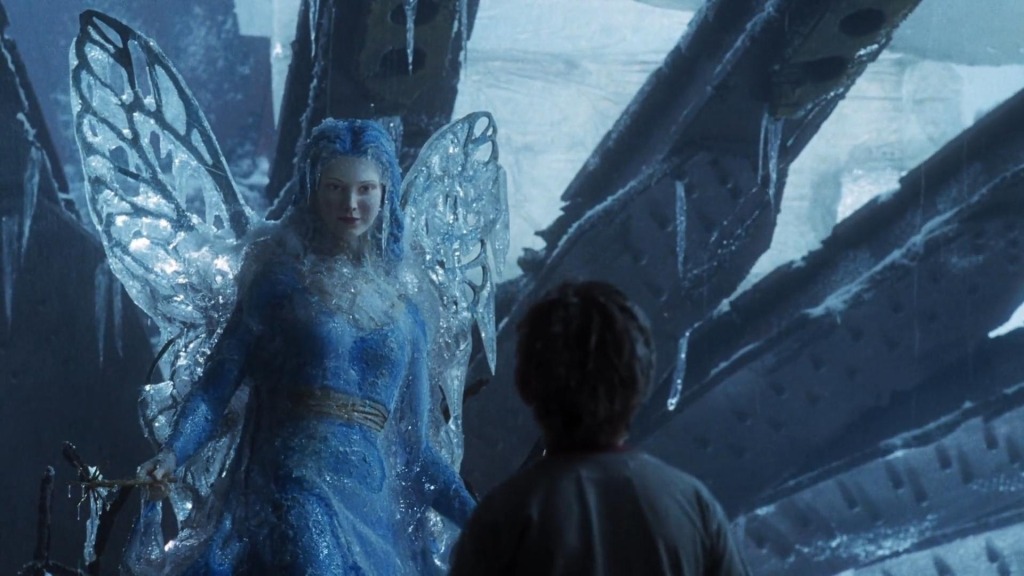
Claim: “[Stanley] Kubrick’s outline for A.I. always ended with David going ‘home’ and meeting the other AIs. No, he did not leave David at the bottom of the ocean staring at the Blue Fairy, and everything afterwards is not [Steven] Spielberg’s invention.” – JD Backberg (submitted via Facebook)
Rating: True
Context: A.I. Artificial Intelligence, the dystopian sci-fi masterpiece made by two of the medium’s greatest filmmakers, developed by Stanley Kubrick and finished by Steven Spielberg, is a feature-length identity crisis. Like trying to disentangle Lennon’s contributions from McCartney’s, many think they know which ideas came from whom.
However, A.I. really is the “Steveley Kuberg”movie that producer Bonnie Curtis describes it as, equal parts wondrous odyssey and melancholy fairy tale, following the world’s first child mecha, David (Haley Joel Osment), who is rejected by his human mother (Frances O’Connor). She would take him back if he were a real boy, David believes, and he seeks the Blue Fairy to grant his wish, eventually finding her on the ocean floor. When other robots discover him after humanity’s extinction 2,000 years later, a Blue Fairy hologram tells David that they can’t make him a real boy but they can resurrect his mother for a single day. However, the stereotypes about the filmmakers’ respective movies led to easy assumptions among audiences who left the theater perplexed by the bittersweet ending. Wouldn’t it have been more Kubrickian to leave him in Davy Jones’ locker, forever praying to a theme park creature? This ending must’ve been a Spielberg addition, because Kubrick would never allow such schmaltz. The truth is, though, the A.I. that Spielberg made can be found in the materials Kubrick assembled over the film’s 25-year development, dating back to the late ’60s.
A.I. is based on a 12-page short story by Brian Aldiss called “Supertoys Last All Summer Long.” Not long after its 1969 publication in Harper’s Bazaar, Kubrick acquired the rights and hired Aldiss to begin work on the story treatment. The pair chipped away at it together for the next decade, but—speaking to how much blame went around for the Blue Fairy—Aldiss settled any debate in his introduction to the making-of book A.I. Artificial Intelligence: From Stanley Kubrick To Steven Spielberg: The Vision Behind The Film, calling the Blue Fairy “Stanley’s idea, not Spielberg’s.”
In Aldiss’ telling, the Fairy drove a wedge between them, but in the director’s defense, Kubrick never hid the Fairy’s enchantment over him. From his earliest meetings with Aldiss, Kubrick was thinking of himself as a Geppetto figure. “I know Stanley has Pinochchio in mind,” Aldiss wrote in the margins of Kubrick’s story treatment during their first meeting. “He wants David to become a real boy! How could that be?” A decade later, Aldiss recalled, as they were working on the flooded New York City, “the Blue fairy emerge[d] from the depths. I tried to persuade Stanley that he should create a great modern myth to rival Dr. Strangelove and 2001, and [that he should] avoid fairy tale.” Aldiss would later turn up the heat on his criticism: “I wanted to nuke the bloody Blue Fairy.”
The ensuing popular debate is understandable. There are no fairies in Kubrick’s work, while Spielberg directed a fairy movie, Hook, a decade before A.I. But there are more obvious reasons for the confusion—namely, credit. Aside from the “An Amblin/Stanley Kubrick Production” card, Kubrick doesn’t receive a single posthumous credit on A.I. Without doing some research, newcomers would understandably assume that the only credited screenwriter, Steven Spielberg, came up with everything they see. And why shouldn’t they blame him for whatever they don’t like? He wrote and directed the thing! But Kubrick wanted Spielberg to direct the movie, and had been trying to hand it off to him since the ’80s.
On the condition of confidentiality, Kubrick brought Spielberg into the project in 1984. The two would go back and forth about it for years, but after the release of Jurassic Park, Kubrick became convinced that technology had caught up to A.I. He wanted to create David through a mix of CGI and animatronics, and ILM had seemingly made that a possibility. That’s one of the reasons Kubrick thought this would be in Spielberg’s wheelhouse. A big-budget, effects-driven sci-fi movie that could appeal to the Star Wars crowd? That sounds like Spielberg. (Never mind that Kubrick directed 2001, but we’re also talking about the guy who forgot he directed Dr. Strangelove.) Kubrick’s belief in Spielberg had less to do with fantasy and more with practicality: Spielberg was a much faster director than Kubrick and could finish the movie before a child actor aged out of the role.
By the time Kubrick stopped actively working on A.I. and shifted focus to Eyes Wide Shut in 1995, he already had his ending. Since Aldiss’ exit, Kubrick worked with a slew of sci-fi writers, including Ian Watson (who came up with Gigolo Joe and the Flesh Fair), Sara Maitland (who said Kubrick “never referred to the film as A.I.; he always called it Pinocchio“), and Bob Shaw (who quit after six weeks). Their notes, along with Christopher Baker’s concept art, show proof that Kubrick was interested in the Blue Fairy before he even knew Spielberg. But don’t take our word for it, here’s how Spielberg himself explained it:
“People assume that Stanley ended A.I. with David and Teddy underwater, trapped by the Ferris wheel, and they’re going to be down there until their batteries run out. I get criticized for carrying the film 2,000 years into the future where the robots that we created have replaced us,” Spielberg said in 2007. “They certainly assume that that’s how I wrecked Stanley’s movie. In fact, Stanley’s treatment, along with Ian Watson, went right into the 2,000-year future. This was where Stanley was going to take the movie had he lived to direct it, and this is where I was obligated to take the picture. Even if I didn’t feel such an obligation to fulfill Stanley’s vision, that would have been my vision as well.”
Do you have film trivia that you’d like fact checked? Email us at [email protected].


 Keep scrolling for more great stories.