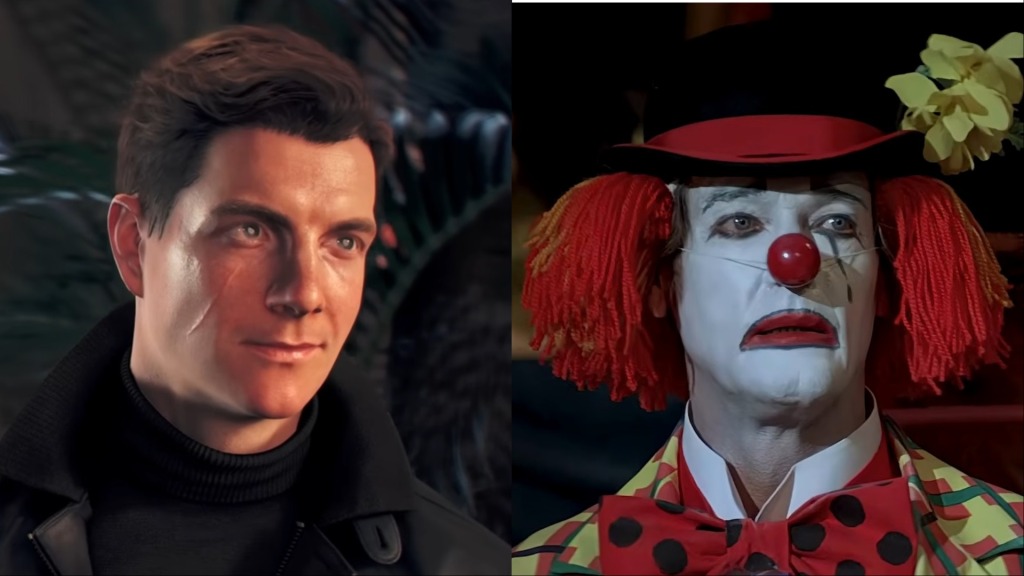
I’ve been thinking a lot about James Bond lately, and also clown costumes—both, in one way or another, thanks to IOI Interactive’s incredibly slick, surprisingly shallow new Bond origin story 007 First Light. We’ll dive into IOI’s visually sumptuous, ever-so-slightly hollow new Bond game in a second, but for now, let’s meditate on the unlikely (and infamous) intersection between the British superspy and the jester’s greasepaint. As diehard Bond fans know, the clowning of 007 happened exactly once, courtesy of 1983’s Octopussy, a film not typically celebrated as one of Bond’s cooler outings. (It is possible that someone, somewhere, has looked slick in a clown costume—but it certainly wasn’t a 56-year-old Roger Moore, doing his best Emmett Kelly as part of efforts to stop a nefarious nuclear plot.) Although it has its defenders, the clown sequence in Octopussy has come in for a lot of ridicule over the years, for a pretty simple reason: It violates a sacred tenet the secret agent holds to even more firmly than “Save England at any cost,” i.e., that he must look cool while doing it.
Patrick Gibson’s much younger version of Bond, front and center in First Light,already knows this principle by heart, even before being inducted into MI6’s revived 00 program in the game’s highly effective tutorial-as-training-montage chapters. While he makes plenty of mistakes as a rookie spy, they are inevitably cool mistakes, those of cocksure overconfidence, or an occasional delusion (usually proven at least halfway correct, at least in hindsight) that other people will eventually find him as charming as he finds himself. Former Dexter: Original Sin star Gibson is expertly pitched at this coolness-at-all-costs approach to spycraft, and his quip-heavy performance is one of the game’s biggest strengths while also, paradoxically, pointing toward its major conceptual flaw. To wit: That “looking cool” turns out to be an inherently limiting concept, one that keeps players confined to a surprisingly narrow band of actions despite playing a character supposedly defined by his license to do anything to accomplish his missions. Like, say, dressing up like a sad-sack circus performer.
My brain keeps circling that ridiculous disguise in part because Bond’s lackof such goofball subterfuge is one of First Light’s big departures from IOI’s previous series of games, the trio of truly excellent Hitman games the studio released between 2016 and 2021. That the new game is indebted to the old ones is undeniable: Bond’s skills at stealth and social manipulation are very clearly copied (albeit in less monotone fashion) from the previous games’ Agent 47, while the locations he traipses through are functionally identical to the halls of wealth and privilege that the master assassin uses as his frequent hunting grounds. At first glance, you’d be forgiven for confusing this Bond with a more gadget-heavy, less bald take on IOI’s previous “hero” outright—but only at first glance.
Because the more time I spent with First Light, the more limiting playing as Bond, cool international problem solver extraordinaire, began to feel. The thrills are extremely high, sure: The game swiftly moves you from set piece to set piece with its story of techno-utopia ideals colliding with the hard realities of espionage, creating myriad situations for Bond to talk, punch, sneak, and shoot his way through. (Even if the game’s occasional explosions into outright gunfire remind you that this is a studio that spent years thinking of gun combat as a punishment, not a pleasure.) First Light’s best levels feint toward the expressive play that made Hitman (2016) and its follow-ups so rich, like a crowded international auction, or an underworld bazaar that gives Bond multiple ways to scheme his way into an operationally necessary wad of cash by flowing wherever his instincts take him. But each of these moments of alleged freedom is inevitably undercut by the need for forward momentum; if Hitman was a sandbox, First Light is a slide, constantly funneling players toward the next big moment its screenplay is palpably anxious to lay out. (I am not the first person to note that the other big chunk of copied DNA here is Naughty Dog’s “playable adventure movie” series Uncharted, with its similar obsession with trading depth of play for big, shiny spectacle.)
Some of that constriction is simply a function of the game’s cinematic aspirations, which, by default, impose a more linear flow onto its structure—often giving its levels the illusion of sprawl and scope when they’re actually a pretty straightforward collection of strictly delineated challenges. (“Here is a Stealth Room,” the game all but announces as you enter one type of room filled to the brim with waist-high walls. “Here is a shooting gallery,” it hints, as you enter another.) But it also forces players familiar with IOI’s earlier work to take a sharp look at the differences between Bond and 47, and specifically as they fare as playable characters—a comparison that’s unlikely to do Britain’s foremost clandestine operative any favors.
Because, fact is, Agent 47 is the kind of guy who would dress up in a ridiculous clown suit in order to reach his target. (See 2006’s Hitman: Blood Money.) He stoically kills people with rubber ducks. He walks fashion show catwalks as a model, dresses in bright pink flamingo costumes, and does anything else that might be required to kill the right people in the right places—with the question of whether it’s making him look ridiculous not even crossing his laser-focused mind. (Admittedly, it helps that voice actor David Bateson, who’s been voicing the character since 2000, has made a precision weapon out of 47’s ability to deadpan his way through almost any possible indignity) That contrast is part of his franchise’s humor, yes, but it also speaks to 47’s perfection as a video game protagonist: He is a man who will do anything, no matter how silly, and that means players are forced to become people who would do anything, too.
And it’s through that willingness to be a big, goofy weirdo that Hitman achieves a pinnacle that First Light can’t hope to match. It’s not just that those earlier games are sillier than 007, although they absolutely are; it’s that embracing that silliness, and the absurdity of a man who’ll go to any lengths to get his job done, is a sublime expression of both player and designer creativity. When First Light’s James Bond enters a luxury hotel or a fancy, rich-dick-filled resort, he sees a handful of avenues of attack. But 47 sees all of them, both those intended by the game’s designers, and those that might emerge from the complicated systems they’ve set in motion. At multiple points while playing First Light—especially as I headed into its more action-heavy back half—I found myself looking at its environments and feeling my Hitman brain kick in, calculating how I’d sneak through if I was playing as 47, master of the toilet distraction, the ridiculous disguise, the mad, seat-of-your pants, “pretend to be a birthday clown” scramble. And then I’d sigh quietly, whip out my laser watch, and simply do the “cool” thing, instead. I’m over cool, turns out; it’s way more fun to play the clown.


 Keep scrolling for more great stories.