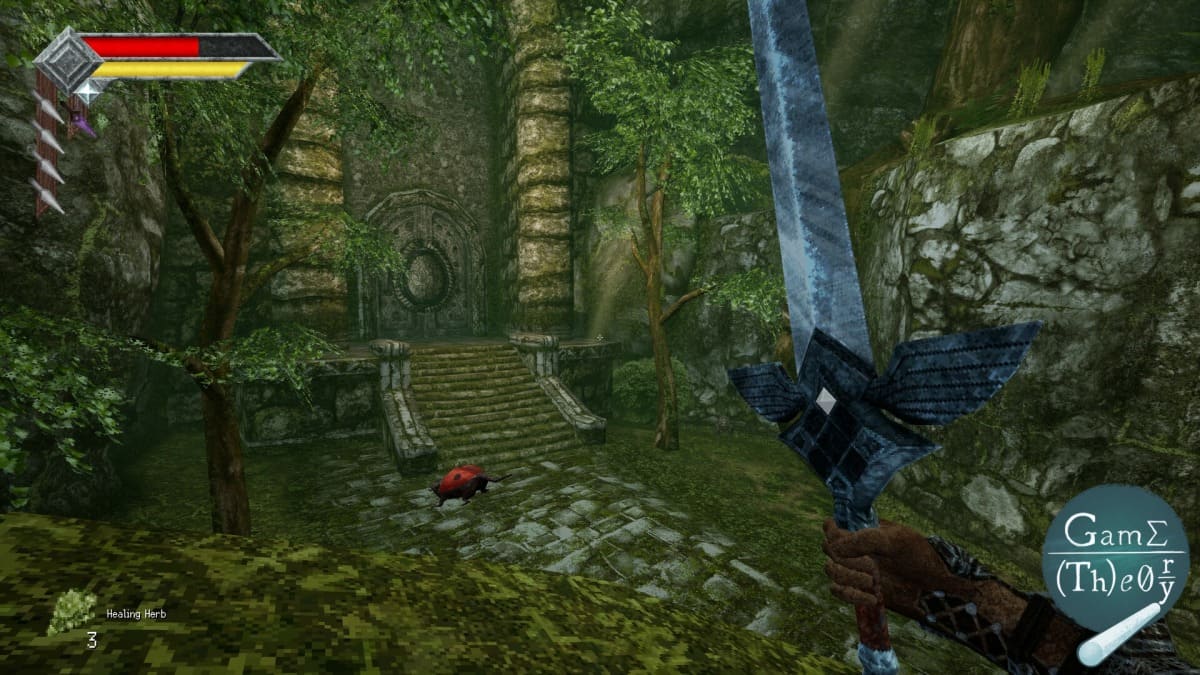
So: I’m standing in a grainy, deliberately lo-res dungeon, magical sword and throwing daggers in hand. My health is, at present, in the crapper—both in the real world, where I’ve just popped a positive on a fresh COVID test, and in Queen’s Domain, where I’m one hit away from death. Lucky me, there’s a treasure chest sitting in front of me. It could have healing items in it, which would let me extend this particular dive a little further before prudence (and the ever-present knowledge that this game doesn’t auto-save or preserve progress after player death in any way, shape, or form) would force me to retreat.
Grateful for this tiny sliver of mercy in a game not generally given to it, I open the chest, peering in at my hopeful new haul. Instead of healing herbs, or a new weapon, or even just some measly coins, what stares back at me from the container’s interior is a pair of eyes, with slavering teeth suddenly revealed on the edges of its “lid.” “Oh, come on,” I mutter, as the “chest” rises to two spindly feet and starts attempting to murder me, “Nobody even told me this game had mimics in it!”
And maybe it’s just the mild fever talking, but I genuinely couldn’t be happier in that moment—even as, yes, the mimic ends up murdering me stone-dead, forcing a reload of my last save file, fully 20 minutes before. There’s been a lot of talk, in recent years, about the intersection between gaming, difficulty, and ideas about accessibility, the principle that anyone should be able to get to the end of any given game as a matter of course. But Queen’s Domain is a reminder that sometimes the best thing that can happen to a title is to append “…if they’re a mildly delusional masochist” to that generally noble ideal. Because the amount of sheer player-focused hostility this game brings to bear on me and my fellow siblings in suffering is not only bracing. It’s a reminder that the only solution to gaming’s current “niceness problem”—a general belief that every big-budget game should essentially be a frictionless slide from start to finish—is a little deliberate and thoughtful cruelty.
Queen’s Domain—released by developer Freshly Baked Games LLC on all major consoles, plus Steam, last week—doesn’t bother trying to hide its hostile intents. The game is clearly patterned on From Software’s old King’s Field titles, first-person dungeon crawlers from back before the Dark Souls studio adopted even the slightest shred of clemency into its game design Bible. The King’s Field-like has been a relatively recent development in the indie gaming sphere, as games like 2023’s Lunacid attempt to mimic not just those games’ PlayStation One-era graphics, but a philosophy toward world design that’s comfortable leaving players lost, broken, and miserable. (No, you don’t get a map in Queen’s Domain. Draw your own!)
When you play a game like this, the feeling of profound unfairness that’s being inflicted upon you—the “Christ, can’t I get a break?” feeling that comes from backpedaling furiously away from lethal enemies while trying not to fall down another damn pit—is a feature, not a bug. We don’t put dungeons in video games to be nice; we include them because getting lost in a deadly labyrinth is as exciting as it is awful—because the feeling of finally seeing the light at the end of the tunnel is as pure a thrill as gaming can deliver.
It feels important to note, in the midst of this conversation, that Queen’s Domain is hostile, as opposed to “difficult.” Although its combat system, which forces you to time out your swings and manage damage types against often hefty hordes of enemies, takes some getting used to, it’s not actually especially hard to get at least passably good at. (I say, even as I mutter “Oh, you dick” as the mimic moves way faster than I was expecting, chopping my last points of health down to zero.)
The difference between those two concepts, “hostility” and “difficulty,” has become increasingly important in gaming discourse in recent years. Take, for instance, recent Castlevania title Belmont’s Curse, which has, as one of its best selling points, a bastard-cruel willingness to leave players disoriented or confused by its giant maps full of secrets, even as it offers robust tools to let them choose how difficult its combat should be. Or, look to easy GOTY-contender Big Walk, which deliberately imposes inconveniences on the player, then invites them to discover abilities and upgrades that wonderfully alleviate them. I’ve been given army-obliterating superweapons in video games that felt less satisfying than the first time my group stumbled across a backpack in House House’s beautiful walkabout.
Difficulty, in this sense, is a mechanical conceit; a reminder that all the damage you take or dish out in a video game is just an arbitrary number that a developer somewhere set, and could turn to your advantage or detriment on a whim. Hostility is more spiritual, and holistic: It is a measurement of how much a developer wants you to care about the moment-to-moment experience of navigating the world they’ve been kind enough to create. Both of these elements can stop a player from completing a game, with a boss that just hits too damn hard, with too much health, serving as as much of a roadblock as a cunningly built labyrinth designed to drain a player’s will to proceed. But hostility is the far richer, and more considered of the two; I’m all for developers providing accessibility options to alleviate the frustrations of numbers being set too high, but balk at the idea of removing the traps and cruelties of my beloved dungeon crawls.
And that’s why, as the mimic gets that last hit in, sending me back to my last save, I can’t help but smile at what Queen’s Domain has achieved. No, it doesn’t feel good to lose that progress. I’m as prone to frustration as anybody else, even if I’m more philosophically inclined than some to take deliberate, comedic unfairness in stride. But that feeling will also lodge, even in my currently disease-addled brain; it will make an impression that a death in a game that doesn’t care about my misery—that exists solely to funnel me from one triumphant moment to the next—never could. To some extent, hostility is the opposite of indifference: It is a profound appreciation for the player’s emotional state, and how it can be tweaked, prodded, and, yes, tormented. We don’t create dungeons for each other to be nice, after all. But that doesn’t stop their creation from being, in their own twisted way, a fascinating act of care.


 Keep scrolling for more great stories.