Since launching Gorillaz, Blur singer Damon Albarn and artist Jamie Hewlett have used the animated characters that make up their group—2D, Murdoc, Russel, and Noodle—as avatars for exploring their curiosity around cultural exchange. Their discography spans an ever-widening array of genres, initially fusing rock, punk, pop, and hip-hop on their self-titled 2001 debut and 2005’s Demon Days, before dabbling in orchestral, funk, and Arabic music and spotlighting tons of artists with extensive experience in those specific arenas.
Bringing in outside influences has sometimes made their work uneven and unwieldy, going so far as to drown out Albarn’s presence and the ideas he’s attempting to communicate, but he and Hewlett have also produced moments of undeniable brilliance with the help of their constantly growing list of collaborators. In the case of The Mountain, their latest and ninth studio record, the former unfortunately applies most: its musings on the afterlife ground its warm, gorgeous instrumentation with a clear, cohesive thematic anchor, but the style ultimately overwhelms the substance.
What’s most frustrating about that dissonance is that the personal inspiration for The Mountain certainly had the potential to generate an emotionally and creatively rich output. Prior to taking a trip to India, Albarn and Hewlett’s fathers and Hewlett’s mother-in-law passed away, and in crafting the album, the two melded the pain around those losses with the more optimistic attitude that Hindus, Buddhists, and Sikhs adopt around death. Recontextualizing those ideas through a non-Western lens is a nice, admirable intention to set, as is repurposing unused vocal takes from deceased former Gorillaz collaborators like Dennis Hopper, Mark E. Smith, and Bobby Womack and synthesizing them alongside contemporary Indian musicians like Anoushka Shankar, daughter of sitar icon Ravi Shankar.
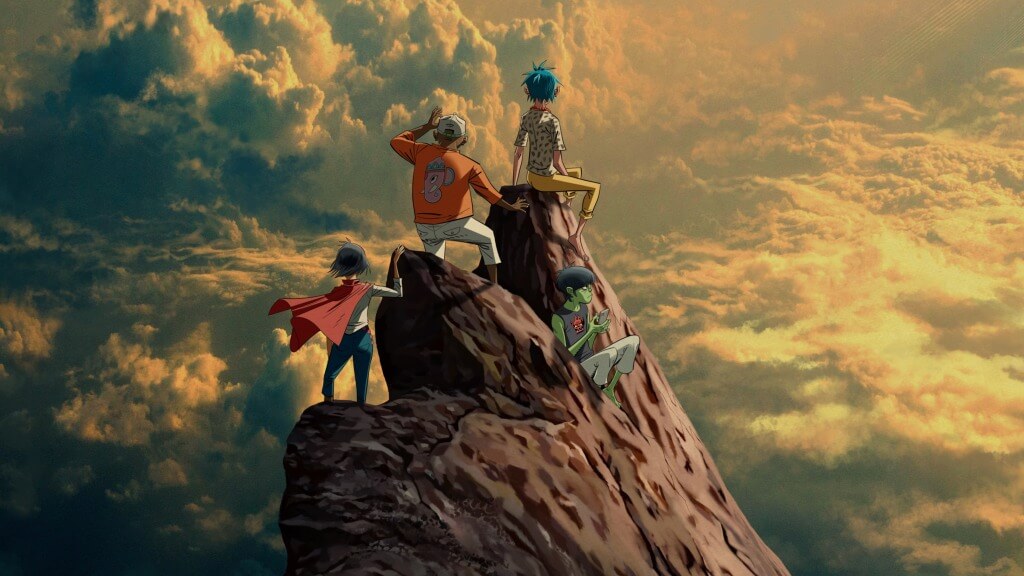
The album itself also acts as a kind of bookend to the unofficial trilogy of Gorillaz’s location-based projects, each of which imagine Gorillaz embarking on a journey to a fictional world in service of commenting on our own. 2010’s Plastic Beach, still Gorillaz’s best LP to date, could be considered the first entry of this series with its equally mournful and upbeat seafaring satire of our culture’s destruction of the environment. 2023’s Cracker Island used a similar approach to explore the isolating nature of cultural echo chambers. In contrast to its predecessors, the commentary on The Mountain takes a backseat in favor of a sincere attempt to find some kind of comfort and joy in the face of losing our loved ones.
Despite its spirited earnestness, though, The Mountain doesn’t quite reach the affecting emotional heights it aspires to, nor does it find a consistent enough rhythm to be fully enraptured by its meditations on grief. The songwriting reaches for poignant but mainly registers as kumbaya-level platitudinous and one-note, an issue that occasionally plagues Gorillaz’s other efforts, while the production, though ornate and quite pretty, grows increasingly repetitive and hodgepodgy as the album chugs along. Hewlett’s desire for listeners to consume the album from beginning to end as a dissent against our “culture of scrolling” might explain the relative flatness of the project. Indeed, The Mountain does play somewhat better when listened to all the way through, as a means of heeding the album’s message of being present. However, such a request also reveals the album’s tedium and the intensity with which Albarn and Hewlett lean on their abundant collective of guests to plumb the skin-deep surface of their themes.
On the album’s few positive standouts, Albarn brings a fun, buzzy energy that helps some of the thematic heavy-handedness go down easier. The boppy disco fever of “The Moon Cave” adds some groovy ‘80s flair to The Mountain’s melancholic slant, as do the New Wave synths and assist from avant-pop duo Sparks on the catchy if familiar “The Happy Dictator.” The percussive sway of “Damascus,” which was originally written during the Plastic Beach sessions but was swapped out for the track “Sweepstakes,” fits much more here in the context of The Mountain’s sitar-heavy sound. The seven-minute centerpiece “The Manifesto” is an ambitious, memorable doozy of a two-parter, with ear-grabbing features from Argentine hip-hop artist Trueno and the late rapper Proof.
It’s when Albarn bluntly engages with the subject matter, or when his guests overshadow his efforts, that The Mountain falls flat. “Orange County” is one such example, a well-meaning but simplistic ballad where Albarn regurgitates the same sentimental line over and over (“You know the hardest thing is to say goodbye to someone you love”) over a banal instrumental dominated by a trite, top-40 pop-song whistle from ten years ago, while folk singer Kara Jackson, a welcome albeit slightly muted presence, just barely plugs some much-needed poetry into the track. Albarn makes a similarly maudlin gesture on “The Plastic Guru,” crooning, “We believe what we choose / Is that not the truth?” a question delivered with utmost sincerity despite being a pretty obvious and threadbare sentiment. On synth-waltz closer “The Sad God,” a strained verse from Roots MC Black Thought (whose contribution on “The Moon Cave” works a lot better) only furthers the song’s mawkishness.
The Mountain earns points for corralling both new and seasoned talents, honoring the voices of those no longer with us, and finding a few sparks in merging the past and present. And hopefully, Albarn and Hewlett have achieved some catharsis in turning their despair into art. Still, the multicultural and multilingual mosaic they construct never goes deep enough, often struggling to match the ecstatic build-and-release and bittersweet existential odysseys of Gorillaz’s earlier work. Mountains aren’t quite moved here, only slightly prodded. [Kong]
Sam Rosenberg is a filmmaker and freelance entertainment writer from Los Angeles with bylines in The Daily Beast, Consequence, AltPress and Metacritic. You can find him on Twitter @samiamrosenberg.


 Keep scrolling for more great stories.