Greenland never made it to theaters. Sent straight to VOD during the heights of COVID in 2020, the surprisingly competent disaster drama was both comfort food and aspirational fantasy—the world as we know it might be ending, but through decisive action, you could personally ensure your family’s safety. Director Ric Roman Waugh’s original film allowed bad-dad Gerard Butler to atone for his domestic sins by escorting his wife and son to a bunker, securing the blast doors moments before the extinction-inducing impact of the massive Clarke comet. When the CGI dust settled nine months later, the survivors poked their heads out to find that life persisted. Hope remained. In the sequel, Greenland 2: Migration, that hope has been manipulated and dumbed down, befitting a less grounded and straightforward survival story.
A once clear and stupid-clever disaster, having stewed for half a decade, has curdled into a schmaltzy post-apocalypse. To match the real-world passage of time and integrate the COVID-derived trauma that was sinking into audience and filmmaker alike at the time of the first film’s release, Waugh and returning writer Chris Sparling retcon Greenland‘s ending. The hope that greeted John (Butler), Allison (Morena Baccarin), and Nathan (now played by Roman Griffin Davis) Garrity was false. As explained by Butler’s opening voiceover, played over a clip show from the first film, they actually had to go right back into the bunker for another five full years.
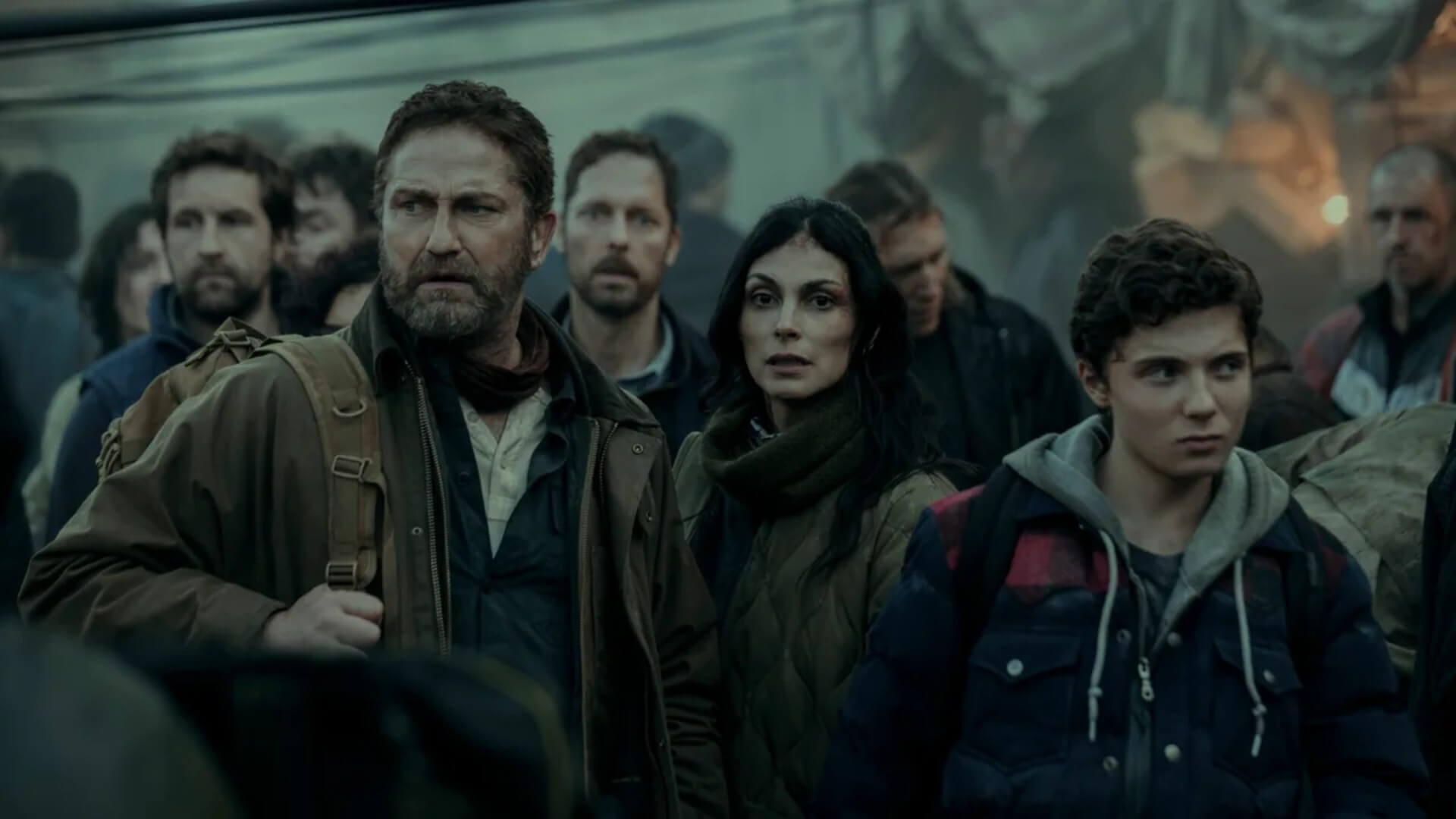
The reasons for this are nebulous and discarded whenever inconvenient. The air is bad for you. The radiation probably isn’t great either (just listen to Butler’s telltale Movie Cough). Masks and hazmat suits are the order of the day, at least until Greenland 2 realizes that its audience would probably like to see the faces of its stars. Soon enough, forced to flee their collapsing bunker, the Garrity family is simply traipsing around in layers as rugged and brown as their film’s color palette, commenting from time to time on how the air isn’t so bad, actually.
This arbitrary and tension-free approach to storytelling applies equally to the environmental fallout of the killer comet and to the more human obstacles encountered by the Garritys. There is no rhyme or reason to the sporadic disaster offspring of Greenland‘s doomsday event, aside from the script’s need for intermittent set pieces. The rogue tremor that fells the Greenland bunker is just one of many that seem to chase the Garrity family around the world. The shards of Clarke still menacingly orbiting Earth only fall from the heavens once, in order to maintain one of the series’ hallmarks (killing off helpful people of color). A quick-moving lightning storm caps the film’s enjoyable opening scene, but only as an excuse to replay the “getting into the bunker at the last minute” moment from the first film’s finale. These natural threats are at least more inventive than the bland checklist of post-apocalyptic denizens encountered by the fleeing family on their way to Clarke’s impact crater.
Although they encounter plenty of communities and survivors after successfully escaping Greenland—eventually making their way to London, which has fallen—John and his family decide to head to France, to where Clarke hit, in hopes that this site will be a kind of nutrient-rich Eden where one doesn’t have to worry about things like ashen air or radiation sickness or polluted drinking water. Or, at least worry even less than these characters already do. Stray scientist characters gab about exactly why this Land Before Time-like utopia exists, but the point is that it does and there is already a war being fought over it. This allows Greenland 2 to tack on some military shoot-outs to its deadly EuroTrip, but nothing truly ever stands in the way of the Garrity clan.
The few setbacks faced by the family in the first film, growing from its more realistic sense of how panicked and entitled people would react to a world-ending disaster, have dissipated in Greenland 2: Migration. Even the internal conflict, where John’s protectiveness was colored by a desire for redemption (he cheated!), is gone. They’re a simple, happy family without anything going on and little for their actors to play—the film can’t even land the simple emotional beats of John’s cough-telegraphed illness. Everyone they meet loves and aids them, bending over backwards to get them to the promised land.
In that uncomplicated helpfulness sits the film’s annoying naivety, or perhaps its cloying wishful thinking. There is a frustrating head-in-the-sand quality to the film’s refusal to engage with its own traumatized world. Still in the safety of the bunker, John speaks to a therapist, who notes that the government saved more mental health professionals than surgeons. To move forward in their new reality, survivors would need help reckoning with what they’d gone through and processing the pain that now colored all corners of the world. Unless, that is, there was a magical piece of land untouched by disaster where they could pretend that none of this ever happened. It’s the logical conclusion of a movie that ignores problems as soon as it names them, the cinematic version of a grizzled Gerard Butler macho-man white-knuckling his way through life’s changes, adamant that he will stay the same.
Director: Ric Roman Waugh
Writer: Mitchell LaFortune, Chris Sparling
Starring: Gerard Butler, Morena Baccarin, Roman Griffin Davis, Amber Rose Revah, Gordon Alexander, Peter Polycarpou, William Abadie, Tommie Earl Jenkins
Release Date: January 9, 2026


 Keep scrolling for more great stories.