When the great De-Justin-Roiland-ing arrived back in 2023, it was both swift and complete: Within a roughly 24-hour span, Roiland—initially revealed as the subject of later-dropped charges of domestic violence, which in turn spawned a tide of allegations of inappropriate conduct towards co-workers, employees, and fans—was not only fired from his TV shows Rick And Morty and Solar Opposites, but was also announced to be resigning his position as CEO of Squanch Games, the video game studio he’d founded with his Rick And Morty money. It was deeply awkward timing for the studio in particular, which was only a month past releasing its biggest game to date, High On Life—a title that had, as one of its major selling points, an extensive voice performance from Roiland, as the first and most prominent of its cast of endlessly chatty talking guns. The hundreds of other people who worked on the game (including lead artists and designers like Erich Meyr, Andy Vatter, and Michael Spano) now had a question to answer that was a variant of the one Rick And Morty would tackle over the next few months: How the hell do you De-Justin-Roiland a brand whose major selling point seemed to be how much Justin Roiland it had on offer?
Less than four years later, High On Life 2 suggests that the only thing you can do in such a situation is cut ties and power through, doubling down on everything else worth celebrating about the original work. And the wild thing about the just-released sequel is not only that this approach works—creating that rarest of things, a comedic video game that is genuinely more funny than painful—but how much Squanch’s game benefits from no longer being “That game where a gun talks to you in the Morty voice the whole time.”
For one thing: Once you no longer have Roiland blathering away in your ear constantly—his gun, “Kenny,” having been ditched by the player back before the first game’s DLC, developed after the allegations began to roll—you can take more time to focus on what an absolute Murderer’s Row of voice talent has been assembled here. Even if you glide past the game’s numerous guest stars—Joe Pera! Richard Kind! Fred Melamed! John goddamn Waters!—and just focus on the ones voicing your most constant companions, your “Gatlian” guns, it’s a frankly ridiculous array of talent: Where else are you going to be able to flip, at will, between getting running commentary from Tim Robinson, Betsy Sodaro, J.B. Smoove, Ralph Ineson, Ken Marino, Frankie Quiñones, and Gabourey Sidibe, all of them chiming in on your various choices and asinine sidequests? The sheer number of ridiculous things they’ve found for Ineson to purr in his beautiful Galactus voice is a minor marvel, no pun intended.
Even beyond the voices, though, the fact that High On Life 2 is no longer just “the Justin Roiland game” gives it room to take a deeper conceptual breath. Despite having no actual links to the better-known work, the original had unavoidable Rick And Morty vibes: Its plot, about the human race being abducted by alien drug dealers who then smoke them in “hyperbongs,” had a stupid-smart appeal that could have easily fit into an early episode of the Adult Swim show, and even the characters not voiced by Roiland often spoke in the digressive, rambly, “Fuck it, and that’s part of the charm” style he made synonymous with his brand. With narrative design from a returning Alec “Mr. Boop” Robbins, the sequel maintains the slacker’s approach to diction but has a sharper satirical sense, including a plot that focuses on the galactic version of Big Pharma attempting to also turn humanity into drugs, except using the language and methods of “civilized,” legal behavior to do so. Not deep satire, necessarily, but deeper.
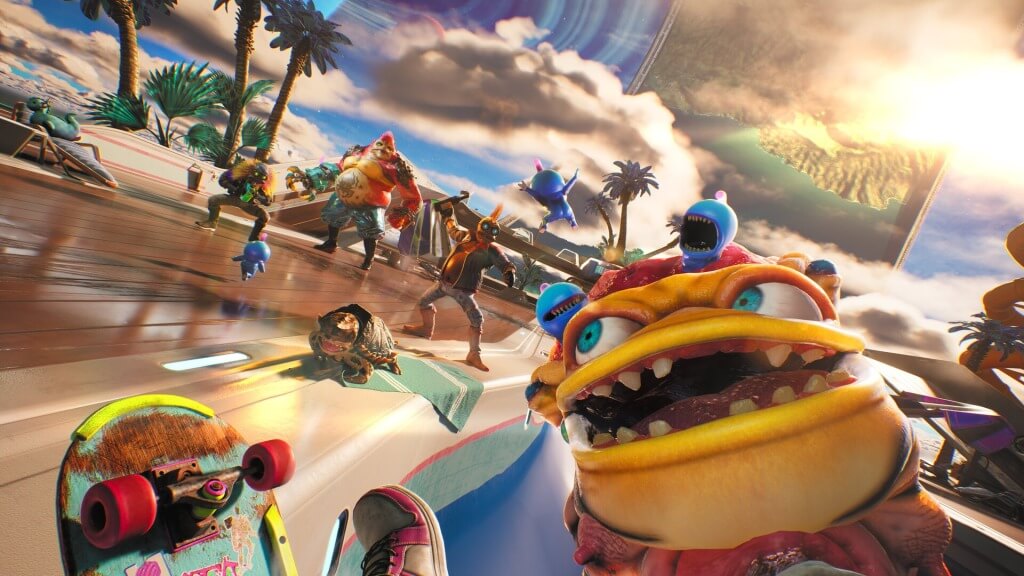
Beyond all that, though, High On Life 2—which features, amidst its back-of-box selling points, several much larger hub zones for players to explore than in the first game—is also just freer to luxuriate in how weird and deeply niche it wants to be. Much of this is expressed through a nigh-deranged obsession with comedic specificity: When you walk through a mall on some far-flung alien world, there’s an initial laugh yanked out of your gut when you see one of its abandoned storefronts has been converted into a fully branded Spirit Halloween. But it deepens into something like fascination when you walk inside, and see that Squanch has lovingly recreated the interior of one of those ephemeral palaces of knock-off wonder, down to the cackling grim reapers and costumes like an ersatz Black Widow labeled “Spy Lady” on the shelves. I don’t know when I’ve ever seen a game go so far for a joke, even when it’s jokes that the original game did first: Players can, for instance, once again plop themselves down in an in-game movie theater to watch actual cheesy movies like 2011’s Manborg or 1986’s Spookies in their entireties—with the latter featuring a full commentary track from the Red Letter Media guys as three aliens chatting their way through the film.
A lot of this stuff is, admittedly, still kind of Roiland-coded. (What is the game’s loving inclusion of numerous ‘80s toy commercials, playing on endless repeat on a TV in your character’s room, but an extended version of Rick And Morty’s nostalgia-for-the-comedy-of-indulging-it Szechuan sauce bit?) But the absence of the man’s voice at the center of it all democratizes things. Playing High On Life, thus, no longer feels like walking through a museum of one man’s comedy obsessions, but something wider and more relatable: An endless pursuit of “Do you really think we wouldn’t take this joke this far?” (To the point that when I saw that an in-game comedy club was advertising an appearance by Jeff Dunham, complete with a picture of the ventriloquist with his various felt humunculi, I genuinely had to wonder if Squanch had shelled out an appearance fee.)
The upshot is I find myself unexpectedly charmed by High On Life 2, after having largely dismissed the original game as the biggest signifier of what had already been a growing sense of Rick And Morty fatigue. (Even before the allegations had begun rolling in.) The core shooting gameplay is no great shakes, admittedly—although movement can be pretty fun, as you skateboard your way around hub levels hoovering up collectibles. (There’s no such qualifying saving grace for its technical faults, though; this is a good-looking, but deeply buggy, game.) But it’s so devoted to the rabbit hole—whether suddenly transitioning the player into a murder mystery, complete with interrogations and collecting clues, or allowing you to waste your money on a “Frasier Crane Machine” that allows you to fill your in-game home with a wide array of Frasier-themed pillows—that I can’t help but love it. (It doesn’t hurt that the game’s casting pulls straight from corners of the internet that I love dearly; every time I hear a character obviously voiced by former Polygon writer Pat Gill or Australian comedian Tom Walker, or encounter a casting choice clearly inspired by my beloved Farscape, it’s hard not to feel a little thrill.) There’s nothing in gaming so intoxicating as hitting an original idea expressed with confidence, and High On Life 2 has so many of those brimming under its skin that it easily overcame any initial resistance I brought to the table.
With very few, largely Stardew Valley-shaped exceptions, video games are a collaborative medium—even more, somehow, than animated TV shows. Justin Roiland had, at his heights, a tremendous knack for hiding that truth, of making everything he touched carry an aftertaste of his perspective in ways that occluded the efforts of hundreds of other people. Occasionally this worked for him (and his collaborators, too), with earlier Squanch games like VR title Accounting living or dying largely on how much Roiland you wanted to immerse yourself in. But I have to accept now that High On Life always had more on its comedic mind than just Roiland’s pet obsessions, a fact that his voice frequently drowned out. By exorcising it, High On LIfe 2 allows a richer vein of comedic brilliance to shine through.


 Keep scrolling for more great stories.