Okay, new theory: Pennywise The Dancing Clown is the reverse Poochie of IT: Welcome To Derry. Which is to say that anytime Bill Skarsgård is prancing around the screen, projecting “menace,” I find myself asking: “Did Pennywise actually need to be here?”
This theorizing is brought to you by “In The Name Of The Father,” one of Welcome To Derry’s best episodes to date—when it’s not getting bogged down in Darth Vader-esque revelations about who is, or isn’t, the deluded spawn of our resident murder clown. Admittedly, the late-episode reveal that Ingrid Kersh the helpful housekeeper was originally Periwinkle Gray—daughter of the circus performer from whom IT stole its favored horror persona—does have obvious parallels to the more nuanced story “In The Name” is telling about parents and children. But despite Madeleine Stowe’s noble efforts to try to keep this apparently mandatory “Oh my god, this changes everything!” late-season turn grounded in the realm of emotional plausibility, the twist arrives like a pair of big, floppy clown shoe steps trodding all over what had previously been a much more elegant affair.
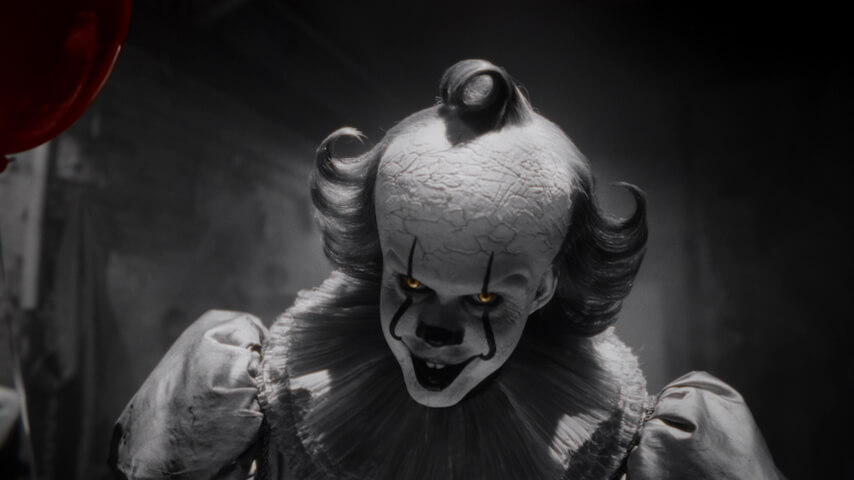
We pick up in 1935, apparently far enough back in time that color had not yet come to the Juniper Hill Asylum (despite the fact that the show has previously given us 1908 flashbacks that were notably non-monochromatic—perhaps Derry’s residents lost the cones in their eyes, along with their shirts, in the Great Depression). A young inmate named Mabel is awoken by a woman who sure looks like Madeleine Stowe after being put through a rigorous course in the de-aging machine, who’s asking her about where “the clown told you to meet him.” Despite the girl’s obvious terror, the woman drags her down to the asylum boiler room, where Welcome To Derry’s editors get to do the “one burst of color in a black-and-white scene” trick via one of Pennywise’s ever-present balloons. And then, obviously, it’s time to get down with the clown.
After the credits, we kick off the episode proper with a series of scenes that do magnificent amounts of work—there’s a novel concept incoming, but stay with me here—by foregoing cheap scares and narrative tricks in favor of simply giving good actors good material to work with. That most especially applies to the opening confrontation between Leroy, Will, and Charlotte Hanlon, in which Leroy’s fear and anger over Pauly’s death run straight into Will’s unwillingness to abandon his friends to the creature preying on them. It’s brutal, stomach-churning stuff, from Will’s “I would never let my friends die” to the full-handed slap that follows it and then most especially Will’s sobbing “It’s got to you, too” as he sees firsthand (uh, no pun intended) how even his “fearless” father can be warped by IT’s influence. This is the stuff I’ve been begging for when I openly wish for Welcome To Derry to steer into the pervasive sense of fear that IT at its most terrifying provokes: an examination of the way fear overtakes us, corrupts us, makes our worst impulses—in this case, Leroy’s bone-deep belief in rigid order and control as the only way to protect the things he cherishes—into weapons that can be used to destroy us.
For a parallel, let’s jump around on the timeline for a second and focus in on Jovan Adepo’s other great scene of the episode, in which he goes to confront Dick Hallorann about whatever the fuck happened to him down in those godforsaken tunnels last week. Chris Chalk gets through the necessary exposition about Dick’s “lockbox” ably, but it’s the explosion of tension that’s always existed between these two, centered in their positions as Black men living in the 1960s military—Leroy’s true believer fervor vs. Hallorann’s “it’s just a job, so get what you can” pragmatism—that fascinates most. Drunk off his ass and literally haunted, Dick is over Leroy’s calls to do what’s right for his country, with Chalk putting tons of spin on the “mmmm” Halorrann gives when Leroy blows past warnings about how his ghosts keep trying to tell him things “the living weren’t meant to know” to ask him to risk his life, and his sanity, for a plan they both know is idiotic. It’s to his authority—as a father, as a higher ranking officer, as a husband—that Leroy keeps trying to cling, in order to get control back of his suddenly overturned world. As Adepo’s scene partners keep demonstrating, it’s impressing literally nobody tonight.
Elsewhere, meanwhile, the episode is a lot lighter—for a “steadily brewing lynch mob” definition of lighter, leastways. That includes building up three key relationships between the kid portions of our cast: Ronnie and Will, Margie and Rich, and, perhaps most importantly, Lilly and her glowing magical rock. (I kid, but one of this episode’s better tricks is how it sketches out that finding a weapon that might potentially hurt IT has made Lilly more of a jumpy, paranoid wreck, not less, as she clings to her pointy black security blanket with her own version of anger born from fear.) Torn apart by the aftermath of Operation: Go Into The Sewer And Get Murdered—and Lilly’s suggestion of a sequel—the crew splits along boy-girl lines, with Will comforting Ronnie over her fear about her dad’s escape. (This is followed by the reveal that Charlotte has now hidden Hank away in a back room of the Black Spot, inadvertently ticking this season one step closer to its big, cataclysmic confrontation.)
I’ve complained in the past about the show’s kid cast, so I want to take a second here to highlight how well so much of this works—especially the scenes between Rich and Margie, which are a strong combination of sweet and funny as the two bumble their way through a first blush of romance. Both Arian S. Cartaya and Matilda Lawler nail the awkwardness and the comedy, which hits its highs when Margie gets approached at school by the Patty-Cakes and drives them away by showing off her wounded eye. (Also: The eyeball’s still in there. Who knew?) This (plus Will’s comforting of Ronnie) make for one of the few times that Welcome To Derry has managed to hit the ease with which Stephen King wrote childhood friendships in the original IT. And it’s helped along by the kids themselves clearly getting more comfortable in their parts—so hopefully we’ll get to see more of it before any of the poor tykes wind up burning to death.
Which leads us, after some semi-deliberate delay, back around to the episode’s two big plot movements. I’ll tackle the last one first, on the grounds that it’s the less annoying of the pair. After some slightly bizarre wish-fulfillment scenes—including an adult bartender spiking two twelve-year-olds’ drinks in a way that suggests we’re supposed to find it funny, and then having Rich get pulled up onstage to show off that he’s a drumming prodigy—the long-promised mob finally arrives at the Black Spot, complete with clown masks in tow. I’ll get to what actually happens here next week, but the arrival of Clint Bowers and his merry band of arsonists feels like as good a time as any to reckon with some of the changes Welcome To Derry is running on King’s original story.
Some background: In IT the novel, the Black Spot is similar on the surface to what we get here: a place off-base for Black enlisted men to drink, listen to music, and spend time with friends and women (although it’s been running for much longer than a single night in the book by the time the men with torches show up). King doesn’t beat around the bush when the building gets burnt to the ground, with almost no survivors, as part of the 1930 cycle of killings, though: The arson is presented in the novel as explicitly racist violence, masterminded by a group calling itself the Maine Legion Of White Decency—a northern adjunct of the KKK in all but name. But Welcome To Derry doesn’t go that route, at least not explicitly: As it often has, the show keeps the racial nature of the tragedy that’s about to happen in subtext, as a bar full of white men whips itself up—with a little help from a third party, who I’ll get to in a second—into a gun-toting frenzy that’s going to end with a bar full of Black men and women burning to the ground with all, or at least most, inside. I’ve been curious, in the past, about the show’s decision to move away from depictions of overt racism and into a more subtle vision of the cruelty IT breeds in its people, and I’m no less intrigued, if also a little perplexed, by it now. The show clearly knows what it’s doing when it touches on these tensions—Jovan Adepo, Taylour Paige, and Chris Chalk’s performances all make that clear. But is IT’s apparent hesitation to engage directly with the blunt semiotics of this kind of violence clever and subtle, or simply a cowardly way to acknowledge what has to be acknowledged without having to talk more explicitly about race? Maybe ask me again next week.
Whereas, I’m not sure any amount of time is going to get me feeling more enthused about the arrival of Periwinkle The Secret Clown Daughter. Credit where it’s due: Madeleine Stowe is suitably creepy in her scenes after Lilly stumbles onto Ingrid’s Big Secret, taking swings at tying the reveal into young Ms. Bainbridge’s own familial trauma. But, god, does this feel like one of the most unnecessary “We’re halfway through the season, so I guess it’s time for a big twist” reveals I’ve encountered in a TV show in some time. Even Pennywise seems kind of baffled by the idea that anyone would give a shit that Ingrid is Bob Gray’s daughter. Has any supernatural villain ever needed a human infiltrator less?
Sure, IT (in both the book and the movies) isn’t above setting a domino in motion in a human mind, notably by weaponizing local bully Henry Bowers to near-lethal effect against the Losers Club when they come back to Derry for their second round. But if what the show is suggesting here plays out in full—that Ingrid, for instance, initiated a secret romantic relationship with Hank Grogan just so she could be in a prime position to sic a mob on him later—then we’re pretty firmly back in “Okay, the military needs to control the 13 pillars so it can take control of the Pennywise Bomb” levels of big, dumb plot moves. And while those developments were just dopey, this one threatens to damage the show fundamentally by weakening IT itself.
Because the whole point of IT is that it is not, by any important metric, actually just a clown that eats you. Part of the delicate alchemy of King’s original novel is the way it marries childhood fears with cosmic horror, the way King hints at what a creaky mask all the movie-monster magic is over something that’s both deeply primal and utterly alien. That’s why sequences like the Black Spot burning are important: because they demonstrate that IT is not simply a monster, but a force. The boogeyman under the bed of the human soul. The thing that lives in the back of every Derry resident’s head, stoking that which is worst in them by poking and prodding at their fear. The eruptions of violence that end the creature’s cycles aren’t scary because IT has been carefully engineering some big blow-up by having a human cat’s-paw make an anonymous telephone call to a bunch of drunk assholes; they are because of what they say about how deep its tendrils are rooted in Derry’s heart, inevitably darkening it as it gorges. Giving this “character” a human sidekick who dresses up in her own clown costume, so she can instigate mass killings on its behalf, doesn’t make IT scarier for how it has its hooks in her; it lessens it by making the creature feel like it’s actually beholden to a human agent.
Which is all, I guess, a long way of saying things I’ve been saying about Welcome To Derry all along: that the show is nearly always better when it’s dealing with character and tone rather than plot. “In The Name Of The Father” has good scenes and great scenes in it both, character beats that made me cringe and laugh and smile. But there’s something gnawing at all that good stuff’s feet, steady and inexorable. And I remain afraid that the plot monster isn’t going to stop chewing until everything worthwhile here has been destroyed.
Stray observations
- • Between the black-and-white, the de-aging, and my own old dumb eyes, I genuinely couldn’t clock whether it was Stowe in the opening scene.
- • Blake Cameron James sells the hell out of Will’s fight with his dad. (Also, whoever put the sound effects on the slap made it hurt.)
- • Leroy hitting Will feels like another way Welcome To Derry links itself into The Shining. Which makes a certain sense: Besides the Hallorann cameo from the original IT, both books are about places/forces that can make monsters out of their residents.
- • Is it just me, or were the needle drops this week insanely on the nose? Roy Orbison’s “Running Scared” as Will biked away from the base, and Derry dipped into mob mentality, was the worst of the lot.
- • Paige doesn’t get a ton to do this week but Charlotte’s “Y’all think you’re all grown?” when picking up Will and Ronnie got a laugh out of me.
- • Hallorann on the net result of the military’s first big incursion into the Derry sewers: “I think we pissed it off.”
- • There’s an effective little jump scare when Pickle Dad pops up in Lilly’s desk at school, but I was pretty distracted by the visual of her clutching her magic rock, uncommented on, in the middle of a classroom.
- • I was going to scoff at the idea that Ingrid is the same age as General Shaw—her photo album of Dadly Remembrance shows her as a kid the same year Shaw almost got eaten—but Stowe is only five years younger than James Remar.
- • Folks obviously noticed last week that Ingrid was being set up to be “Mrs. Kersh,” the creepy old lady disguise IT uses in IT: Chapter Two; tonight she busts out the “No one who dies here ever really dies” line from that movie.
- • Boy, these Black Spot drinkers sure are chill about the random kids hanging out in their midst!
- • Stephen Rider hasn’t gotten a hell of a lot to do in this series besides look freaked out and angry, but he gets a nice scene here where Hank gently grills Will about his relationship with Ronnie.
- • Anybody else half-expecting Hallorann’s drunk walk through the dance hall to turn into a very dark, much more gory take on the “past comes alive” dance sequence from Sinners?
- • That drink-spiking scene weirded me out because it felt like the show didn’t think it should weird me out, if that makes sense.
- • We’ve got one woman listed in the credits as “Lone Lady Black Spot Survivor,” so, uh, yeah: Things are probably about to get pretty grim.


 Keep scrolling for more great stories.