James Gunn gets weirdos. He’s fluent in the language of the outcast and the misfit, and his affection for them has made him a household name. It’s hard to imagine Guardians Of The Galaxy having the impact it did—launching a new franchise and influencing Marvel Studios’ house style to boot—without Gunn’s appreciation for the third-stringers who populate it. Anyone can make a talking raccoon and a walking tree look real with enough money and the right tech. But only someone who understands the isolating feeling of being different can make people want to invest in characters like Rocket Raccoon and Groot. It takes an artist, not an executive, to tell these stories, someone who sees a character’s worth beyond toy sales and market appeal. James Gunn’s irreverence toward intellectual property made him a good choice to direct movies for a billion-dollar studio, and probably a bad choice to run one.
Still, it’s a shame Gunn’s tenure as co-head of DC Studios ended as unceremoniously and predictably as it did. The silver lining is that we got to see what the DC Universe looked like under his care, or at least a freaky little corner of it. Peacemaker, Creature Commandos, Superman, Lanterns, Clayface, Supergirl, even 2021’s The Suicide Squad (which Gunn directed before DC Studios launched in 2023)—these projects blended into a fizzy, peculiar pop concoction that offered only a whiff of a larger universe beyond them. These projects work because they can stand on their own and merge only as needed, avoiding the sweaty interconnectedness we so often see in other shared-universe attempts. In fact, Gunn has been mindful of interconnectivity since his start at the studio, building a failsafe to avoid confusion about which projects are canon to the DC Universe and which aren’t: Elseworlds, the outside-continuity label where The Batman and its sequel live and, reportedly, where Clayface has wound up. It’s a comic-brained approach that shows readers that the guy responsible for their favorite characters is one of them.
As a creator, Gunn’s affection for the outsider made his vision for the DCU unlike anything we’ve seen in previous DC adaptations. Take Superman: In terms of character, Gunn’s idea of Clark Kent (David Corenswet) is deliberately and comfortably removed from the idealized version embodied by Christopher Reeve and from the stock, stoic version Zack Snyder realized in Man Of Steel. Gunn’s respect for DC superhero comics, with their unfashionable gee-whiz Golden and Silver Age trappings, gives Superman a retro zing that contrasts marvelously with the ironic, often aloof personality traits we so often see in the post-Whedon Marvel Cinematic Universe.
Thunderbolts* launched a team made up exclusively of broken, cynical antiheroes, offering only shades of gray; Fantastic Four: First Steps cast Marvel’s First Family in a maudlin, doomsday-clock register. Superman, which came out the same year as those films, wears its Silver Age silliness like Corenswet’s bulky super-pajamas. It’s colorful and energetic, without a hint of edgy detachment. It’s no wonder its villain, Lex Luthor (Nicholas Hoult), works as well as he does. He views Superman as many people in real life do: an impossibility of kindness and sincerity that should be treated with suspicion, if not outright hostility. One of the first things Superman says in Gunn’s movie? “Golly!”
Despite the interdimensional stakes of Superman, it also plays like a comic story arc. It’s a self-contained story with glimmers of the universe beyond it—a trade-collection showcase of the personalities that interest Gunn, namely the complex, often imperfect versions of characters we might more often see idealized or sanded down.
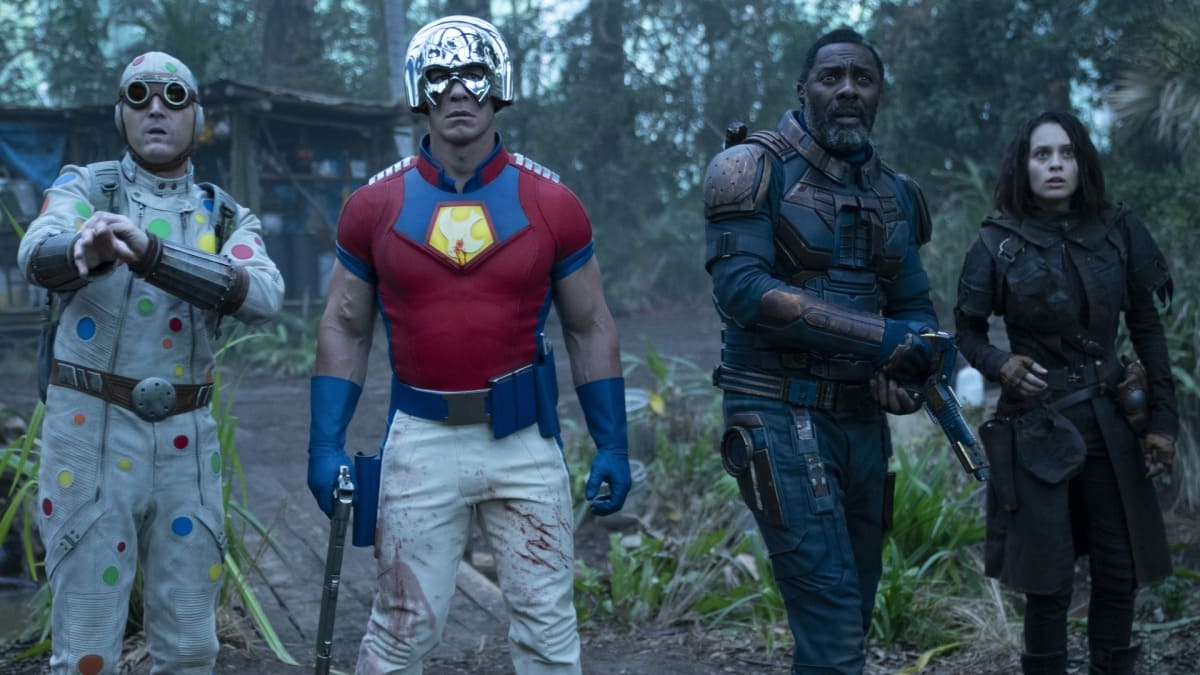
Look to The Suicide Squad, both seasons of Peacemaker, and Creature Commandos—the most eclectic and successful modern superhero trilogy—to see how Gunn approaches the darker side of the DC coin. The characters in these stories are bad people: Peacemaker (John Cena) is a deranged mass murderer; Polka-Dot Man (David Dastmalchian) is a psycho-depressive with gnarly mommy issues; Weasel (Sean Gunn) is a drooling man-beast who allegedly murdered a bunch of kids; Bloodsport (Idris Elba) is a jaded mercenary who wields an arsenal of deadly weapons. Yet Gunn does what he does best, digging beneath these hostile facades to reveal the wounded people (or weasels) underneath.
He doesn’t excuse what these villains do or suggest that we should, he simply offers a clear-eyed explanation of how hurt people end up hurting people, then finds a way to break the cycle. Peacemaker finds peace by accepting the messiness of his life rather than an idealized (and far more dangerous) version of it. Polka-Dot Man wounds Starro The Conqueror and feels something beyond morbid despair, even if only for a moment. Bloodsport bonds with Ratcatcher II (Daniela Melchior) and realizes a semblance of the father-daughter relationship that he’s failed at up to this point. It turns out Weasel didn’t kill those kids, but instead tried, and failed, to rescue them from a burning fire; because he’s a giant weasel, he was pursued by an angry mob and thrown in prison. It’s a familiar trick for those well-acquainted with Gunn’s work—present an unlikable character and reveal their hidden qualities through the choices they make. It’s the inverse of what he does with Superman, where he takes the perfect man and shows his flaws.
As unorthodox as his projects are, Gunn has repeatedly shown he focuses on characters rather than corporate strategy. That’s why he teamed with production partner Peter Safran when the two took the helm of DC: Safran was the business guy, Gunn the creative. His storytelling approach as co-CEO—including a mandate to dial in scripts before a green light—was creator-friendly and almost certainly irked the top brass at Skydance, which now owns DC Studios. What business sense does it make to prioritize DC B-listers like Peacemaker and Clayface while billion-dollar intellectual properties like Batman and Wonder Woman collect dust? Why wait to see how Gunn assembles this still-early-days DC Universe into something resembling its competitor, using a bunch of weirdos and risky projects, when Skybound needs money now—and lots of it? Gunn and Safran had to go.
It’s not surprising that the new regime under incoming DC head Jeremy Latcham is prioritizing Batman and Wonder Woman, but it is disheartening to see DC lose Gunn’s guiding creative vision, especially when the genre yields bland, uninteresting versions of itself time and again. And there’s every reason to believe Latcham’s more sober approach to film production will be less interesting and less risky than Gunn and Safran’s. Promoting Dungeons & Dragons: Honor Among Thieves, Latcham said that broad appeal is just as important as making fans happy with the material, if not more so, and that he doesn’t come into projects like Iron Man, Guardians, or even Spider-Man: Homecoming with a burning zeal for the source material. “I bring the ‘every person’ perspective,” he said. “I never want to be too close that I’m like a fanboy who loses perspective, who goes, ‘It has to be this way!’ Like, ‘I don’t understand that; I’m just a mom from Omaha. This isn’t for me.'”
Latcham’s appreciation for the moms and grandmothers in the audience suggests a softer edge for DC. The Wrap has called him “squeaky-clean.” Gunn isn’t squeaky-clean. His career has often been messy. Yet he’s maneuvered around each roadblock to make some of the genre’s most colorful, strange, and exciting films. What Gunn brought to DC Studios is what he brought to Guardians: A reverence for the misfit that made Peacemaker, Polka-Dot Man, and, yes, even Superman relatable to a broad audience. For now, this funky, off-kilter DCU still exists, and if DC Studios must endure yet another publicly messy overhaul, the smart move is to use what Gunn built with his fellow writers and directors as a springboard for the next phase at DC. They need a vision that sets DC apart from Marvel; right now, it’s still there for Latcham to use. James Gunn might have left something to be desired from his corporate overlords, but he made DC and its ensemble of outcasts exciting.


 Keep scrolling for more great stories.