The Legend Of Zelda, originally released in Japan 40 years ago this week, was a significant hit for Nintendo. To this day it remains one of the few Zelda titles that has sold at least one million copies in Japan alone, and is the third best-selling title on Nintendo’s original home console among those that weren’t at one time pack-in games for the system, with over 6.5 million sold. (No offense to various Super Mario Bros. titles or Duck Hunt, of course, but Zelda did it on hard mode.) The Legend Of Zelda inspired a wave of games that would be known as “Zelda clones” for years after, the kind of designation that occurs for only the most important, genre-defining titles like Tetris and DOOM. 40 years later the series is as strong as it’s ever been thanks to the success of mainline entries such as Breath Of The Wild and Tears Of The Kingdom, as well as spin-offs like the Musou Hyrule Warriors: Age Of Imprisonment and the Zelda-starring Echoes Of Wisdom. There’s even going to be a Zelda live-action movie now, and rumors of a theme park persist. Everything in the series that has come after The Legend Of Zelda has overshadowed it in some ways, and 40 years on, that’s one long shadow.
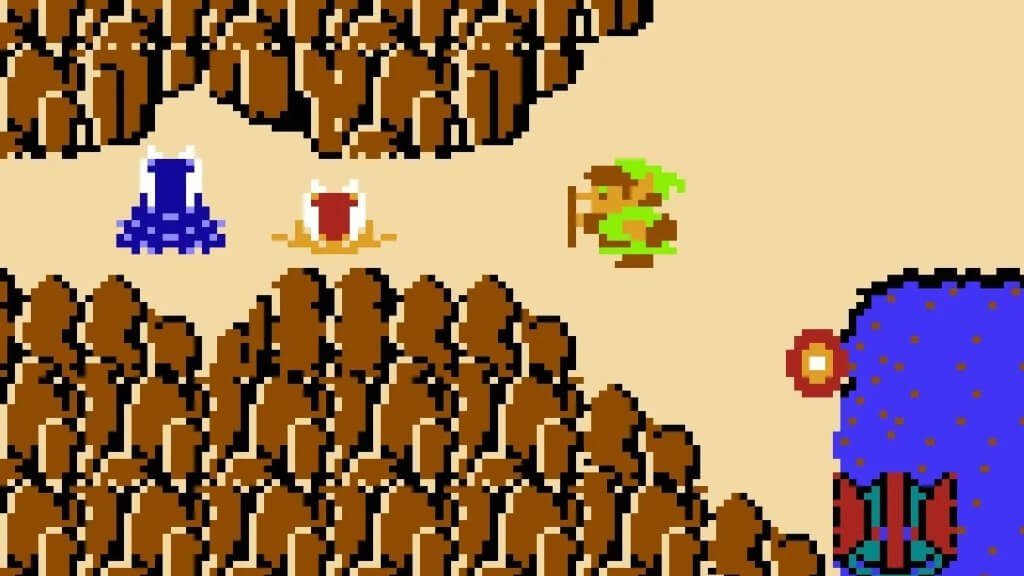
And yet, it’s still a joy to play four decades on, especially if you know the context in which it was released. It might look simple today—again, overshadowed by what followed it—but it was a technological achievement, with superior and smooth screen-to-screen scrolling, as well as a soundtrack that showed off the hardware improvements of the day, and techniques to get past the hardware limitations that still existed.
The most important thing that The Legend Of Zelda did, however, was to bring the depth, gameplay, and challenge of computer role-playing games to the masses in a brilliant, albeit streamlined version, through consoles. It’s the same trick that Enix’s Dragon Quest pulled off in the same year; whereas Dragon Quest achieved this feat for turn-based RPGs based off of the likes of the Wizardry and Ultima series, The Legend Of Zelda had its influences in the works of more action-oriented RPGs created by Namco, Falcom, T&E Soft, and Cosmos Computer. Dragon Quest was such a massive shift in the kinds of RPGs that could be developed that the game—and ones it helped inspire simply by existing—ended up sold internationally on the Japanese-made consoles that were available worldwide. (Nintendo famously retitled it Dragon Warrior for its American release, in an early example of a Japanese game getting a more aggressive makeover for the States.) That worldwide distribution in turn created a Western conception of a Japanese video game development reality that didn’t actually exist: a specific, well-defined genre known as the JRPG, or Japanese role-playing game. Computer RPGs had a significant audience in Japan, but since those games were not localized nor spread internationally in the same way as their console cousins, being developed for Japanese PCs like the X68000, PC-98, MSX2, and plenty of others, only half the story was told in the moment—and that half continues to shape Western ideas of Japanese role-playing games.
A similar result occurred for The Legend Of Zelda, which we now think of as an “action-adventure” game but was—and still is, in some camps—thought of as an action RPG. Zelda, like its influences, married arcade-style game design with the rules and breadth of computer role-playing games to create something entirely new. Namco’s seminal hit, 1984’s The Tower Of Druaga, had a massive influence on Nintendo, and especially Zelda creator Shigeru Miyamoto. Miyamoto had Nintendo put a Druaga arcade cabinet in the office, and the original design of The Legend of Zelda borrowed more than just a little bit from it, going so far as to reverse the titular tower setup to instead have a many-floored descending dungeon to traverse—there was no open-world surface in the original plan for the game, but rather a “series of dungeons underneath Death Mountain” instead. What Zelda kept in later versions, though, were Druaga’s hidden secrets and need for context-specific items and tools; if the original Zelda seems difficult to play without a guide in 2026, well, it was a cinch compared to Namco’s arcade smash hit.
T&E Soft is responsible for Hydlide, a predecessor to series like Ys featuring bump combat and overworld exploration. Like with Druaga, this game was released in 1984, but rather than being a massive success in arcades it was instead popular first on Japanese PCs, and then later on the Famicom after an updated port was released. While a North American version of Hydlide was released on the NES years after the games it had helped inspire came out, serving to mostly confuse and frustrate those who played it, there was nothing else like it when it first arrived on the scene in Japan. Despite the differing combat style, the influence on Zelda is clear to the point that North American reviews of the NES edition bagged on Hydlide for being an inferior version of the formula: you searched the world for hidden secrets and specific items needed to progress both in said overworld and in the game’s dungeons, free to roam but not without danger of overreaching due to being unprepared for what awaited you in what were designed to be late-game areas.
Cosmos Protector developed the PC-8801 action RPG, Courageous Perseus, which was another key 1984 release. In Perseus, you travel back and forth (and back and forth, and back and forth…) across an island full of monsters, searching for necessary MacGuffins and engaging in continuous combat with progressively tougher and tougher monsters, all of which exist on the map from the start. There is plenty of proto-Zelda here, in the sense that there is screen scrolling and backtracking, as well as an emphasis on very lightly guided exploration. You are left to your own devices here, figuring out where to go next on your own; if you have never thought of The Legend Of Zelda as particularly player-friendly or beautiful in its technological achievements, such as its ability to plop you down in a playable, useful spot when you transition from one screen to the next or keep the action and sprites moving at all times, well, Courageous Perseus will cure you of that misconception. Perseus is a key title in Japanese action RPG history, and worth experiencing to see why, but its importance outweighs its enjoyment, which was even the case at the time: there is a reason that it was Hydlide and Falcom’s games that found both an audience and space for sequels.
Falcom’s Dragon Slayer and Xanadu—especially Xanadu—are clear influences on Zelda, as well, to the point that if you play the latter even a little bit you will immediately see what Nintendo’s R&D4 studio had spent its 1985 playing. Dragon Slayer, along with the above titles, was one of the first action RPGs that helped to shape what the genre was and could be, but its first sequel, Xanadu, was even more ambitious and astounding. It is an action RPG as well as a proto-Metroid, owing to its blending of side-scrolling and isometric gameplay segments with vastly different gameplay and goals in each. It’s a computer RPG full of action role-playing elements with a character creation system meant to allow for player customization, includes a multilayered and deep system for powering up your character and his gear, features purposefully difficult but enticing exploration, and a morality system that, if ignored, will result in your being unable to complete the game, on account of being too evil to wield the legendary blade, the titular Dragon Slayer. It is in every sense of the idea the next generation of action RPG that followed 1984’s vital foursome.
What Zelda took from Xanadu was not necessarily any of the more complicated, layered sections described above, but specific dungeon designs. The game switched from its side-scrolling segments to topdown, room-by-room dungeons with locked doors and puzzles and special items required for progression, and the boss fights reverted to the side view… just like those in The Legend of Zelda would. If Hydlide and Perseus influenced Zelda’s overworld design and decisions, Xanadu had just as much of a hand in the dungeon elements as Druaga.
All four of Druaga, Xanadu, Hydlide, and Courageous Perseus are games that you could describe as “not for everyone,” even though that is true of every game and therefore kind of a meaningless bit of vocabulary that we carry around with us. But it’s a phrase that’s a bit instructive here, at least, in the sense that the idea behind Zelda, like with Dragon Quest, was to take these more hardcore, sicko experiences and streamline their design for a larger audience that maybe wasn’t ready for the specific levels of intensity that those games featured. Contemporary reviews of The Legend of Zelda brought up, again and again, how it was a translation of the agreed-upon difficulty of the computer RPG into a more digestible, approachable arcade form designed for the living room—a way to experience the depth and challenge of the games of the day but without some of the opaqueness, and with the most hostile bits removed or at least refined.
It’s difficult to argue with the results. The Legend Of Zelda got the “clones” treatment for years and years after, becoming the shorthand for the birth of an entire genre at a time when we lacked the language and complete picture to call it what it was: a refinement of existing—and ongoing—games in a genre that predated it. It influenced its own slate of action-adventure and action RPGs, and has either outlasted the games that inspired it or never gone dormant for long stretches in the way that other influences have. And it’s all due to Nintendo taking a similar swing as Enix did with Dragon Quest, recognizing the possibility of adapting an existing genre into something that even more people would be able to enjoy, something that was both familiar and new, and most importantly, refreshing and approachable without lacking in the challenge that made the source material a draw in the first place.


 Keep scrolling for more great stories.