In 2026 alone, Martin Scorsese has appeared in films by directors like Julian Schnabel, Jon Favreau, and Jonah Hill, who are bringing on Scorsese not just as a mentor, but as someone with an established onscreen persona. Before he acted for others, though, Scorsese acted for himself. Scorsese’s acting career goes back to his scrappy time working on his first films, Who’s That Knocking At My Door? and Mean Streets. If he jumped in as a background gangster, it meant saving a little off the production costs of his independent films. But the always-energetic director never stayed behind the camera for too long before making in-film cameos, a bit like a jittery New York version of Alfred Hitchcock. He makes quick appearances as a brothel client in his Roger Corman-produced B-movie Boxcar Bertha, a diner patron in Alice Doesn’t Live Here Anymore, and most famously, a passenger in Taxi Driver. Later, a few of his cameos would reference the director’s work using fields related to his expertise, playing a TV director in The King Of Comedy, a projectionist in The Aviator, a radio narrator in Killers Of The Flower Moon, and a photographer in both The Age Of Innocence and Hugo.
With few exceptions, Scorsese has kept his modest acting career to himself, only briefly loaning out his talents in the 1990s to friends like Akira Kurosawa, Robert Redford, and Albert Brooks. He played the role of Vincent Van Gogh in Kurosawa’s Dreams, rhapsodizing about art, taking inspiration from nature, and the work of creating. In Redford’s Quiz Show, Scorsese plays a sharp-but-smooth business executive caught up in a cheating scandal, and delivers his lines with fast-talking ease. Later, Scorsese appears as a version of himself looking for inspiration from the namesake character of Brooks’ The Muse. The moment is brief, but both he and James Cameron, who appears in his own cameo, poke fun at their images as Hollywood hitmakers who’re always on the hunt for the next idea. His cameo in Brooks’ film shows he’s got a sense of humor about this whole showbiz thing, something that served him well in his appearance on The Studio, where he once again played an outsized version of himself, skewering the absurdity of the business.
Recently, Scorsese has stepped up his appearances in front of the camera, sometimes having a laugh at the public persona he’s created or not-quite disappearing into a role as a voice actor with a noticeable New York accent. Such was the case of Scorsese’s turn as a mutli-armed space monkey street vendor in Favreau’s The Mandalorian And Grogu, naturally named Hugo. Like in his role as a fast-talking pufferfish in Shark Tale, Scorsese channels a street-smart, no-time-to-waste delivery—this time, as an Ardennian under pressure from The Mandalorian (Pedro Pascal)—in a comic interrogation scene that’s one of the highlights of the film. Although George Lucas is no longer with the Star Wars franchise, he and Scorsese are longtime friends, so in some sense, this role feels like a belated collaboration between the New Hollywooders.
Less fittingly, Scorsese also appeared this year in Jonah Hill’s anti-cancel-culture film Outcome. Scorsese still steals the show in the role of Richie “Red” Rodriguez, an agent for child stars. Instead of being creepy, which is where that role could have certainly gone, Scorsese plays the part with a sympathetic air. His prodigies have all outgrown him, leaving him an empty nester who no one bothers to call or write. They’ve moved on with their careers. But he’s still hustling, trying to talk up kids at an arcade (again, this easily could have been a creepy character) because that’s all he knows how to do in the business, a sad cog whose purpose in the industry is to become obsolete for his client.
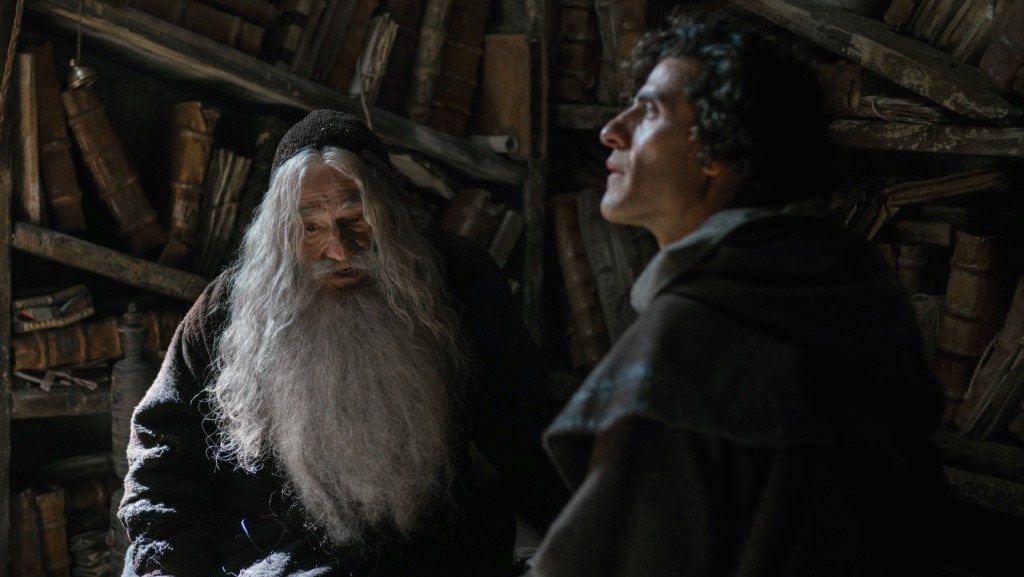
While Scorsese often brings life to the films he performs in, his performance In The Hand Of Dante is noticeably more subdued. While there are big character swings from Gerard Butler and Jason Momoa, Scorsese’s scenes with Dante (Oscar Isaac) are more that of a wizened teacher and student. Scorsese, hidden behind a Gandalf-like beard and long hair, is mystery personified; Dante isn’t even sure that Isaiah is his real name. He represents wisdom in an ignorant time, and answers Dante’s riddle-like existential questions with rhyme and riddles of his own.
His slow, steady, almost weary performance in In The Hand Of Dante is far different from the roles we’ve seen Scorsese fill before, but he’s there on screen (and as an executive producer) for a reason. For generations of movie fans—which includes directors like Schnabel, Favreau, and Hill—Scorsese is an inspiration. The chance to work with one of your heroes is too good an opportunity to pass up, especially if he’s one of the last of his generation still hard at work making the movies and TV shows he wants to make. Like his character in In The Hand Of Dante, he represents a source of wisdom and guidance. Not dissimilarly, his jokey presence in industry-related cameos is a reference for the audience who likely have also seen his movies. When he’s making fun of how hard it is to get funding for his next project in The Studio, that joke lands harder for film fans in the know.
No matter how many Scorsese interviews you’ve seen, how many times you’ve heard him tell one of his quick and witty stories, his tireless, fast-talking screen persona still commands your attention and, depending on the role, a few laughs. Just look at his social media videos with his daughter Francesca Scorsese, or his documentaries like A Personal Journey With Martin Scorsese Through American Movies, or him cutting it up with Fran Lebowitz in Pretend It’s A City to see what makes him such a charismatic presence. He knows the camera so well, he knows how to play to it, and he understands comedic timing and delivery. Because he knows movies, he knows how to steal one.


 Keep scrolling for more great stories.