At this point, it’s hard to blame anyone for suffering from severe Marvel fatigue. While the MCU may not be dominating theaters like it once was, we’re still recovering from almost two decades of box-office bullying that led to dozens of movies, many of which were delivered in an overly familiar, sterile style. Meanwhile, these superheroes have also made themselves known on the small screen, as they’ve been featured at the forefront of Disney’s streaming efforts. The Alan Moores of the world are not happy, and they have a point.
We’re even seen this pop culture hegemony return to gaming in a big way as of late: Marvel Rivals, Marvel Snap, Insomniac’s Spider-Man games, and the upcoming Marvel Tokon Fighting Souls may not be directly developed by Disney, but they certainly feature many familiar faces.
For all these reasons, the prospect of even more spandexed antics may be a bit off-putting for some. Thankfully for the latest tie-in, Marvel Cosmic Invasion, developer Tribute Games (Teenage Mutant Ninja Turtles: Shredder’s Revenge) and publisher Dotemu understood the assignment, translating the pulp of a bygone era of costumed heroics while introducing fresh concepts to the beat ‘em up format. It may not entirely reinvent the formula like Dotemu’s recently released Absolum, but it brings enough fresh ideas to avoid feeling like a back issue.
Cosmic Invasion’s plot setup is pretty straightforward; it is a beat ‘em up after all, a style of game that has traditionally crammed its narrative into a brief opening cutscene in order to maximize time spent pilfering teenagers’ quarters. Here, the evil space bug Annihilus is waging an all-out invasion of the universe, using mind-control slugs to recruit an army of heroes and villains to his side. Then, good guys from across the cosmos band together to go beat him up. While there is a bit of dialogue before each mission, unsurprisingly, the focus of the experience is very much wailing on minions instead of engaging them in Socratic discourse.
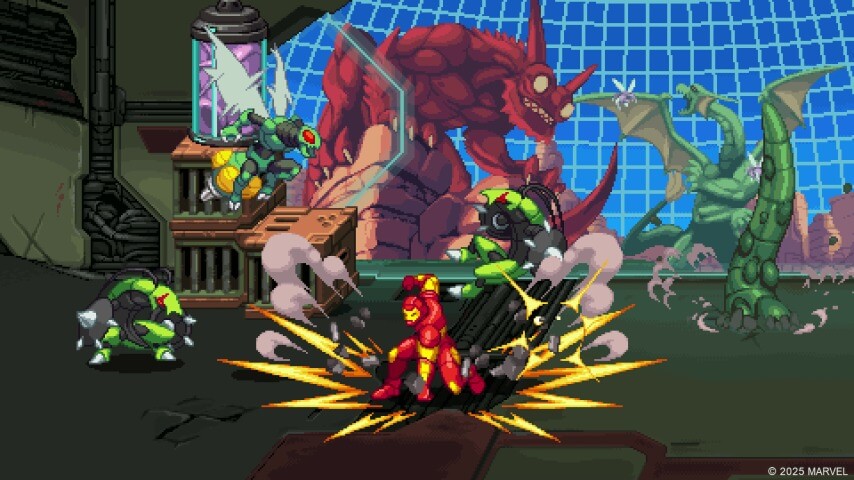
It’s a good thing then that these beatdowns prove mighty satisfying. Keeping in theme with this disparate band of crime-fighters teaming up, the main distinguishing factor here is that instead of controlling a single superhero, you play as a pair, switching between the two in the heat of combat. Tag fighting games like the storied Marvel Vs. Capcom series are clearly a massive inspiration here, something fitting considering that Capcom also happened to create great Marvel-themed beat ‘em ups back in the day, like The Punisher.
As for how the tagging works, you can switch places with your ally at virtually any time, including mid-combo, which gives the other hero time to rest up and restore their health. You can also call in several different types of assist attacks while still controlling the point character, which allows both to be on screen at the same time. In practice, this makes it so that you can essentially puppeteer both characters at once, crafting your own cinematic sequences as these heroes go back to back while pummeling deep-space insects in unison; it is quite neat and comes across like the game’s entire raison d’être.
Although calling in your buddy this way spends some of your focus meter, you generate this resource so quickly that it’s rarely a problem unless you’re eager to use more of that hero’s extra-powerful special attacks. And even if you’re out of juice, this offers the perfect opportunity to switch places with your other character, who has a separate focus meter. Between this and the backup hero regaining health when they’re tagged out, you’re encouraged to switch between the two on the fly, naturally leading to more variety in these battles.
On top of this, each character comes with their own lineup of (mostly) unique moves and attributes. Many can fly, offering a means to easily deal with winged enemies, while others can fire projectiles. They all have a defensive mechanic as well; either a parry meant to counter predictable attacks like long-winded charging strikes, or a rolling dodge that can flow into a follow-up attack. Thankfully, these systems are more than an afterthought, helping you get out of tough situations: the parry in particular is very satisfying to pull off, accentuated with a clang as your assailant is stunned in place.
At its best, these variables from character to character combine to create some very unique fighters among the meaty 15-character roster (I have a hard time thinking of many bigger beat ‘em up lineups outside of Castle Crashers). For instance, there’s She-Hulk, whose grappling-focused movset and crunchy attack animations set up deeply satisfying sequences that involve ground bouncing foes before meeting them in the air with a sequence of suplexes—this very much rocks. As a fun little bonus, most of her moves serve as homage to classic beat ‘em up and fighting game big bodies like Mike Haggar and Zangief. She can also do an infinite, which is the best MvC reference of all.
And she’s just one example of how many of these characters have their own mechanics: Spider-Man can web-sling, Black Panther is a lithe combo-fiend with vibranium projectiles, Beta Ray Bill sends Stormbreaker spinning to keep combos going, and Phyla-Vell teleports across the screen with a massive sword in tow. Meanwhile, the expressive pixel art and lively comic book coloring act as a welcome complement to the flying fists, leading to a suitably empowering experience that delivers the exact kind of mayhem you want from an arcade-styled brawler. Its fisticuffs are responsive, letting you quickly transition from offense to defense, and its focus on tagging results in flashy sequences that scream comic book cool.
That said, there are a few unfortunate arch enemies that drag things down a tad, especially as it goes on. While there are quite a few distinctive characters in the 15-character lineup, like the previously mentioned green attorney, there are also way too many fliers who also happen to have a long-distance laser beam or other projectile (Iron Man, Nova, Storm, Phoenix), making many of them too lightly distinguished. When combined with the somewhat limited assortment of enemy cronies, it eventually leads to repetition. This isn’t helped by an unnecessary leveling system that encourages you to bolster heroes by playing them repeatedly.
However, the biggest sticking point for many will probably be how the game handles checkpoints—in that it mostly doesn’t. While not as cruel as the coin-guzzlers of yore that loved sending you to the beginning of the entire game when you ran out of allowance, in this case, if both brawlers get KO’ed, you’ll have to play that particular level from the start. Were you one hit away from sending Knull to the Void? Too bad, back to the beginning of the area, which usually takes between seven and ten minutes to conquer. As you can imagine, this can be irritating in spots, especially considering that your deaths will almost always happen at the end of a region when fighting its boss. While not particularly difficult in general, you will almost certainly have to make this walk of shame at least a few times, especially if you’re playing solo; this all seems like the kind of thing that could be addressed by optional save points or some sort of difficulty toggle.
Still, even with these flaws, Marvel Cosmic Invasion proves quite heroic. Its tag system sets up coordinated beatdowns where weirdo pairings like Rocket Raccoon and the Silver Surfer take turns wailing on Thanos and a murderer’s row of other usual suspects, all so you can slug a devious insect from an alternate dimension. Is this premise a bit self-indulgent and sometimes at risk of turning into another all-too-familiar fan service fest? Maybe, but you likely won’t care considering how good it feels to dribble underlings across the stage like a pair of pros crashing a community basketball league. When it comes to beat ‘em ups, combat is king, and Cosmic Invasion hangs with the best of them.
Marvel Cosmic Invasion was developed by Tribute Games and published by Dotemu. Our review is based on the PC version. It is also available for the Nintendo Switch, Nintendo Switch 2, and PlayStation 5.


 Keep scrolling for more great stories.