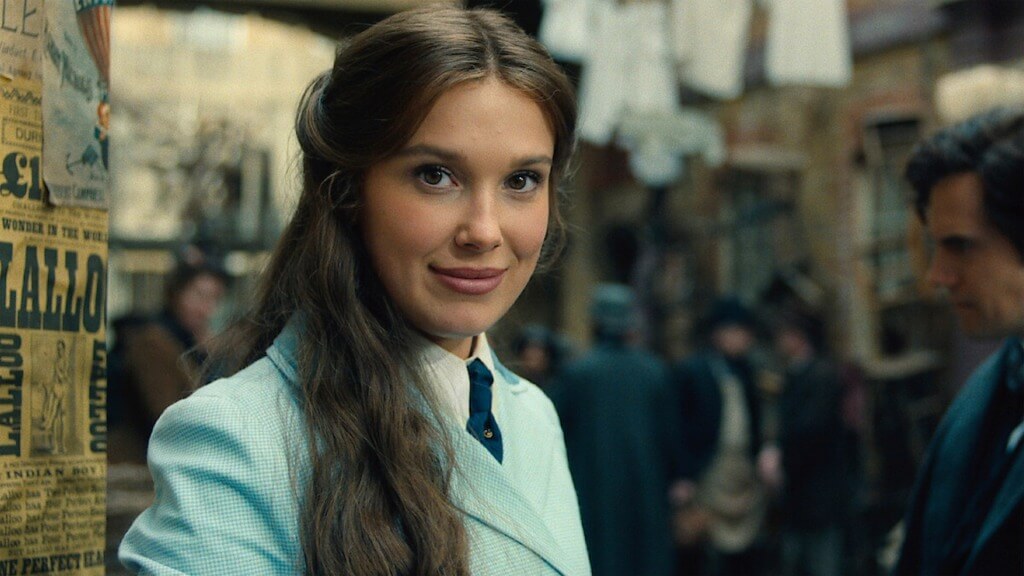
In Enola Holmes 3, the plucky youngest sibling of the Holmes family is ready to marry. She’s preparing for her wedding to Lord Tewkesbury (Louis Partridge) on the gorgeous island of Malta when her brother Sherlock (Henry Cavill in a glorified cameo) is kidnapped. Cue a mystery, some action scenes, and a chance for Enola to once again prove herself. Millie Bobby Brown’s third outing as the character has given her one of her most fun roles, but this time around, things are a little different. She is now an adult, and this is her first major step into the world of post-child-actor work. As Netflix’s leading lady and the streaming service’s biggest homegrown performer, Brown finds herself in a curious—yet not historically unprecedented—position.
For all its claims of disrupting the stuffy old film industry, Netflix has found its surest footing when it’s replicating the old ways of Hollywood. Its TV shows may have briefly shaken up the way series were released with the streamer’s binge-watch formula, but with its films, sticking to the tried-and-true has made its most impactful hits: cinematic releases (albeit brief ones), high-concept fare with workhorse directors, and the elevating of familiar faces. Netflix offered bank-breaking salaries to established big-screen performers and blockbuster filmmakers, then sent them on worldwide press tours to advertise the next era of movies. But that fell flat when the results were forgettable dreck like Red Notice and The Gray Man. Why stay at home for them when a new MCU entry is playing in cinemas? Netflix needed something that the studios did not have. They needed their own stars, the kind you could only see on their platform for a monthly fee. Preferably, they needed one who could appeal to a younger demographic. Enter Eleven.
Nobody expected Stranger Things to become what it did. The first season of the Duffer brothers’ Stephen King-inspired sci-fi thriller was meant to be a throwaway summer release. It, of course, evolved into Netflix’s foundational series, a multibillion-dollar worldwide phenomenon that won awards, spawned a Broadway play, and inspired merchandising that Disney would blush at. While it elevated the profiles of its entire core cast, turning David Harbour from a jobbing character actor into a leading man, it was Millie Bobby Brown who was flung into the spotlight as something new.
Barely 12 years old when the show premiered, the British actress had only previously been seen in bit parts in shows like Grey’s Anatomy and Modern Family. With her shaved head and near-total absence of dialogue, she was a magnetic presence in Stranger Things, an embodiment of the show’s grand mysteries and ’80s pop culture nostalgia. Her presence was a real “Who’s that girl?” moment for viewers, and soon she was a very big deal. In her first season, Brown landed Emmy and SAG Award nominations, and Netflix went to work making its star into a leading lady.
Brown and Netflix’s relationship is another old-school move by the streamer. In the first wave of Hollywood, for over 50 years, the studios owned their stars. They signed up the talent, crafted their image (often drastically reinventing their appearances), and developed projects around their types. Judy Garland was the appealing ingénue with a voice for the ages. Greta Garbo was the tragic ice queen. Marlene Dietrich was the seductive woman of the world who no man could tame. It was a stifling system to work under, one that many actors pushed against in favor of deciding their own fortunes, and it died out once the studio system gave way to New Hollywood.
Now, as the film world scrambles to find new stars that can guarantee commercial success in the era of uncertainty and desperate IP devotion, it’s no wonder that Netflix is so eager to keep Brown in its good books. The company has sought to maintain her status as someone outside of cinemas, the icon you can only see from the comfort of your own home, and one many of you grew up alongside. Getting out of Eleven’s shadow was always going to be hard, especially as Stranger Things grew to a gargantuan state. So, what was the ideal role for an adolescent girl who seemed wise beyond her years that would appeal to the biggest audience possible?
While Brown’s first major movie role was in Godzilla: King Of The Monsters, she has made almost everything else at her home base of Netflix. Enola Holmes, which she also produced, felt like the ideal meeting of talent and material: a YA rewrite of Sherlock Holmes from the perspective of his sleuthing younger sister. It plays out like a higher-budget Nancy Drew mystery by way of Guy Ritchie’s Sherlock Holmes movies, with Brown as a witty, intelligent, and fiercely feminist young woman who lets the audience in on her adventures. She’s at her best as Enola, cheeky and self-assured without being hopelessly saccharine in the ways that many a child star playing precocious can be.
The film was initially intended to be a Warner Bros. release, but Netflix savvily picked it up when COVID-19 hit, knowing that it needed to keep Brown on home turf. And it worked. Not only is Enola Holmes a delight that gave Netflix a true hit, it became a franchise. It proved that Brown had staying power with the audience she had cultivated through Stranger Things. Enola Holmes wasn’t a dazzlingly original idea, but it did fill a YA niche that had mostly died out in film by 2020. It was a good slot to put Brown into: the spunky and approachable teen star who got to be front and center in her own stories, and with stories that grew up alongside her as she aged. We’ve seen Enola go from sparky teen to independent adult over three movies, much like fans have seen Brown (and Eleven) grow into adulthood. There aren’t a ton of franchises that offer that to rising stars, making Enola Holmes a welcome exception.
But Netflix is a platform that struggles with true originality, especially when it aims at adults. Its most expensive movies tend to falter on those grounds, and the overreliance on trying to copy well-worn molds of big-budget storytelling has led to some forgettable flops. Brown has not been exempt from this struggle. Damsel, a 2024 dark fantasy about a young woman flung into a case of royal treachery and dragon attacks, had a great hook, but gave Brown little to work with beyond a thin Strong Female Character stereotype. She’s gutsy, and you can imagine her doing something more with a meatier version of the derivative action fare, but as with so many Netflix blockbusters, she’s smothered by a sea of beige. It felt like a role anyone could have played, and one probably initially intended for someone older. As Brown aged into late adolescence and tried to find a new niche beyond Eleven, Netflix’s offerings felt limiting in a different way. A stoic action part might work for a Charlize Theron, but not someone who’s at her best when she’s winking at the camera.
Nowhere was this struggle (and this color palette) more evident than in last year’s disastrous The Electric State. On paper, it should have worked. Simon Stålenhag’s graphic novel is an elegiac and thoughtful exploration of a future ravaged by technological overreach. The protagonist, Michelle, is mostly alone aside from her robot companion, and her search to find her long-lost brother explores her isolation and queerness in the before and after times. It could have been an ideal role for Brown, who showed she was capable of doing a lot with little dialogue. But the Russo brothers turned gorgeous source material into a ceaseless barrage of bad jokes, buddy-comedy shtick, and generic commentary on freedom. It’s like adapting a Leonard Cohen song into an EDM club hit.
And poor Brown, saddled with an egregiously fake wig, has even less to do than she did in Damsel. At least that character had an arc. In The Electric State, she’s forced to play second fiddle to tedious robot chatter. It’s not simply a bad role, it’s one that offers no growth for her as an adult performer. The version of Michelle in the book would have been an incredible step up, but it was as if the directors did not trust their star or audience to keep up with something so muted. Both Electric State and Damsel seem like Netflix trying to force Brown into the derivative mold it’s forced on other big stars rather than crafting something around her specific foundations.
Brown is now 22 years old, and married with a child. Her career is a multipronged blend of acting and side-hustles, which includes a makeup line, a ghostwritten novel, fashion collaborations, and brand deals. Post-Eleven—and post-flops—she’s remained loyal to Netflix, with rom-com Just Picture It and a new spycraft series with David Harbour in the works. She’s clearly a draw for the platform, the First Lady of streaming who helped launch Netflix into the stratosphere before she was a teenager. But one has to wonder if the company is serving her well. The studio system used to build bridges for its child stars to transition smoothly into adulthood, like it did for Judy Garland and Elizabeth Taylor. But it did that by knowing what worked best for the stars. Imagine if MGM had tried to force Garland into a gritty war drama.
Brown is the platform’s first and most beloved homegrown idol, and their partnership is one built on a very old-fashioned kind of star-making. It wouldn’t be the worst idea to borrow some more tips from the past and be more active in developing films around Brown rather than shoehorning her into copies of what everyone else is doing. A romantic comedy feels like a great fit for her warmth and charm, which is especially clear in her interviews. Building stories around Brown that are by and for young women is also a keen way to go. The leap from child actor to adult star is a treacherous one that many talented performers have struggled to make without the right material and support. If Netflix wishes to further elevate its biggest star, it’ll need more than the same old action fare to make it happen.


 Keep scrolling for more great stories.