Early Hollywood history repainted in the image of the Minions, the jabbering pill-like immortals from the Despicable Me franchise, sounds like a nightmare that could be conjured only by the dark magic of AI possessing your aunt’s Facebook page. It’s also, frankly, an idea that seems too focused (if more than heretical enough) for bargain-priced animation studio Illumination. In their usual haphazard style, a goal as straightforward as Looney Tunes-like gagwork becomes weirdly abstracted into bits and pieces that can (sometimes) provide momentary amusement without ever coalescing into well-orchestrated classic-cartoon mayhem. For two Minions spin-off films, alternating with the four Despicable Me features where the characters serve as stylistically emblematic extra-comic relief, the filmmakers have failed to distinguish between nonsense that escalates its own comic logic and nonsense where stuff just happens. Put another way: It would be funnier if the Minions got, say, tutored in kung fu for a cockamamie but genuine reason, rather than trying to make it one more side quest that’s so random.
Yet when James and Henry bumble their way into silent-era Hollywood and lead the larger group to become unlikely movie stars, the time and place (however fancifully depicted) lend the movie both a framework and a sense of purpose. During a chase scene that takes the Minions from wide-open spaces into a bustling backlot, Minions & Monsters breaks out three successive tributes to silent-film comedians in about 30 seconds flat, and it becomes clear that this movie loves movies more than, say, Illumination’s Sing ever loved or understood pop music.
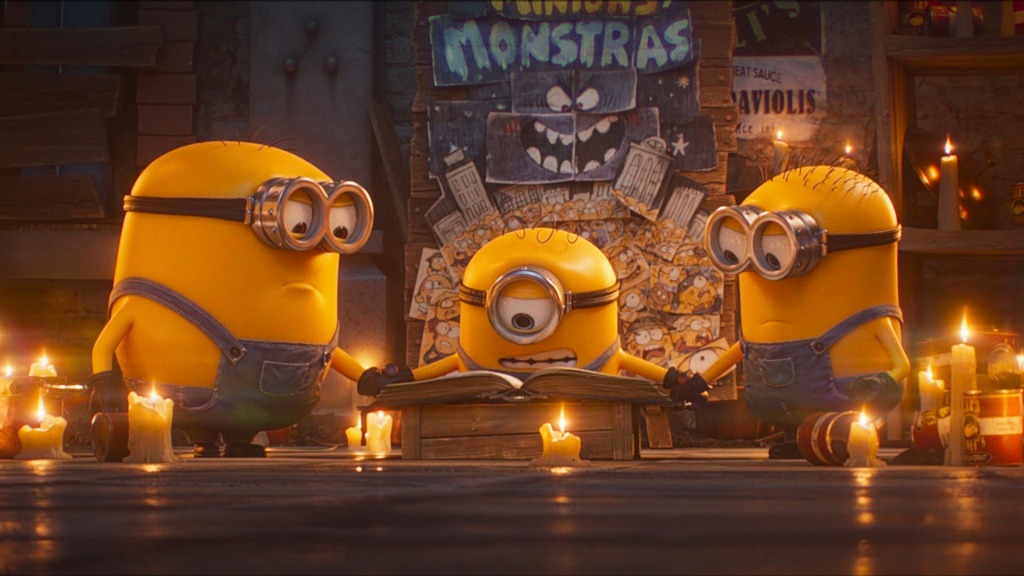
There are more obscure early-film references than the replication of a famous Buster Keaton shot, alongside even broader parodies, woven into the vaguely postmodern spectacle of Illumination—intentionally or not—basically speedrunning the plot of Damien Chazelle’s maximalist Hollywood epic Babylon, complete with a long tracking shot through a series of adjacent silent-film sets. The Minions find great success in this early version of cinema, only to reach a stumbling block when the pictures turn to sound. Their former director and mentor Max (Christoph Waltz) encourages James and Henry to realize their monster-movie dreams; suddenly lacking studio access to cutting-edge special effects, they summon monsters led by Goomi (Trey Parker), who looks like a Baby Cthulhu, to star in their film. This is how the movie swings from Babylon (or, if you prefer something sweeter, Singin’ In The Rain) to the Peter Jackson remake of King Kong (filmmakers pursuing real-life creatures for their magnum opus) to a sort of reverse Bowfinger (instead of filmmakers using a movie star without his knowledge, the monster stars attempt to use the filmmakers for their own goals).
Minions & Monsters is not as good as any of those. But boy, is it preferable to any previous Minions adventure. Part of the advantage is that Coffin and his crew prove far more adept at designing monsters than they are at creating humans. Illumination people tend to look like a second-tier newspaper cartoonist was hired by the French to create a cruel caricature of Americans, all weak limbs and pear-shaped bodies; their creatures (including a pair voiced by the reliably entertaining Bobby Moynihan and Phil LaMarr) are way more fun to regard. Even the movie’s most characteristically disjointed and nonsensical-in-the-bad-way subplot, involving a Zoey Deutch-voiced suffragette and a Jesse Eisenberg-voiced parody of Gort from The Day The Earth Stood Still, scrounges together some daft charm, aglow in the warmth of its strange homages.
Granted, with a movie-geek fantasia for kids comes geeky standards to not quite meet: It’s a bit disappointing, for example, that a movie distributed by Universal Pictures—the monster movie destination among the big studios—sets some of its action in the 1930s, only to skip past ’30s and ’40s monster classics and abruptly arrive at something more akin to 1950s sci-fi creature features (and even then, Universal’s gill-man is confined to a museum-piece background cameo). Moreover: Minions are gonna Minion, which means frantically zig-zagging between loosely connected sequences and leaving parents to debate amongst themselves which slapstick laughs cross the bad-taste line. (Is it the actual on-screen beheading, or the unwanted-rectal-probe gag? The beheading is at least pretty funny.) Still, it’s shocking how well the gambit of crowbarring the Minions into cinema history works. For the better part of 90 minutes, movie fans might actually feel like cackling kids, or at least boomers on Facebook.
Director: Pierre Coffin
Writers: Pierre Coffin, Brian Lynch
Starring: Pierre Coffin, Christoph Waltz, Trey Parker, Allison Janney, Jeff Bridges, Jesse Eisenberg, Zoey Deutch
Release Date: July 1, 2026


 Keep scrolling for more great stories.