While Zelda, often leaning to a teen rating more than an all-ages one like the Mario series, has teased at romance between Link and Zelda more, it too is all subtext. Whenever love for Link is explicitly brought up in these games, it’s either tragic and unrequited, like Mipha’s pining in century-old flashbacks, or treated as a joke, like the hustlers outside of Gerudo Town hitting on Link while he’s in the guise of a Gerudo woman. Much like Mario’s “special one” line, the romance between Link and Zelda is only alluded to—sometimes cheekily, as with Zelda getting close enough to kiss Link in Skyward Sword, only to turn him around and tell him to jump off a building (it’s a tutorial, don’t worry)—with the text often explicitly stating that they’re only “friends.”
Instead of “will they or won’t they,” Nintendo has subjected its audience to decades of “are they or aren’t they.” To understand why we have to go back to well before the digital age. Nintendo got into video games in the 20th century but their inspirations are far older. Over centuries dramatic archetypes around romance consolidated into a simple, recognizable triad, as significantly codified by the commedia dell’arte tradition: the hero, the villain, and the damsel in distress. That love triangle remains at the heart of so much of human storytelling, including the works that directly inspired Nintendo.
Nintendo’s first video game hit, Donkey Kong, famously started life as a Popeye title before licensing issues reared their head and King Kong became the primary inspiration. And so the love triangle at the center of Popeye cartoons (which were themselves based on the more expansive adventures of E.C. Segar’s Thimble Theatre comic strip) became the basis of Nintendo’s game. Popeye the working class hero became Jumpman and then “Little Mario,” damsel Olive Oyl became Lady (later Pauline), and Bluto the brute became everyone’s favorite ape. Where Popeye would woo Olive by rescuing her from a bully’s clutches, so too did Mario with Pauline, literally objectifying her love as a reward. At the end of the game, a giant heart appears between the two, finally unbroken by DK’s downfall. Nintendo imported romance into Donkey Kong because that’s the relationship that defined Popeye—and it would be nine years and several games later before Mario saw anything resembling romance again.
Maybe it’s incorrect to talk about a singular, defined Mario, though? From the start, Mario creator Shigeru Miyamoto was throwing his hero into whatever situations he could, much like how cartoon characters would regularly be transposed into all kinds of time periods. From carpentry to plumbing to breakdancing, he’s done it all. You see the characters and immediately know their dynamics and where you stand in the story. This has only continued over the years, with prominent spinoff series seeing Mario and Bowser set aside their differences to save a whole kingdom from a mutual enemy in one game or play tennis in another. Today they’re platforming, but tomorrow they might be karting or painting or crossbow training. They’re treated as avatars meant to be as much of a cipher for the player as possible. With this philosophy, anything that builds out the characters beyond a couple of set traits—think Luigi’s cowardice or Impa’s wisdom—gets sanded down to be as inoffensive as possible. And what’s viewed more controversially today than sex?
If Mario’s original love triangle was a vestige from an unmade Popeye game, Nintendo’s rejection of romance could be a curious byproduct of larger cultural trends over the last several decades: a conservative reaction to the sudden explosion of sexuality in pop culture. In the late 20th century, lust was marketed everywhere, but sex rarely entered into the picture—and genuine romance, which ultimately leads to sex, often disappeared alongside it. In the wake of the sexual revolution of the ‘60s and ‘70s, culture started to grow more conservative in the 1980s, even as sexuality became more openly commercialized. Nudity and discussions of sex, once not entirely uncommon in PG-13 or even PG-rated movies, became largely confined to the 17-and-up R rating by the end of the ‘80s; at the same time, Madison Avenue increasingly used the sexual appeal of the human body to sell products, even as responsible depictions of sexuality largely disappeared from media that wasn’t exclusively for adults. Slut-shaming, victim-blaming, and “thinking about the children” spread alongside Girls Gone Wild videos and the overt sexualization of underage pop stars who routinely touted their wholesomeness. Culture was inundated with sexual imagery but was petrified of actually discussing sex.
The excessive sexuality of the ‘90s and ‘00s has faded, but its beauty standards haven’t, and we haven’t become any more comfortable talking about sex or romance. Both have trickled down into a larger sexlessness of current pop culture. Where action movies that kids would see on the big screen after playing Donkey Kong at the arcade in the 1980s proudly basked in the chemistry between the male and female leads, today our culture is dominated by the likes of the MCU, snarky heroes with godly physiques that ape the one-liners of the past but largely avoid romantic entanglements. In their essay “Everyone Is Beautiful And No-One Is Horny,” R.S. Benedict argues that “today’s stars are action figures, not action heroes. Those perfect bodies exist only for the purpose of inflicting violence upon others.” In the case of superhero films, they’re literally selling action figures off of them; in the case of Nintendo’s games, they’re selling a bevy of lifestyle merchandise featuring their colorful characters. Mario and Link don’t have the abs of any of Marvel’s many Chrises, but they’re just as free of anything resembling actual romance. Best to leave that icky stuff, and the promise of what it leads to, out of the picture.
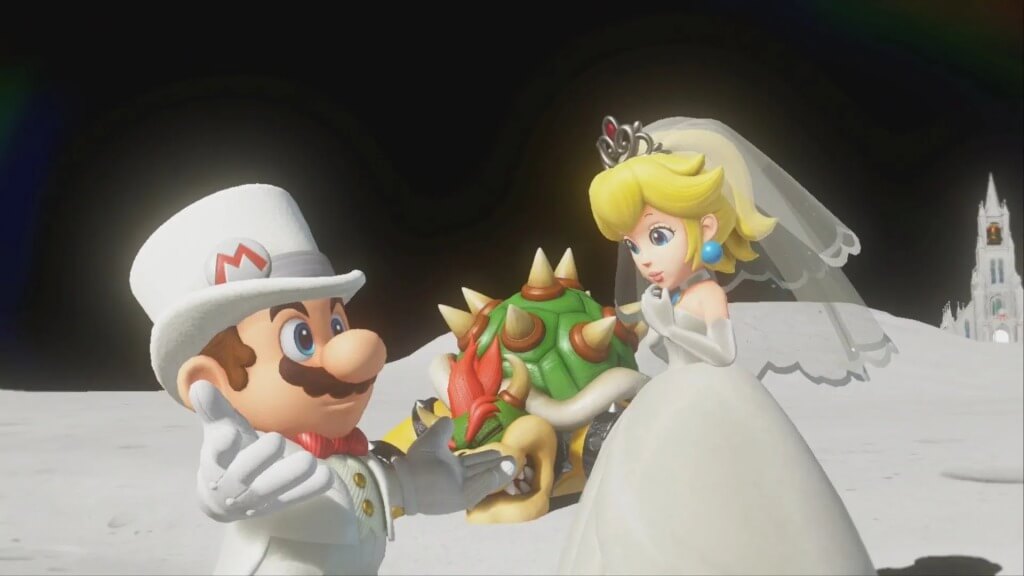
With romance less of an option than ever, what to do with Nintendo’s princesses? In 2017’s Super Mario Odyssey Nintendo began to transition Peach away from the damsel in distress role. The object of Odyssey is literally to rescue her from a marriage to Bowser, making the only explicit depiction of the most traditional romantic relationship in a Mario game villainous. At the end of the game, Bowser and Mario vie for her love with bouquets until she pushes them both aside and goes on a globe-trotting adventure of her own, explicitly rejecting romance. Although 2019’s Super Mario Maker 2 ended with another peck on Mario’s cheek, this would be the last time: since then, she’s taken on a starring role in both her own title and in Super Mario Wonder in 2023, her first time being playable in a mainline 2D Mario game since Super Mario Bros. 2 in 1988. Also in 2023 was Illumination’s The Super Mario Bros. Movie, which cast Luigi as the damsel in distress and had Peach in a leading, action-heavy role while reframing the Bowser’s wedding plotline from Odyssey. Peach and Mario, clearly, are just very good friends. Similarly, Zelda has become a more active participant in her legends. She’s one of several playable characters in the Hyrule Warriors games, and was the lead in 2024’s Echoes Of Wisdom—the first time she’s ever been the main character in a mainline Zelda title.
Although shedding the more chauvinistic tropes of their early inspirations has served Nintendo well, removing love from the equation altogether for their main mascots robs their biggest games of a beating heart. Nintendo has always operated on a family friendly image, no more obvious than now, with their animated features, Lego sets, and My Mario toys aimed at toddlers. We’re at a point in modern culture where the most mild signs of affection can be misconstrued as inappropriate for younger audiences, and Nintendo is happy to keep their main money-makers as clean as possible. In their games, babies are brought by storks, couples sleep in separate beds, and Donkey Kong, once the kidnapper of Lady, only has eyes for bananas.


 Keep scrolling for more great stories.