
President Curtis isn't a huge change from Rick And Morty, but you can believe it
Keith David's bummed-out action-hero president deserves your vote.

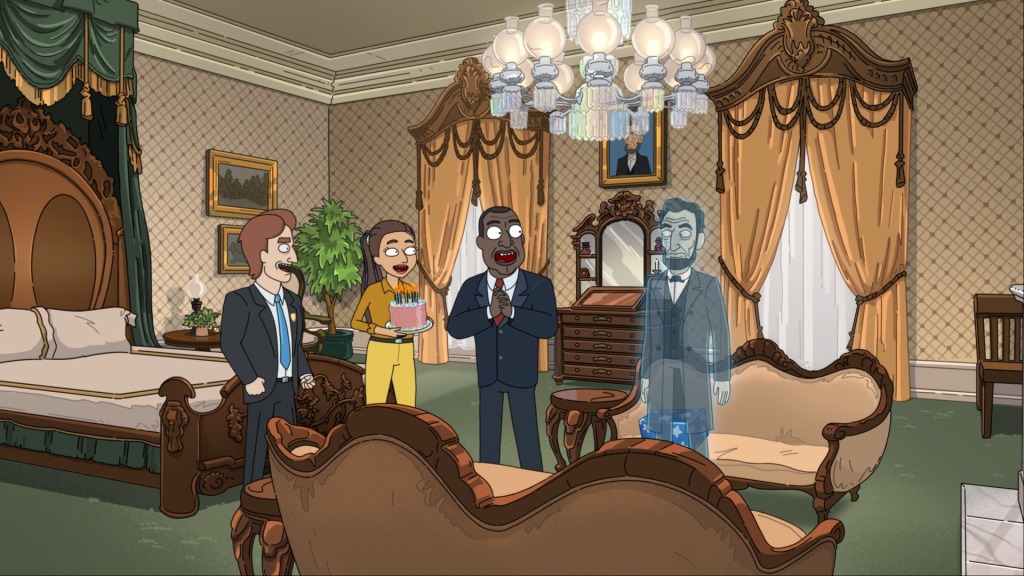
The news hit with more of a “huh?” than a “hell yeah”: After more than a decade of seeking out new comic potential in infinite universes and a far more finite range of science-fiction premises, the Rick And Morty team were centering their first spin-off on… President Curtis? The guy who, when he’s not butting heads with Rick Sanchez, is calling on the mad scientist and his grandson Morty to handle the messes the White House can’t clean up itself? The limited number of times the president has reached out to Rick would suggest the stentorian bumbler has plenty of crises he can handle on his own, but what’s there to recommend him for his own solo project—beyond a lead role for the great Keith David?
A lot, it turns out. In the first season of President Curtis, creators James Siciliano and Dan Harmon find a worthy vessel for expanding the genre riffs and cheekily sophisticated storytelling of Rick And Morty. Starring a slightly less pompous, but no less flawed, version of its titular character, the new series has a more earthbound focus than its predecessor. Harmon has likened the differences between the two shows to those between Doctor Who and The X-Files, and the first 10 episodes of President Curtis bear that comparison out. Not only is the scope narrowed to paranormal activity being investigated and combatted by multiple layers of the federal bureaucracy—leading to a spectacular, very Rick And Morty jurisdictional dick-measuring contest at the top of episode two—but the first season gradually builds toward a satisfying mix of monster-of-the-week plots and episodes that build out the backstories of President Curtis‘ corner of the multiverse and those of the new characters joining him there.
Before these pieces click into place, though, the president’s staff are almost entirely defined by repetition of their vital statistics. Enlivened by a multifaceted performance by Harmon’s old Community pal Jim Rash, half-leprechaun Secret Service Agent Francis O’Doyle spends most of the season telling outrageous tales about his monstrous mother, which feel pretty thin and standard-issue Freudian until we actually meet said monstrous mother. (There’s a more entertaining game in O’Doyle’s steadfast honesty, a stubborn denial of the predisposition to trickery in his leprechaun DNA.) Greater surprises are in store from the third member of the show’s core trio, cybernetically enhanced chief of staff Banks (Stephanie Beatriz). And while each character occasionally feels like they’re little more than their quirks and gimmicks—in Banks’ case, it doesn’t help that her boss is obsessed with RoboCop—those quirks and gimmicks do make for a fun personification of the tensions between the scientific and the supernatural that drives President Curtis.
We’re reintroduced to the main character as he informs the White House press corps that he and his obsidian boomerang have ended Paul Bunyan’s cannibalistic reign over the nation’s wilderness—the show’s goofball hybrid of American myth-making, horror-comedy capering, and workplace plotting in a nutshell. The volley of questions that follows provides a glimpse of the first season’s prevailing mood: Curtis’ extra-office activities don’t have the unanimous approval of the American public, and it just might be that he’s committing himself so deeply to hunting monsters and fostering diplomatic relations with the denizens of Hollow Earth because he’s trying to fill the void left by the end of his marriage to the newly elected governor of Illinois.
 Keep scrolling for more great stories.