
A rabid chimp goes to town on people in the simple yet satisfying Primate
The horror is really just about an ape attacking humans, but after some mild backstory tedium, it unleashes stylish suspense (and gore).
Photo: Paramount Pictures
For a movie of exceeding simplicity, Primate manages to encapsulate more or less the entire deal of horror filmmaker Johannes Roberts in a single compact creature feature. Roberts isn’t even as big a name in horror as Osgood Perkins or Ti West, much less a minted mainstream auteur like Jordan Peele or Zach Cregger. Fans might not necessarily realize (or care) that the same guy directed a Strangers sequel, a Resident Evil reboot, and a pair of shark thrillers. But Primate makes a characteristically concise case for Roberts as a genre stylist to keep watching.
In it, a rabid chimpanzee kills a bunch of people. Truly, there is not much more to it than that. OK, technically there is some family-business backstory with Lucy (Johnny Sequoyah) returning home from college for the summer to her family in Hawaii, with the bog-standard dead mom, beloved younger sister Erin (Gia Hunter), and a semi-neglectful working dad (Troy Kotsur) who must prove his allegiance to his family. This material, as written by Roberts and co-screenwriter Ernest Riera, isn’t especially bad compared to other movies of this ilk. It does struggle, however, to create any meaningful thematic link between lingering family traumas and the presence of the family’s pet ape Ben. Does his link to their departed scientist mother carry a burden of painful memories? Is he a symbol of familial interdependence? Or is this plot device, as it appears most of the time, a curiosity whose ease of maintenance is vastly oversimplified?
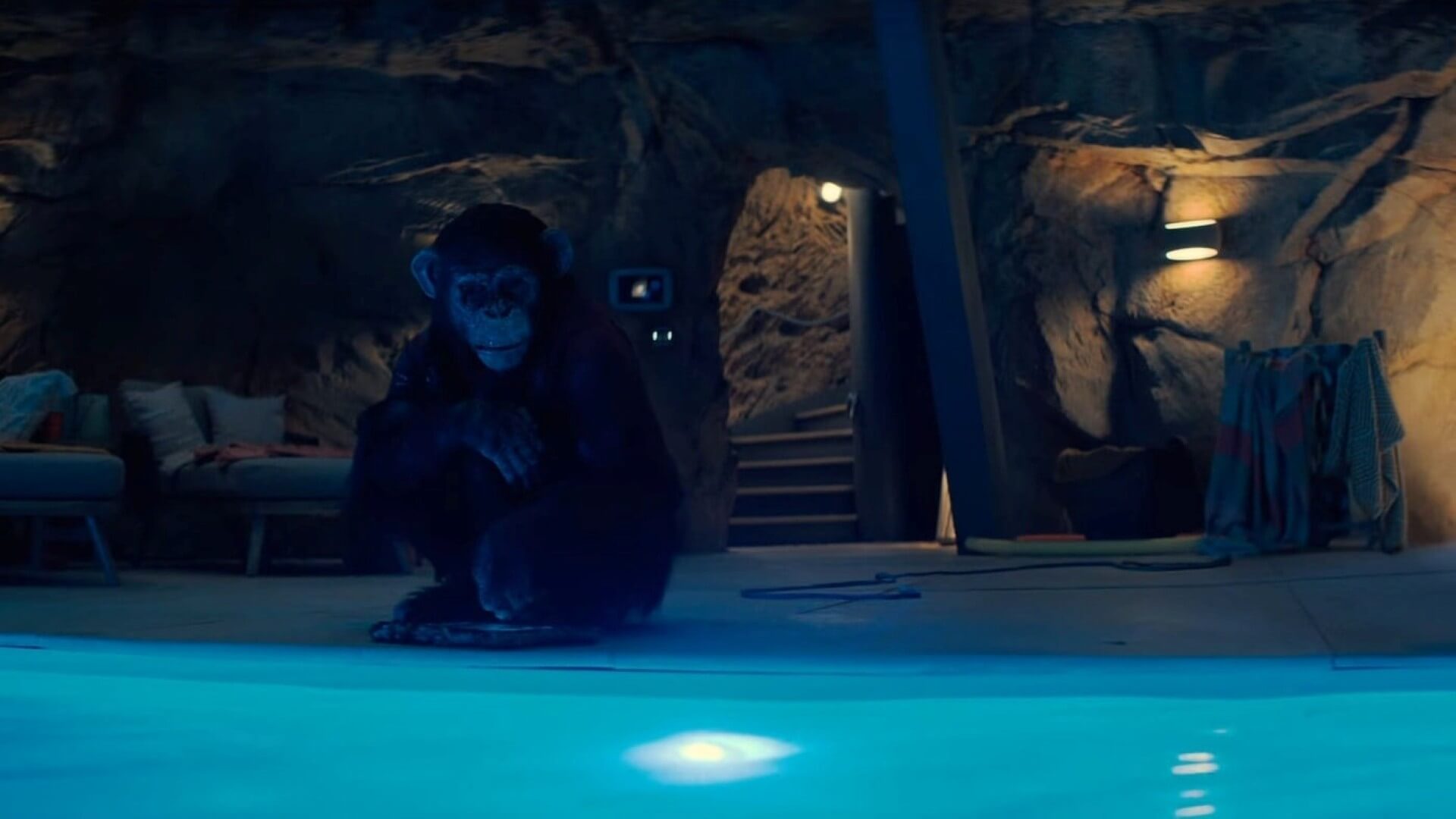
No matter. The point is, Ben gets rabies and starts attacking humans. (The movie opens with a brief definition of rabies, followed by a vicious chimp attack, so there’s no doubt that this is where it’s headed.) Said humans include Lucy, Erin, Lucy’s friends Kate (Victoria Wyant) and Hannah (Jessica Alexander), as well as a few randos thrown in to up the movie’s body count. Lucy’s family lives in a well-appointed cliffside mini-manse, which means help is not so easy to come by, especially with a ticking clock that begins as soon as one of the humans is bitten by a rabid Ben. The girls spend a not-inconsiderable amount of time cornered in a swimming pool; Ben can’t swim, but he also plunks himself by the only exit.
Roberts must loves pools, and/or find them mortally terrifying; the most memorable sequence from The Strangers: Prey At Night (the one that made the A.V. Club’s best scenes of the year list back in 2018) set a nasty slasher scuffle in a neon-lit, Bonnie Tyler-soundtracked motel pool. In Primate, he works a surprising number of angles to generate suspense in this limited space. There’s eerie beauty, too, as he keeps returning to an underwater shot of Ben’s gently distorted image looming from above. Though the movie has plenty of the low-contrast lighting seen in so many contemporary studio productions, Roberts uses the low light to envelop the movie in a slightly dreamy haze, hovering between something like reality (Ben really is just an animal with rabies, no further gimmick needed) and bizarre nightmare (at times, the film makes it look as if Ben is cackling maniacally at his former family while plotting their deaths with uncanny precision).
 Keep scrolling for more great stories.