
Quantum Leap's got corn, a Robin Williams impression, and Russ Tamblyn
And pre-Home Improvement Patricia Richardson lends Sam a hand.

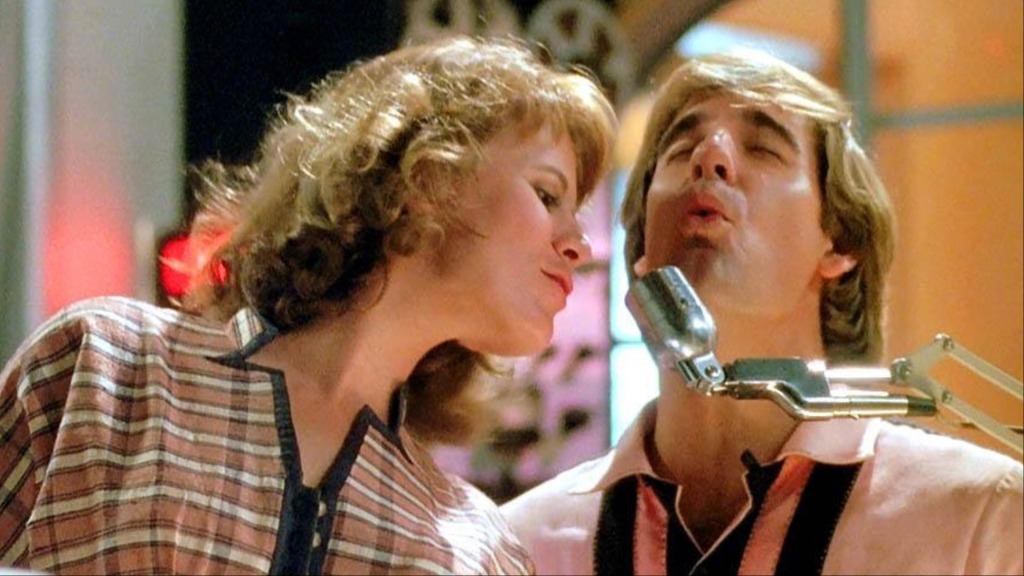
“Good Morning, Peoria”
Originally aired 11/8/1989
In which Sam saves rock ’n’ roll…
In case it hasn’t become obvious by this point, I’ve been reviewing Quantum Leap on a bit of a curve. The show has clear strengths: a great central premise, a sense of optimism about the human experience, and two well-cast leads with terrific chemistry. It’s also a production of its time, and while I’m sure there was more sophisticated television happening in the late ’80s, most of it was formulaic and dependent on cliche. A lot of what I loved in childhood is best left in memory, and there are times when I wonder if QL belongs in that category. It definitely can’t withstand the scrutiny I’d apply to a better show.
Still, I find myself loving it almost in spite of myself, and a lot of my patience for it has to do with a certain tolerance for those aforementioned cliches. There are still outright bad episodes—I’d rate “Blind Faith” in that category, although it did win some points for sheer weirdness. But while we haven’t seen anything outside of the pilot that I would rate as legitimately good, if you can get on the wave-length of the era, there’s a charm and sweetness that can win you over. At least, it can win me over, and since I’m writing these, I guess that’s a good thing.
Case in point: “Good Morning, Peoria” has Sam leaping into the body of “Howlin’” Chick Howell, a ’50s disc jockey for a failing radio station. The title is not a one-off; as a DJ, Sam does Scott Bakula’s best impression of Robin Williams in Good Morning, Vietnam, right down to the signature opening line (slightly tweaked for current circumstances). Patricia Richardson plays Rachel Porter, the station’s owner, and when a local curmudgeon tries to prevent them from playing rock ’n’ roll, Sam and Rachel pull an all-nighter to fight for their right to rock on.
The setup wouldn’t be out of place in a ’50s movie, albeit one where the grouchy adults got less sympathy than usual. The actual mechanics of how Sam and Rachel aim to win the day are obscure, and the period references are as corny as ever. (Worst joke: Sam briefly forgets the Beatles didn’t exist until the late ’60s, and there’s a forced pun about Buddy Holly and The Crickets.) Sam meets with the actual Chubby Checker and teaches him how to do the twist, which is either silly or outright offensive, depending on your current mood.
The corn is as high as an elephant’s eye, is what I’m getting at, and Sam’s efforts to be a wild, funny radio DJ are… well, Bakula puts a lot of energy into it, and there’s a clear sense of the joy of getting to play behind a microphone, even if the jokes aren’t very good. The climax of the hour has Sam reading an editor’s note praising the value of freedom after World War II; the editor is the exact same old fogey who pushed the town council to ban rock ’n’ roll, and the apparent hypocrisy of his behavior is enough to defuse the situation and put our heroes on top.
I’ll admit to a certain nostalgia for a time when I believed “pointing out hypocrisy” could be an effective political solution, but that’s not why I liked this one. It’s not sophisticated in the least, but the fact that we spend a lot of time just watching Sam and Rachel interact makes them more human than their cornball situation, and the burgeoning romance is a fun one; I don’t think Richardson ever looked at Tim Allen the way she looks at Bakula here. There are fun, chatty scenes with Al as well, and while the episode eventually falls back on “generic rock music” for its soundtrack, the few songs we do get to here are fun ones.
It’s pleasant, and it doesn’t strain that much to be pleasant, I guess is what I’m saying. I’m not sure if that makes for great art, but it was a nice break from the rest of the world. I don’t think I ever really bought into the struggle to save rock here, or Sam’s lofty ideas about freedom of expression, but I enjoyed the clever ways he found to keep the station running no matter what bad guys threw at them, and the ending was a sweet one. Sometimes corn isn’t so bad, y’know?
Stray observations
- • Rachel and the DJ got married a year after Sam leaped out. I always wonder about the relationships that Sam kicks off; are the partners disappointed when the real guy steps in?
- • Patricia Richardson is extremely hot. I said it, and I don’t feel bad about it.
(Screenshot: Quantum Leap)
“Thou Shalt Not…”
Originally aired 11/15/1989
In which Sam definitely does not perform a bris…
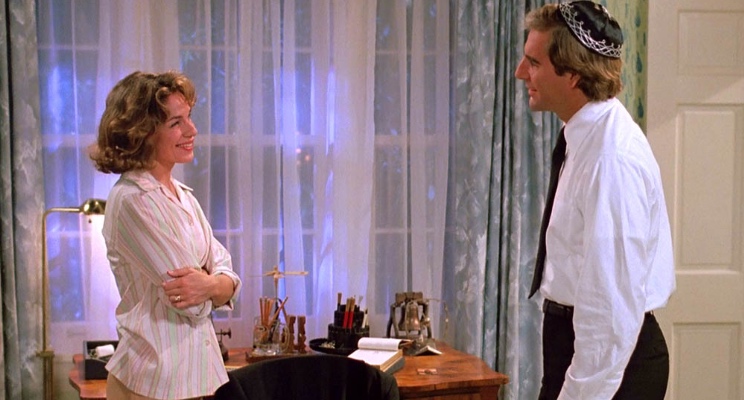
Now it’s time for a different kind of corn. “Peoria” was all about good vibes and fighting the Man; “Thou Shalt Not…” is considerably more sober in tone, as is evident from the first scene. Sam leaps into the body of Rabbi David Basch, right in the middle of a girl’s bat mitzvah. Oddly, the cold open seems to set us up for cringe comedy, but it cuts before we get to the awkwardness, and once the credits are over, Sam is out of the danger zone, glad-handing party attendees while he struggles to get his bearings.
In fact, I don’t know if we ever get a real joke about Sam having to fake it as a Rabbi. Al covers for him once, but while Judaism is in the forefront throughout the hour, Sam’s status as a religious leader is never particularly relevant. Occasionally, we get leaps that feel more personal for the writers than others, and this is one of them; the story of a family struggling over the death of a child, and a predatory outsider who attempts to take advantage of that struggle, makes for good drama, but there’s just enough texture to it to make it come across as specific.
That being said, we’re still on the Leap curve here. “Thou” is pure melodrama, and while there are a few jokes here and there, the core narrative is played intensely straight, almost to the point of self-parody. That can be bracing, if you’re in the mood for it, and the longer I watched, the more invested I became. There’s not much in the way of nuance here, and there’s no real subtlety to speak of, but the intensity of the situation, and the actors’ commitment to selling that intensity, has some real weight to it.
Also, it’s a relief that this just didn’t turn into a bunch of jokes about Jews. Leap can often treat its various circumstances as a tour through America’s near infinite variety of subcultures; and at worst, those tours can feel shallow, childish, and flat. We get a joke about a bris, and we get some Hebrew; we learn that one of Al’s wives was Jewish. But the religion is more of a background for the story than it is a focus of the episode, and while that may seem strange given Sam’s status, it helps to make these people feel like people, and not just props for Sam to study as he learns an important lesson about tolerance.
All of that, and we get Russ Tamblyn guest-starring as a predatory psychologist. This episode aired about six months before Twin Peaks premiered, and Russ’ character here, an author named Bert who seduces women so he can write a book about their struggles (and get laid), feels almost like a dry run for Jacoby, albeit a more outright villainous one. Tamblyn has that chummy, persistent creep thing down cold, and it’s fun to see him pop up here.
My biggest problem with “Thou” is its leading man, and I’m not talking about Sam. The central conflict revolves around David’s brother Joe and his family. Joe and his wife Irene’s son died in a plane accident a year before Sam leaps in, and Joe still blames Irene for the son being on the plane. He’s cold and distant and refuses to spend much time with his wife or their surviving daughter; Irene’s isolation leads her to have a one night stand with Bert, which ruins her life, and which Sam has arrived to prevent.
It’s just, Joe is such a convincing asshole that I found it hard to root for the family to come together. While losing a son must be incredibly painful, we’re never really given a reason to sympathize with the guy, and it mostly feels like Sam is trying to save a family just because we’ve decided that families are better than not-families. Joe ignores his daughter (because she isn’t a boy), and, again, blames his wife for what happened, even though it’s obviously not her fault. And since we have to wait until the climax of the episode to see anything remotely human in him, it’s hard to root for it all to work out.
There’s also a lot of very corny music to deal with, which doesn’t help if you’re already struggling to take any of this seriously. Maybe it’s not that I’m reviewing these on a curve; maybe it’s more that I’m watching them with certain assumptions built in. Normally when I review a show, I try to be–well, “objective” is impossible, but I try to go in as neutrally and open as I can. But with something like Quantum Leap, where I’m already well-aware of its limitations, I find myself looking at what makes each episode distinct, what small idea or character interaction is worth saving. It’s not a great approach as a critic, but there are worse ways to go about things as a fan. Just keep that in mind when you read these: When it comes to QL, I’m more of the latter than the former.
Stray observations
- • Not much to add this week, but the tease for next week’s episode has Sam jumping into the body of a young man with Down’s Syndrome. The r-word is dropped twice in less than three minutes. Should be a fun ride!
 Keep scrolling for more great stories.