“Jimmy”
Originally aired 11/22/1989
In which “Jimmy” is no Jack, thank god for small favors
Quantum Leap means well. I think we can all agree on that. Yes, it’s a commercial work of art in a medium with a pretty rigid definition of what that means; and it’s absolutely a product of the perspectives of the people who created it, and whatever limitations their worldview might have. Even at its best, the show was never particularly revolutionary, and while it occasionally flirted with ambition, it very rarely achieved the kind of transcendence we associate with greatness. But still: It means well. And while we can talk about the road to hell and what-not, it’s still worth approaching an episode like “Jimmy” with that assumption firmly in mind.
In “Jimmy,” Sam jumps into the body of a young man who appears to have Down Syndrome. This is never officially diagnosed–any time anyone talks about his condition in the episode, it’s either to say he’s slow or to use some variation of the r-word. (Note: I’m not going to use that word in this review, because it’s unpleasant. I don’t blame the episode for that unpleasantness. Times change, is all.) I’m calling it Down Syndrome because Brad Silverman, the face Sam sees when he looks into the mirror, has Down Syndrome. But as far as the episode’s concerned, it’s not a specific condition.
That feels appropriate for the ’60s, but it is a bit odd that Al doesn’t offer anything more specific in his visits; he and the others in the future would, after all, be able to talk to Jimmy directly. But the show has yet to really use that idea to its fullest—by and large it treats the person that Sam leaps into as just a costume that Sam has to learn to work with before he can leave it behind. This works when Sam is thrown into a white dude, but it gets tricky when he’s in the role of a minority whose experiences aren’t often the subject of television programs.
Really, that’s one of the central tensions of Quantum Leap: There’s beauty in the idea of learning empathy one person at a time (and it’s not like Sam ever comes across as unempathetic), but it’s also still centering Sam as the most important person in the story. There was a book (and movie) called Black Like Me from 1961 about a white man who disguised himself as a person of color so he could experience racism and bigotry firsthand. You can argue that sort of story is a useful tool for getting white people to accept that Black people really do live in a “different” America; or could you point out that, uh, maybe us white folks could just trust the Black people who’ve been telling them all these things for decades.
“Jimmy” (and other episodes that fall into this kind of “let’s learn about a horrible social injustice” theme) has some of that problem, although it’s nowhere near as bad as it could have been. The biggest, best choice the episode makes is not having Sam try to pretend to be “slow” himself. He’s a bit more on edge this time, and he drops things a lot, but the script goes out of its way to stress that this is because of the tenseness of the situation. Seeing how a “normal” person struggles when faced with the kind of hardships someone like Jimmy sees every day is instructive in and of itself.
And boy, are there some hardships. I found this episode difficult to watch at times, and I honestly don’t know if that’s because it succeeded or failed at what it was trying to do. Most of the time is spent on Sam doing his best and failing repeatedly, usually for reasons that are beyond his control, only for someone to show up and either yell at him for being a freak or offer support that still comes with an edge of victim-blaming.
It’s hard for me to decide if the intensity of the cruelty here is warranted, because I have no doubt in my mind that being a person facing the kind of challenges Jimmy faces would be extraordinarily difficult in the ’60s (at least today there are more people aware of this sort of thing; Jimmy could likely find better support, and his brother wouldn’t feel quite so alone in taking care of him); but man, it’s a lot to take in. Michael Madsen as the asshole dockworker covering for his own dyslexia is one thing, but Connie, the wife of Jimmy’s brother Frank, is unsparingly dismissive of Jimmy throughout the story, only coming around when Jimmy saves her son’s life via CPR.
That’s a weird message in and of itself—that not only is Jimmy forced to suffer and endure because the people around him don’t (or refuse to) understand who he is, but that he also needs to somehow be even better than all those people in order to prove he has value to them. Sam claims that the CPR is something Jimmy learned “at the institution,” and that’s certainly possible; but it’s hard to shake the feeling that, had Sam not been in Jimmy’s body, the kid would likely have died.
Maybe that’s the point? Maybe we’re supposed to think about how unfair it all is, enjoying the wish fulfillment of an outside angel swooping in to save the day, while still remembering that, in the real world, Jimmys don’t get that kind of luck. It’s a kind of melancholic thinking that the show doesn’t leave much room for, though; the sweeping music and unfettered sentiment both work together to create an illusion of triumph even if the actual facts make that illusion harder to believe in.
I’m not quite sure what to make of this one. As I said, its heart is in the right place; and reminding “normal” people that folks who don’t quite fit their definition of normal are not monsters is always a good thing. I didn’t enjoy watching Connie be an asshole to Jimmy, even when I knew she’d ultimately relent, and I didn’t particularly enjoy watching people yell at a guy who was just doing his best. But those are both intentionally uncomfortable situations. How much of my discomfort is intentional, and what value does it have? Not sure. I do know it’s unlikely I’ll watch this one again any time soon, but I think it mostly achieves what it’s going for.
Stray observations
- We learn Al had a sister with disabilities who was put in a home and died there at a young age. The show is leaning hard into melodrama here, but I think Dean Stockwell’s delivery of Al’s backstory, and his determination throughout the episode that they don’t “lose” Jimmy makes it convincing.
- It is funny, though, that Al is worried about Sam failing. Has Sam ever failed in leap? We don’t even know what would happen if he did. (I feel like there’s an episode later on that addresses this, and I know it comes up during the “evil leaper” arc, but I can’t remember the details.)
- Brad Silverman, who plays Jimmy in Sam’s reflection, will show up in three more episodes over the course of the run.

(Screenshot: Quantum Leap)
“So Help Me God”
Originally aired 11/29/1989
In which we learn that Sam does not, in fact, have a law degree
Okay, let’s try and do some classifications here. Let’s figure out the different “types” of Quantum Leap episodes. After all, you’re reading a review of an hour of television almost four decades old, what else are you doing with your life?
Sarcasm aside, it might be useful to establish some base criteria for talking about individual episodes of the series—not in a limiting way, but to help us get a better idea of just what the script and direction are trying to accomplish. “Jimmy” feels like a specific kind of story. There’s no real confusion about what Sam is trying to accomplish, and all the action revolves around the person Sam leaped into–a person who faces challenges in a society that refuses to accept even the slightest deviation from the norm.
We can call these “message” episodes, at least until we get a better term, and we’ve had a few of them so far. This is as close to the classic “very special episode” archetype that Quantum Leap really gets, but while we don’t have a cast member stepping forth to remind us what lesson we should have learned, “message” episodes do tend to suffer from all the hallmarks of the genre. They’re well-meaning, but hindered by the mainstream assumptions of the time in which they were produced, prone to oversimplification and campy sentiment, and often suggest vague solutions like “understanding” and “compassion” to what are, largely, systemic problems.
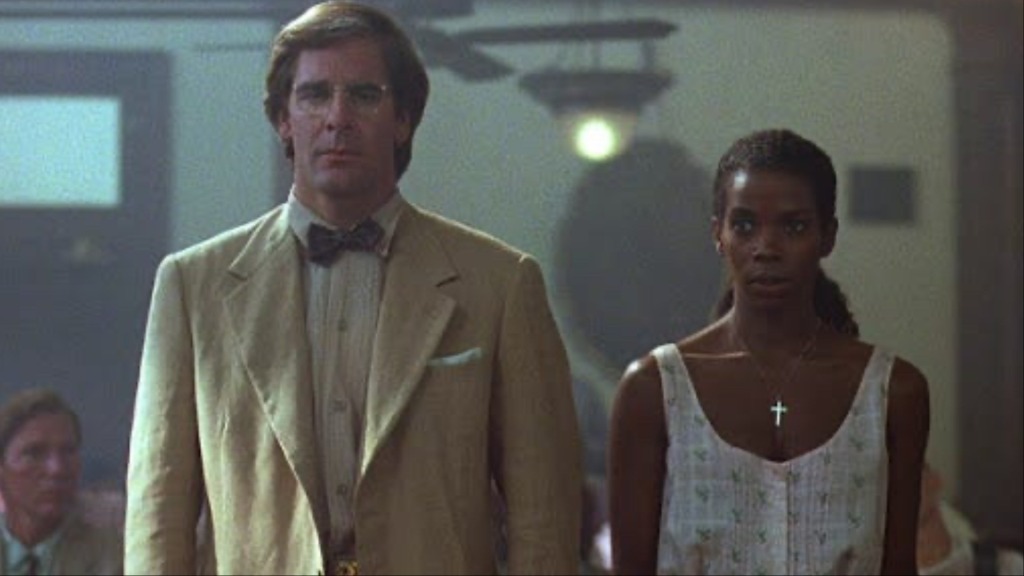
“So Help Me God” might look, at first blush, as a “message” episode. Sam leaps into the role of Leonard Dancey, a schlubby Southern lawyer defending Lila Berry, a Black woman accused of murder. We get a healthy (more than healthy) dose of Southern racism, up to and including the n-word; we also get a fair share of misogyny, as various people around Leonard accuse him of defending Lila simply because she seduced him into doing it.
But there really isn’t a single message here, and while Sam is an important mover of the plot, he’s here to bring the truth to light, not have any real part in that truth himself. I’ve taken to calling these “angel” episodes, because they remind me a little of Highway To Heaven. Leap’s religious ties are considerably more generic than Heaven’s, but in terms of action, it’s the same basic idea: our hero is an outsider brought in to resolve a situation, someone who can see things more clearly simply because they aren’t a part of them, and who is able to extraordinary lengths in order to ensure it all comes out right in the end.
The main difference for the viewer, at least in distinguishing “Jimmy” from “God,” is how the latter is much more interested in digging up backstory than the former is. We know Jimmy has been in an institution, and our knowledge of how bad that place was for him makes us, but it’s not like Sam has to go find out how that institution was corrupt, or uncover malfeasance at the docs to save the day. He’s there more to endure and give Jimmy an edge at one of the most difficult times of his life, not play detective for someone else.
Maybe it’s really just a question of how much we care about the person Sam has leaped into it. “God” actively seems to discourage it; after learning that Leonard had willingly accepted a plea bargain before Sam mucks things up in the courtroom, we later get Al telling Sam how the real Leonard lay curled up in a ball for six hours before saying “I’m a lawyer, take me to your leader.”
It’s not that these are necessarily unreasonable reactions (Lila had signed a confession, and the plea would’ve saved her from the chair; I can’t imagine blinking and finding yourself in the future would do much for anyone’s sanity). But everything’s handed to us in a very specific way, including the visual reveal that Leonard looks like, as mentioned, a schlub. The episode repeatedly to signals us that we can forget about this guy, and just watch Sam do Sam things without worrying he might blow his cover.
This also makes for a plot that’s slightly more complicated than “Jimmy works at the docks.” Not that much more complicated, but it still requires some leg-work and thinking on Sam’s part to pull the whole thing together. While Lila’s race is absolutely a factor in both her trial and the circumstances leading up to that trial, the era’s bigotry is more an environmental fact than a lesson we all should learn about tolerance. It’s there because it serves the story by making things harder and worse than they should be; the fact that it’s also more or less true is a kind of thematic bonus.
That being said, this is still very melodramatic and corny, and the twist is… well, it’s not awful, but it has that “this is ripping something famous off but I can’t remember what it was” feel that makes me a little less thrilled by it. Still, by keeping the story front and center, the script resists turning anyone into a simple plot obstacle. I don’t know that it feels “real,” exactly, but it does feel slightly more real than it might have.
If you’d asked me point-blank which were likely to be better, “message” or “angel” episodes, I would’ve guessed “angel.” Something built around teaching us a lesson has to work much harder to be effective than something just trying to engage us for forty minutes; writing for story almost always makes for better results. And yet, I think “Jimmy” is better than this, if only because there’s an edge of desperation to it that’s lacking here. “God” isn’t bad, and I certainly don’t think it would’ve been improved if it had turned into a lecture about racial equality. It just suffers a bit because there’s no specific reason it should be a Quantum Leap episode. Al doesn’t even seem to care that much about the outcome.
Stray observations
- I, uh, admire Sam’s passion when he gives Lila a reading primer and tells her to learn how to read. (It feels like something you could clip for a “well-meaning liberal” meme.)
- Maybe the plot seems familiar because the whole thing sounds like a Tennesse Williams play, albeit a pretty tame one.


 Keep scrolling for more great stories.