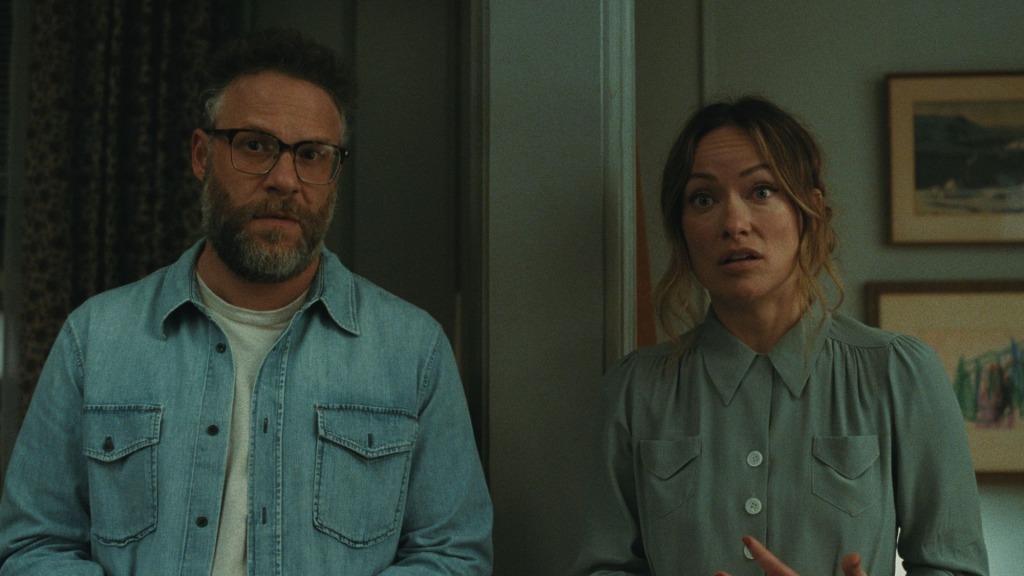
Ethical non-monogamy is introduced in The Invite as something both frank and risqué, and Rogen and Wilde are particularly gifted at their “Not that there’s anything wrong with that!” dialogue, delighted to discover what’s “different” about their uber-cool neighbors without hiding their attraction. It’s clear that swinging is on the menu long before the actual invitation is extended, which itself is long after the severity of Angela and Joe’s incompatibility has been established. There’s therefore entertainment but not much tension to the film’s line of inquiry: Is sex outside marriage the solution, or do you first need to meet a high threshold of honesty and vulnerability? The Invite’s answer will not surprise you.
It’s a similar narrative arc to last year’s screwball-inflected Splitsville, where schlubby gym coach Carey (Kyle Marvin) finds out his wife Ashley (Adria Arjona) wants a divorce and that his best friend Paul (Michael Angelo Covino) and his glamorous wife Julie (Dakota Johnson) opened their marriage a while ago—no big deal, except all four might be too jealous and bitter to make the partner-swapping work. If there is an uptick in heteropessimism in American films, it’s manifesting in a primarily hysterical mold; there’s no casual extramarital sex in The Roses, but the 2025 film shows an English couple, Theo (Benedict Cumberbatch) and Ivy (Olivia Colman), waging venomous and verbose war on each other. Each of these films presents the idea that marriages are built on accepted imbalances—be they gendered, financial, or romantic—that trigger shrieking, resentful breakdowns if questioned or altered.
This is not a novel observation on the part of these filmmakers. In fairness, though, what they’re observing hasn’t stopped being true since the wave of marriage breakdown films from the era of the sexual revolution and legal breakthroughs like no-fault divorces and Roe v. Wade. Yet, a miserable couple lashing out because they witness a less uptight and fragile alternative feels more impactful in a film like Who’s Afraid Of Virginia Woolf because it is set in a time of increased marital privacy, where cracks in conservative traditions were clear as day but still not acceptable to openly call out. The Invite is true to how clinical language has infiltrated relationship discussions—both in and out of therapy sessions—but Angela and Joe’s giddy, talking-over-themselves reaction to their neighbors’ lifestyle, as realistic as it might be, has its roots in an older, more conservative era, where couples who clearly resent each other can at least unite by snickering about not doing anything quite so out there. The Invite is so intent on portraying its protagonists as living in denial that it cannot see that they’re also living in the past.
That’s not to say that complicating the frivolous, taboo-testing theatrics of a bedroom farce with realistic and recognizable marriage discourse isn’t fun to watch, but the recent films in the genre switch things up only to scale them back. Fraught solutions to irreconcilable differences are suggested and tested: In Splitsville, Carey opens his marriage with Ashley and befriends everyone she dates; in The Roses, Theo and Ivy feel an illicit thrill in trying to outdo each other with insults, sabotage, and outright physical violence as their personal crises and pettiness eat their marriage to the bone. Since The Roses is a remake of 1989’s The War Of The Roses starring the more convincingly vengeful Michael Douglas and Kathleen Turner, you spend most of the film wondering when it’s going to shake loose of its tired delight around codependent couple carnage. Instead, the film faithfully rehashes a husband-and-wife spat from the late ’80s, which indicates how hostile modern filmmakers are to imagining marital conflict as anything other than essentially doomed.
In all these films, the solutions fail every time. In The Invite, Joe injures his back and lashes out at Angela, Hawk, and Pína, his contempt shattering their shared erotic spell. Splitsville reveals that neither Paul nor Julie were actually having sex with anyone outside their marriage, Carey only befriended Ashley’s partners to annoy her, and opening relationships lessened nobody’s neurosis. While The Roses ends with Theo and Ivy on the brink of passionate sex, their blowout fight causes a gas leak that will blow up their home just when the credits hit—a cute, blunt metaphor for their unsustainable and self-destructive resentment. There’s literally nowhere to go from here, pessimism turned into comic fatalism.
The Invite and Splitsville (as well as earlier comedies like The Overnight) opt for traditional resolutions to their drama, dropping the pretense that extramarital sex could mend their problems and only entertaining the taboo erotic appeal of swinging until deciding that everyone is just kidding themselves. Pína, a sexologist, sits opposite the unhappy couple and therapizes them until they admit their marriage is a sham; Ashley and Julie make a kintsugi pot, everyone having copped to either lying about having extramarital sex, or being glad they’ve put it behind them to return to monogamy. Honesty has been reached—even though Angela and Joe decide to split, she sits with him as he plays piano, a rare, intimate, and special recalling of their past—but non-monogamy is pushed aside as a mere catalyst for erotic comedy that leads to a mundane resolution.
All these seemingly boundary-pushing films uncomfortably conform with the repeated centrist wisdom around open relationships: They’re risqué, sure, but not necessarily helpful, and maybe even a little dishonest. Making a modern marriage crisis drama means acknowledging that these models are as common as they’ve ever been in American culture, but always from a curious and slightly cynical perspective—it’s telling that queer communities have long embraced non-monogamous relationships, yet most mainstream films around the topic focus on straight characters who can’t make them work. This is where The Invite and Splitsville feel most indebted to an older era. They insist that problems are rooted in the domestic and familial spaces, and even though ethical non-manogony is not treated as something as toxic as Who’s Afraid‘s George and Martha seducing and humiliating their fresh-faced guests, they are dramatically equated as simple distraction tactics.
There’s a venom and honesty to the influential marriage crisis dramas of the ’60s and ’70s that extends beyond the scope of characters acknowledging a common romantic failure. The coping strategies available to the couples in these older movies were limited and hostile, but the films often ended in the same place as their modern descendants. Sixty years later, couples have a plethora of acceptable alternatives to pursue (ranging from the sexy to the clinical), but after an hour of playing with erotic tension, The Invite comes out in favor of conventional talk therapy, and only in order to put Joe and Angela’s marriage to bed. It’s a disappointing yet representative finale, one that highlights the film as stuck between the mortifying cruelty of a more regressive era and the modern freedom of non-traditional relationships. The modern reluctance among filmmakers to imagine success through any other means keeps their couples treading the same choppy waters. In 2026, these films acknowledge that the taboos are innocuous, but their filmmakers are somehow still afraid of them.


 Keep scrolling for more great stories.