Even judged against a modern gaming industry where big-budget titles take a half-decade (minimum) to ship, the sci-fi horror game Routine has been a long time coming. It was originally announced at Gamescom way back in 2012 as the first title from the small studio Lunar Software, but years of internal difficulties and multiple delays put the project on ice.
However, development would later resume in 2020 with the backing of publisher Raw Fury as the game was rebooted from near scratch. And now, over 13 years after its announcement, it’s finally coming out. It has all made for the type of long buildup that tends to whip long-waiting devotees into a fervor, setting up impossible-to-meet expectations from those who wrongly assume that all this time was spent making the game.
Unfortunately, while Routine has flashes of brilliance in its found-footage presentation and lovingly rendered Space Race-era tech, it’s unable to live up to a decade-plus of anticipation. Much of this comes down to a classic horror trap: showing too much of the monster(s). Its tension and first-person puzzling fizzle out amid the umpteenth encounter with unkillable adversaries that send you sprinting back to an all-too-familiar hidey hole where you’ll wait for them to mechanically restart their patrol route; there’s nothing less scary than the phrase “patrol route.”
Admittedly, though, it takes a little bit before you run into these problems. Events begin as an unnamed software engineer arrives on a commercial lunar base defined by retrofuturistic technology, flickering CRTs, and a profound sense of unease. Before long, a natural question will arise from its empty halls: where did everyone go? From here, you scrounge up a repair tool, the C.A.T., a device needed to access the rogue computer network that seems to be at the heart of this place’s problems; spoilers, this process involves completing a bunch of puzzles while running away from killer robots.
It’s in the opening moments before these chrome killers make their appearance that Routine is at its most eerie. Here, its first-person presentation utilizes a washed-out color palette and an ever-so-slight layer of digital grain to create the sense that you’re playing out the happenings of some forbidden VHS tape that isn’t meant to be seen. Adding to this uncomfortable ambiance is the near-complete absence of traditional on-screen UI, which breaks down the barriers between the player and what’s on screen. For example, you interact with the C.A.T. tool directly, pushing its buttons to interface with projectors and computer consoles throughout the base. There’s no mini-map, no inventory, just you and unforgivably dark corridors that may or may not be hiding a nasty surprise.
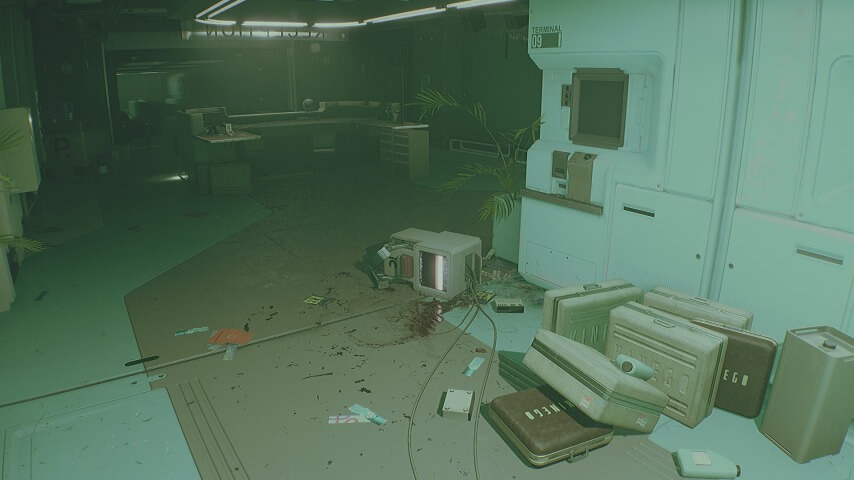
The immediacy of this perspective makes it easier to appreciate the striking particulars of this alt-history moon base, where helper robots have monochrome monitors for heads and a thin pane of glass separates you from the vacuum of space. There is a tactile sense of truth to these surroundings that places us firmly in the setting and the horrors therein.
The bad news is that this carefully curated despair dissipates as Routine reveals what it actually is: a puzzle game that makes you dread its unkillable monsters for all the wrong reasons. Much like Amnesia: The Dark Descent or Alien Isolation, your character can’t put up much of a fight—you repurpose a doohickey meant for space electricians, which proves as effective as it sounds—making your first course of action to retreat. However, instead of being hunted by a pursuer that feels either frighteningly clever or enigmatic in its randomness, your attacker has the IQ of a guard from Metal Gear. Sure, you’re dealing with literal robots, so their mechanical approach to patrolling areas makes perfect sense, but the unfortunate side effect is a game that plays like an extended stealth mission gone wrong.
Related to this, while the world is visually cohesive, this setting doesn’t feel designed around the fact that you’ll be playing a lot of hide and seek with your foes. While Amnesia’s spooky haunted mansion contains a cartoonish number of person-sized armoires to hide away in, this lunar base is very much devoid of wardrobes or desks to cower under. There are vents or an occasional safe room, but they’re infrequent enough that the act of progressing through an area often involves a lot of jogging back to a home base as you’re repeatedly accosted, grinding the pacing to a halt.
It rarely feels like you’re reacting to an unpredictable, dynamic threat that requires ingenuity, but that you’re running into an enemy AI in the middle of its pre-programmed path, something that prompts a similarly robotic response. After sprinting back to your safe spot and hiding for a very long time while footsteps fade into the distance, you’ll creep to get a bit farther in the puzzle before getting interrupted all over again. It’s a laborious process that isn’t helped by a few questionable puzzles that may have been less grating if it weren’t for this stop-and-go element. It’s not that the experience can’t be scary; it’s just that in repeatedly throwing the monsters at you with the subtlety of blunt force trauma, they become less an unknowable, shadowy thing and more familiar props in a haunted house.
Thankfully, there are stretches in the second half of the game’s six-to-10-hour runtime that better understand how to build tension, all foreboding concrete walkways and cryptic cult-speak that create an air that something decidedly unscientific is going on. Here, you encounter a different type of Very Bad Thing that wants to kill you, and although it suffers from some of the previously mentioned problems, it gets much closer to achieving the game’s creative vision before it too overstays its welcome.
It’s a shame because in the moments when Routine leans on the strength of its visual design, you can see the promise that’s kept people dreaming about this project for 13 years. There’s the first time you encounter a metallic attacker, its chrome grimace and glowing red eyes evoking some T-1000-style terror. Then there are the long walks where silence slowly builds, as the lack of UI and thoughtfully envisioned setting come together to create an alarmingly thin separation between the player and their beleaguered avatar. It’s in these too fleeting moments where the unease of isolation gives way to a particularly terrifying thought: what if we’re not alone?
Routine was developed by Lunar Software and published by Raw Fury. Our review is based on the PC version. It is also available for the Xbox One and Xbox Series X/S.


 Keep scrolling for more great stories.