The beautiful, bloated chaos of The 1975's second album

Revisiting the band's maximalist, neon, sprawling I like it when you sleep, for you are so beautiful yet so unaware of it means reckoning with who we were when instability was a frontman’s most valuable currency.

The beautiful, bloated chaos of The 1975's second album

On a crisp fall afternoon in 2015, I came home from school to find my mom sitting at our kitchen table, a postcard shaking in her hands. “You got something,” she says warily. “I don’t… who is it from? It’s… creepy.” She flashes the card at me, and I see a neon pink sign shining against a white background, with five rows of lettering: I LIKE IT WHEN YOU SLEEP, FOR YOU ARE SO BEAUTIFUL YET SO UNAWARE OF IT. 

“Oh my god,” I gasp, snatching the card from her hands. “It’s from the 1975!”

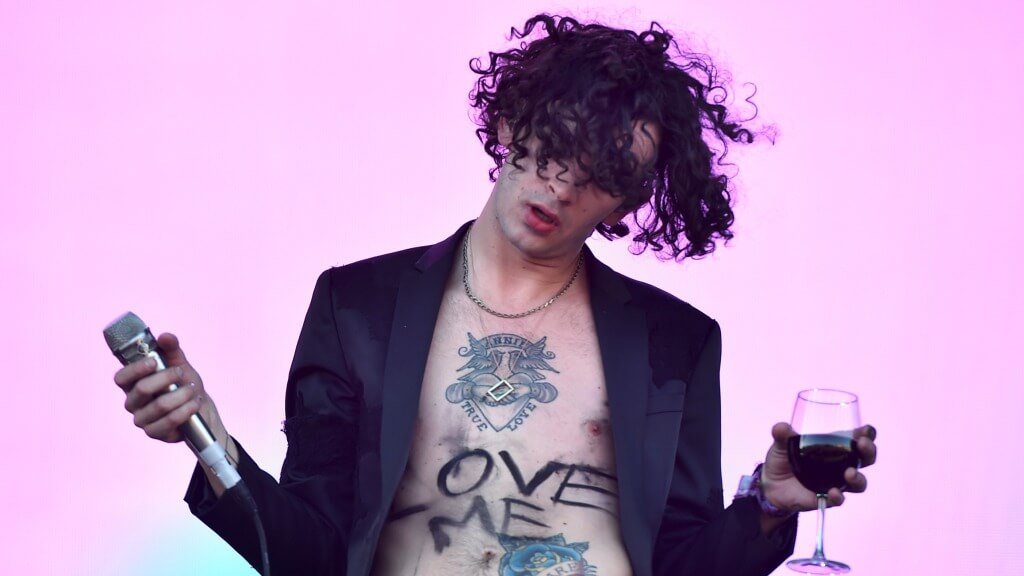
I’d been a devoted 1975 believer since their debut, graduating from One Direction standom to align my identity and personality with a grungier, scuzzier group of British men. Almost like One Direction Warios. Stills from the “Sex” music video came up on my Tumblr dashboard one time my freshman year of high school, and I was forever changed (and I’m still certain their stage lighting going viral on the platform kickstarted their ascent). I was a questionably young audience member at their Terminal 5 run a year later, bearing direct witness to frontman Matty Healy’s flailing, bottle-of-red-deep on-stage persona that, at that point, wasn’t really a persona so much as a guy already teetering on the verge of not okay. But the years of Topshop Jamie jeans, American Apparel skater skirts, smudgy eyeliner, and the T1 VSCO filter were good to me. Probably a little too good. 

A half hour into their 2025 live album Still… At Their Very Best, Healy baits the crowd: “Don’t be nostalgic… don’t do it!” Manchester’s AO Arena coos knowingly at the opening melody of “A Change of Heart,” the first song in their set from the band’s sophomore LP, I like it when you sleep, for you are so beautiful yet so unaware of it

Unfortunately, being nostalgic is one of my favorite things to do. And few albums hit my water sign romanticizer core harder than I like it when you sleep. There’s just nothing like being 16-going-on-17, a fresh junior license glistening in your hands, the new CD from your favorite band soundtracking your earliest drives around your hometown. I knew how formative it was as it was happening: screaming along to “Love Me,” lyrics already memorized an hour after it dropped; whipping across three lanes of traffic to the tune of “She’s American;” unknowingly playing my mom a song about Healy’s recurring coke problem (“UGH!”); going 30 over the speed limit on a solo beach drive to belt out “The Ballad of Me and My Brain” in peace. It feels sorta last-chopper-outta-‘Nam of me; teendom before the age of complete brainrot.

In recent years, the 1975 have treated themselves more as a legacy act than anything else. Their At Their Very Best tour, coupled with their most recent studio LP (2022’s Antonoff-pilled Being Funny in a Foreign Language), feels like both a swan song and a reintroduction. Healy’s always been almost painfully self-critical, poking fun at past and present versions of himself throughout his lyrics. But ten years down the line, he’s criticizing versions of himself we all saw firsthand. The opening track on Being Funny includes the line “You’re making an aesthetic out of not doing well and / Mining all the bits of you you think you can sell,” which immediately makes me think of Healy at those earliest shows, drinking on stage to the point of blacking out, slurring across his already mumbly lyrics, at times carried off-stage by his bandmates. He was smoking heroin and doing coke, and would end up going to rehab at the end of the ILIWYS tour (he’d then use again before quitting cold turkey a year later). 

And that’s not necessarily Healy romanticizing his addiction; it was just how he was showing up in front of his impressionable, mostly teenage audience at that time. And the fans, for better or worse, ate it up. Ate him up as a frontman, idolized him in all his disarray, and took his instability as authenticity. Healy was vulnerable and untethered, and we felt like we knew everything about him. Life’s a bitch, and this guy sure thinks so, too. He gets it. He has real problems, problems so real we can’t even really understand them, we just know he packages his emotions in such a heightened, almost melodramatic way that directly speaks to our volatile teenage existences. The yearning, the commiserating. We can all be horrible and unhappy together. The “Robbers” music video had us swooning over a guy actively holding a loaded gun to his girlfriend’s head, and before people were self-diagnosing on TikTok, we were on Tumblr hosting the Fandom Depression Olympics: Well, how many times has “Antichrist” made you want to end it all? But did you cry after losing your virginity to “Sex”?? Healy’s lack of on-stage inhibitions mirrored the cathartic emotional release that traveled through the crowd, shouting along to lines like “Now everybody’s dead!” or “And it’s not my fault / That I fucked everybody here!” like mating calls that we couldn’t exactly relate to on our own, borrowing Healy’s edge and grunge that defined so much of the band’s early catalog. 

THE 1975’S LORE WAS just starting to bubble in the I like it when you sleep era, which capitalized on the cult following that came with their debut by pink-ifying their signature black-and-white rectangle aesthetic and treating the release like a secret (hence the unsolicited postcards teasing song titles). The album is built on self-reference, doubling down on the group’s lore and mythology, Healy’s identity and persona continuing to blur together. 

I like it when you sleep starts with a reinterpretation of their debut opener, “The 1975,” a kind of band theme song (each album since has included the self-titled opening track), giving off the feeling that you are stepping into an experience when you press play on a 1975 album. There’s an inherent nostalgia built in, using familiar chord structures to create a knotty, twisted web between different branches of the 1975 discography. “Lostmyhead” repurposes a melody line from the debut deluxe track “Facedown,” and I can distinctly remember the “wait, am I psychic?” feeling of already singing along to it on my first listen. “A Change of Heart” calls back to lyrics from debut tracks “Robbers” and “The City” (“You used to have a face straight out of a magazine / Now you just look like anyone” and “I never found love in the city,” respectively), establishing a sort of 1975 Sonic Universe for fans to unpack and analyze.

The 1975’s vision has always involved forging connections in the midst of upheaval and chaos, and their acknowledgement of that chaos has only grown more pointed. On I like it when you sleep, it’s done via verbose, rambling half-joke lyrics set to ‘80s funk synthwave pop, bridging their catchy debut sound and the experimental edge to come. There’s a second-album-ness to it that can border on cliché, the predictable acknowledgement that fame is weird and can mess you up a little. (The music video for “The Sound” unsubtly depicts the band performing inside a glass box, a spectacle for others to judge, while their performance is cut with quick-hit critiques across a pink background: vapid, derivative pop; pretentious; unimaginative; annoying.) But Healy is often so lyrically witty that he gets away with it. Lead single “Love Me” is a funk-forward word salad (“Karcrashian panache”) about being scrutinized and fawned over, set to Adam Hann’s bright guitar tones, Ross MacDonald dancing across the bass, and George Daniel’s steady backbeat. Healy dissects not only his own rise to fame but also those of his newfound peers, going so far as to surround himself with cardboard cutouts of Harry Styles, Mr. Bean, Ed Sheeran, and Elvis, among others, in the music video. “You look famous, let’s be friends and portray we possess something important,” he sings, almost prophetically, to Charli XCX’s cutout in that addictive descending drawl.

Later, on “The Ballad of Me and My Brain,” Healy wails about physically misplacing his mind. Where’s it gone? A car? A train? A Sainsbury’s? He’s interrupted by an onlooker (“And would you sign an autograph for my daughter Laura? / Cause she adores you / But I think you’re shit”); someone is always trying to get something from him. It’s about fame, yes, but it’s also about any situation where you feel out of body, where you don’t recognize yourself, where you could’ve sworn you had it all together, but then one thing happened, and you’re left on your hands and knees, blindly patting at the ground looking for your psyche. There’s a desperation in his voice bolstered by Daniel’s booming, syncopated drums, adding to the track’s sense of urgency. The hopelessness extends outward on “If I Believe You,” as Healy looks to a higher power he doesn’t believe in for reprieve or guidance, to fill the “God-shaped hole” in his chest that leaves him scrambling, scattered, and overwhelmed by the banalities of existence. The repeated “If I’m lost, then how can I find myself” hits a little harder after he begs through the opening verses. Healy rationalizes with God, stating plainly: “If it was you who made my body / You probably shouldn’t have made me atheist.”

Healy channels that devotion when writing about drugs, bringing some of his sharpest, most self-aware analyses. “Do you have a card? / My irregular heartbeat / Is starting to correct itself” on “UGH!” left little to the imagination, while subtler lines like “I said I’m done, babe I’m out of the scene / But I was picking up from Bethnal Green” on “Paris” sneakily weave themselves into the rest of the album’s narrative. On “The Sound,” he calls himself a junkie in passing, tacking it onto the end of a list of his other traits: “sycophantic, prophetic, Socratic, junkie wannabe.” 

THE MOST OUTWARDLY political track on I like it when you sleep is “Loving Someone,” a wordy and rhythmically intricate talk-rap track that the band performed under rainbow lights on the ILIWYS tour. On their Live from the O2 album, recorded a month after the 2016 election, Healy introduces the song by saying, “I’m not here to talk about politics, we’re not here to think about politics, we’re here for a release, we’re here for some music.” Someone in the crowd yells, “Fuck Donald Trump!” which kicks him into an impassioned, two-minute monologue on turning anger into empathy: “I know it’s very sad to see all of these young voices of progression and change being drowned out by regressive ideas and bullshit… But it’s also about a lot of these people who voted against what we stand for; they feel so disenfranchised by both sides of the political system… It’s our responsibility to be compassionate, to listen to everybody, to listen to their concerns and move things forward.” 

The song’s narrative became even more relevant in the wake of Trump’s election, speaking to the rigged systems for disseminating information meant to cause harm and keep people from questioning the world around them. (The song is like the slam-poetry version of Healy’s lead-in speech: “And disenfranchised young criminal minds / In a car park beside where your nan resides / Are not slow, they’ve just never been shown”). When the song ends at the O2, Healy cuts the tension before kicking into “She’s American”—“Fuck politics, let’s do some dancing.”

Even the most straightforward tracks on I like it when you sleep—the ones that shot the 1975 further into the mainstream and/or have entered the canon since—have something about them that makes you do a double-take. “She’s American,” which is little more than one big diss track for their American audience (or, depending on who you ask, specifically for Halsey), drops the phrase “proper weird” in the middle of the bridge. It’s such simple phrasing that it almost sounds out of place on the same album as a line like “Charlatan telepathy exploiting insecurity and praying on the purity / Of grief and its simplicity.” Meanwhile, the moody, midtempo “Somebody Else” is built on lyrical parallelism that haunts me to this day. There’s just something about “I’m looking through you while you’re looking through your phone” that makes my spine tingle. The synths curl and loop with Healy’s lush vocal delivery, so the melody feels like it’s circling itself. It’s countered with some more blunt, simple phrases, though “Fuck that get money” isn’t necessarily my favorite bridge, sitting somewhere on the “proper weird” side of the lyrical spectrum.

Healy’s wordiest lyrics are delivered with a phrasing that never makes them feel overstuffed, even if it takes a couple of listens to fully get what he’s saying. Between the repetition on the shimmery, unassuming dream-pop “This Must Be My Dream,” Healy sneaks in the backhanded “Well I thought it was love / But I guess I must be dreaming / ‘Bout feeling something instead of you,” while a song like the mellow bop “Paris,” sitting tucked away in the second half, is packed with blink-and-you-miss-it moments. You’re so focused on “Hey kids, we’re all just the same, what a shame” that you completely whizz past the “There was a party that she had to miss / Because her friend kept cutting her wrists / Hyper-politicized sexual trysts / Oh, I think my boyfriend’s a nihilist” that comes before it. Packs a much bigger punch than fan-favorite “Babe, you look so cool” off debut standout “Robbers.” 

I like it when you sleep is long-ish, albeit not necessarily by the 1975 standards. The deluxe debut—which, real ones know, is its true form—has almost 40 songs. Despite their sophomore effort being only 17 tracks, it feels longer when you consider that almost 20 of its 75 minutes are used up by ambient, trancey meanderings that only start to hint at the glitchy techno moments that would become fully realized on their next record, A Brief Inquiry. The Brian Eno-cosplaying “Please Be Naked” and the wandering title track pale in comparison to “Lostmyhead,” the best in the album’s instrumental triad. The guitar’s phasers chase each other in cascading falls. When the beat finally breaks open, it feels exactly like the David Bowie “Heroes” needledrop in The Perks of Being a Wallflower, that same kind of euphoric release. Each of these tracks offers a moment for patience and contemplation. Similarly to their debut’s piano-only closer “Is There Somebody Who Can Watch You,” I like it when you sleep ends on two acoustic tracks, “Nana” and “She Lays Down,” written for Healy’s grandmother and mother, respectively. These tracks serve the same purpose as on the debut: letting the dust of the preceding craziness settle, grounding itself in the themes of home and family, allowing Healy to return home and recalibrate his center after the rush.

I like it when you sleep is indulgent, yes, and occasionally bloated. It’s verbose and sometimes self-satisfied. But it’s also self-aware, constantly folding back on itself, repurposing melodies and calling back to old narratives as it builds its own mythology. The sprawl makes more sense when you hear it as the sound of a group figuring themselves out as the world watches, mistaking instability for identity, and selling it back to us as connection. 

IN THE YEARS SINCE I like it when you sleep, the name Matty Healy has become synonymous with controversy, conflict, and misunderstanding. Lesser things like eating raw meat on stage and making out with fans sit alongside his very public beef with fellow artists, many of them women of color, like Rina Sawayama, Ice Spice, and Azealia Banks. He’s toed the line of cancellation for years, tweeting the band’s song “Love It If We Made It” (which includes the lyrics “Selling melanin and then suffocate the Black men”) beneath a post speaking out against George Floyd’s murder, which prompted accusations of him using the BLM movement as an opportunity to self-promote. When performing that same song in 2023, he flashed a nazi salute when singing the Trump-quoting lyric “Thank you, Kanye, very cool,” bringing on a frenzy of debate around his intentions. His apologies would often sit squarely between “Sorry you misinterpreted me” and “Sorry I said that.” 

He’s since established himself as a kind of post-woke, realist liberal figure who would rather disengage and make TikToks for Dax Flame than risk being misunderstood. That in itself, though, is its own kind of controversy—his ability to step away or ignore is a privilege, albeit  also a bit of a lose-lose situation. But at a certain point, he decided it was best to disengage entirely (“Having manic episodes on Twitter at 35 is kinda pathetic,” he posted in 2024). 

Healy’s now in his STFU, California-sober, lounging-with-his-model-fiancée period of life, coming out from behind the mask of this brash, over-the-top persona that he’d spent the previous decade crafting—the persona that, at one point, was more or less him. I think of Healy now as a person who will say one profound thought for every five impulsive, half-baked ideas he lets escape his mouth. Like how that clip of him talking to Zane Lowe about artists who monetize fan connection recirculated during Harry Styles’s recent ticket-pricing fiasco: “Do it where it’s 20 quid a meet-and-greet, and every single fan, before they touch you, go, ‘Lemme see that 20.’ You’ll do it for two minutes and you’ll never fucking do it again, because you’ll realize it’s disgraceful.” He really used up all his sense-making brainpower for the year with that one!

I like it when you sleep has aged better than I would’ve expected at the time. Compared to the records to come—the tech-political heavy A Brief Inquiry; the expansive, if unfocused, Notes on a Conditional Form—it’s simultaneously more and less on the nose. As time’s gone on, we’ve seen Healy address this era of his life and the band. A Brief Inquiry’s “Give Yourself A Try” is set up as talking to his younger self, Healy warning 2014-him of the downward spiral to come (“And you’ll make a lot of money, and it’s funny / ‘Cause you’ll move somewhere sunny and get addicted to drugs”). It’s a sharper interrogation of his own life, an autobiographical reckoning, rather than something like “Love Me,” which looks outward in equal measure.

The way Healy chronicles his life through his music allows us to track not only his mental and political evolution but also his personal evolution across the 1975 discography. His situation during I like it when you sleep is expectedly clearer in hindsight: mid-20s, mid-addiction, mid-achieving something he’d been working toward for almost a decade. The record teems with coming-of-age themes that are even more relatable for the 1975’s audience who feel like they’ve gone through all of Healy’s problems with him, as much as he’s gone through all their problems with them. That parasociality is at the core of what it is to be a 1975 fan.

Looking back on the music of your teenage years can be embarrassing. Lyrics that once seemed groundbreaking to you can now seem trite and corny—and that’s certainly the case for much of the mid-2010s indie rock that bordered on Tumblr poetry. The 1975 is no exception. But if there’s anything the 1975’s discography has shown us, it’s that you’re never really done growing up. I like it when you sleep stands the test of time as an irreverent, bold, audacious chapter in the history of a band and a frontman that’s since defined a generation of alt online teenagers desperate to find their way. Behind the neon pink haze is an almost unrightfully brave Healy, much too young to be this confident about putting out a record as unabashed and openly confused as this. 

Watch The 1975 play at Stage on Sixth in 2013 below.


Join the discussion...
Keep scrolling for more great stories.