B+

The Agency returns with a taut study in the personal cost of spydom

Michael Fassbender comes in from the cold on the underrated Paramount+ drama.

The Agency returns with a taut study in the personal cost of spydom

It’s hard to be a spy. For every James Bond flick in which the iconic character gets to actually smile, there are a dozen dramas that center the human cost of loyalty to country over personal wants like family, love, or free time. More Le Carre than 007, Paramount+’s The Agency introduced yet another spy whose Achille’s heel is his heart. The first season elevated that stock arc with brainy dialogue and one of the best ensembles in the streaming world, and creators Jez and John-Henry Butterworth top themselves in the second season by rippling their theme across The Agency’s cast of characters, revealing how a spy’s willingness to fall in love can impact an entire office, and maybe even world politics.

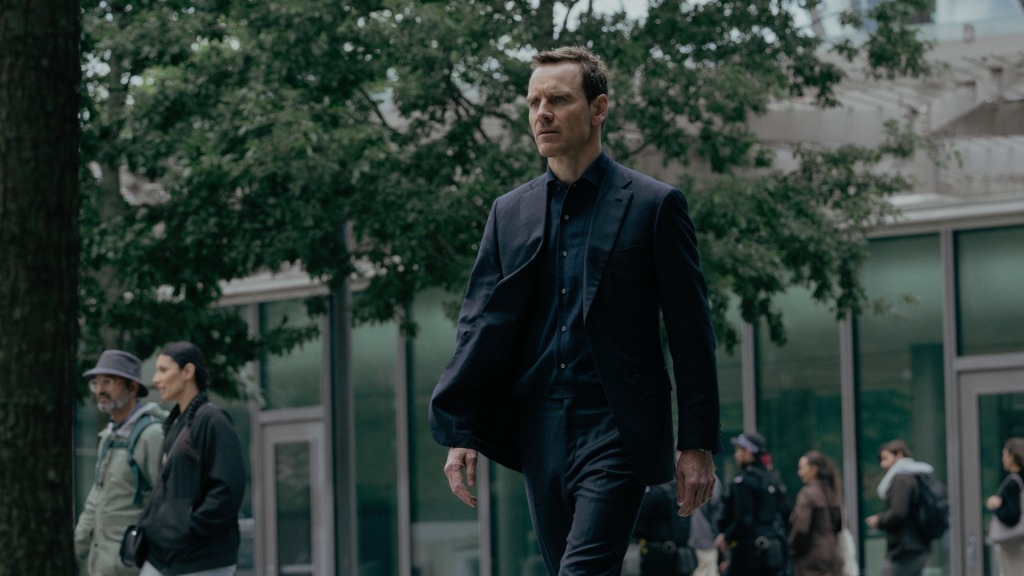
Eschewing the weekly cadence of season one for a binge release, season two picks up with CIA operative Brandon Colby, aka “Martian” (Michael Fassbender) adjusting to being a double agent for the Brits, pushed into this position by MI6 slimeball Jim Richardson (Hugh Bonneville). The British will do everything in their immense power to retrieve Dr. Samia Zahir (Jodie Turner-Smith), Brandon’s lover, from Sudanese custody—but only if Martian does something for them. Probably more than one something.

The Butterworths use Martian’s relationship with Samia as a foundation for multiple arcs this season, most of them about people who have buried their own personalities so deep that anything that forces human emotion to the surface becomes exploitable. The two A-plots force agents to take on new identities as Danny aka “Gremlin” (Saura Lightfoot-Leon) becomes the fake girlfriend of an Iranian power player and Agent Owen Taylor (John Magaro) goes into the field with his own fake relationship in an effort to track the season’s big bad, a mercenary named Viking (Clayne Crawford).

How other key players respond to growing suspicion that there’s a rat in their house feels like a natural outgrowth of the show’s main theme, because the betrayals become personal. When Gremlin herself becomes a pawn in Martian’s game, handler Naomi Ford (Katherine Waterston) and Chief Henry Ogletree (Jeffrey Wright) go into action, both Waterson and Wright deftly finding the right gravity for their roles. The latter’s work serves as a righteous throughline for the season as Ogletree attempts to turn his suspicions about Martian into verifiable facts. 

Some of the discoveries and coincidences in season two might play as contrived if the Oscar nominee weren’t there to ground them, ably assisted by a different kind of world-weariness from Richard Gere as his boss, James Bradley. The two have a clever dynamic in that they’ve both seen it all, but they come at the search for a turncoat with complementary approaches rather than conflicting ones: Gere going with a disappointed sigh opposite Wright’s unshakable furor.

The Butterworths’ sharp writing is helped by a cast capable of selling intellect and immediacy. Fassbender did the work in season one to anchor his character in unflappable love for Samia, and so every action he takes to retrieve her feels truthful. Her safety has become Martian’s most important mission, even if it conflicts with the needs of the CIA, giving Fassbender a no-nonsense approach to the character, one who doesn’t have time for emotion, even if he knows how much his choices are being influenced by his affections. He smartly avoids the melodrama that could’ve sunk The Agency, making the few scenes in which he does let down his guard more powerful.

Even more than in season one, the writing allows for individual performances to shine across the ensemble. The star of First Cow may seem unorthodox casting for a super spy, but that allows Magaro’s performance to stand out opposite the more Bond-esque Fassbender. He’s arguably the MVP of the season as he navigates his undercover assignment to a stunning centerpiece episode that hums with an unpredictable threat of violence. The truth is there are no bad performances here—just the occasional actor straining against an underwritten villain, a product of a show with more than a dozen characters to track across the world, and the writer’s choice to rarely give us their POV.

The intertwining narratives get a bit tangled roughly two-thirds through the season. The Butterworths let some slack into the pace to set up the endgame, but it leads to a few scenes of characters discovering and discussing things the audience already knows. It’s the one stretch of this season where the scope of The Agency feels more like a flaw than an asset, and the first time the show resorts to the common streaming affliction of over-expositing. 

Luckily, the writing recovers for the finale, which brings all of the season’s arcs together in unpredictable ways, building to a great cliffhanger. Once again, Martian has used his training to get everything he wants, ignoring orders and international law to do so, and The Agency ends its second season on a variation of spy fiction’s defining question: At what cost?

 
Join the discussion...
Keep scrolling for more great stories.