MC: It was very complicated. Because I’m crazy and I follow all the chatter online, I thought it was really interesting. A lot of it was very well-informed, some of it was totally misinformed, but I don’t think, if you’ve only experienced that film previously on VHS or Blu-ray, because of the technology at the time those were created, it didn’t look like how it looked when it showed theatrically in 1999. The new Criterion master is far more accurate to how the film looked theatrically, which was very grainy. Basically, he force-developed the entire film, which is crazy. If you’re losing light, you would try to push it, but that would be for a scene or two, not for an entire movie. And there’s the fact that he died before it was totally finished. There was only a temporary color-correct done by the editor, Nigel Galt. That work print no longer exists. It was destroyed. So we had to go to Warner Bros.
I think the misconception, at least with the naysayers, was like, “Oh, Criterion just took this film and did whatever they wanted.” And it’s totally untrue. I mean, first of all, Criterion [uses] sublicenses, so they don’t have the authority to do that. But when the 4K scan was made, it was matched in terms of the color-correct to an archive theatrical print that Warner Bros. provided. By the time we took the master to London, it had already had a color grade. Larry Smith, the cinematographer, helped us make sure the balance was right, make sure it wasn’t too grainy, and made sure the HDR wasn’t ridiculous. You could do crazy shit with HDR. I was shocked. Just as an example, at the party scene at Ziegler’s at the beginning, you could crank the HDR so high, you could actually see the bulbs in those fairy lights. It’s amazing how much information is in a 35mm frame. So you could go way over the top with that. Larry helped us get it in the range that he remembered.
There were also some minor things: When the film originally came out in theaters, there was one shot that just drove Larry crazy because in Ziegler’s bathroom, you see his focus puller reflected in the chrome. That was like a knife through his heart. They ended up fixing it subsequently, but we scanned from the original negative, so it was there. He wanted to make sure that was taken care of.
AVC: Did you have to paint it out in a way that he approved of?
MC: Yeah, that’s exactly what they did. When they did it the first time, I think they pulled some of the prints, and then there was some sort of photochemical thing that they did to erase it. It’s not on the old videos, and it’s not on the DVDs and old Blu-rays. It’s much easier to do now.
AVC: That’s so funny that he was still thinking about it, or that he still remembered to catch it.
MC: He told me that he had seen the film once, probably at the premiere, and it just killed him.
I talked to Nigel Galt, the editor, and I talked to Larry Smith separately. They hadn’t spoken in almost 30 years. I asked them each what they thought of the old master and what they thought of the color-correct, and they had almost identical things to say. Basically, they were like, it’s largely correct. It wasn’t the night scenes that caused them problems, it was like the daylight scenes, because there was enough light, so you wouldn’t need to force-develop the daylight scenes. So if you’re force-developing the entire thing, it all just looked too bright to them. It was work. I ended up going to London and we did a lot of the work over there with Larry. In the end, I’m really proud of that one. I think it turned out really beautifully.
Criterion, to their credit, I think the way they grade things and the way they like to release things is they like it to look filmic or they grade things along a filmic curve. Eyes Wide Shut is a really interesting example of how that could work in the digital realm, because the grain isn’t mushy. It’s very fine. And it’s very in-focus. I mean, all of Kubrick’s films, I mean, he was obsessed with focus. He was a master at that. But I think for a film on 4K, Eyes Wide Shut looks incredibly filmic.
AVC: I’m excited to crack into that one. I’ve only gotten into the early documentaries so far, because I hadn’t seen them before. Even those pop.
MC: They look amazing. Weirdly, the shorts were kind of the trickiest [films]. That was the biggest challenge. It almost wasn’t a complete Kubrick because of the shorts, because he was working totally independently, so the rights around that stuff was very gray. We had to clear certain things. And the other thing—this was important to me, and it’s important to other people, certainly important to Criterion—is that if we’re going to reinforce the completeness of this set, well, Stanley Kubrick’s very first film, Day Of The Fight, actually exists in two versions.
AVC: I saw that, there’s the RKO version.
MC: Correct, so the short version has never been on 4K before. The Library Of Congress at the time wasn’t exactly sure if they even had the correct elements for that. I said, “Well, we have to have that, because it is different.” When he sold it to RKO, they re-edited the film and they added footage that Kubrick didn’t shoot and they changed the soundtrack and narration around. The Complete Kubrick presents both of them, so this is the very first time that Kubrick’s first film has been presented in 4K. It reinforces the completeness of the set.
AVC: The colors in The Seafarers are staggering.
MC: I know, it’s shocking. That was also struck from the original negative. We got in touch with the rights holder and made a new transfer. It’s Stanley’s first color film. I’m sure that when it was rediscovered in the early ’70s, because it was a work for hire, I’m sure he was just like, “Oh, what? I thought that was at the bottom of the ocean.” But it’s a beautiful film, photographically.
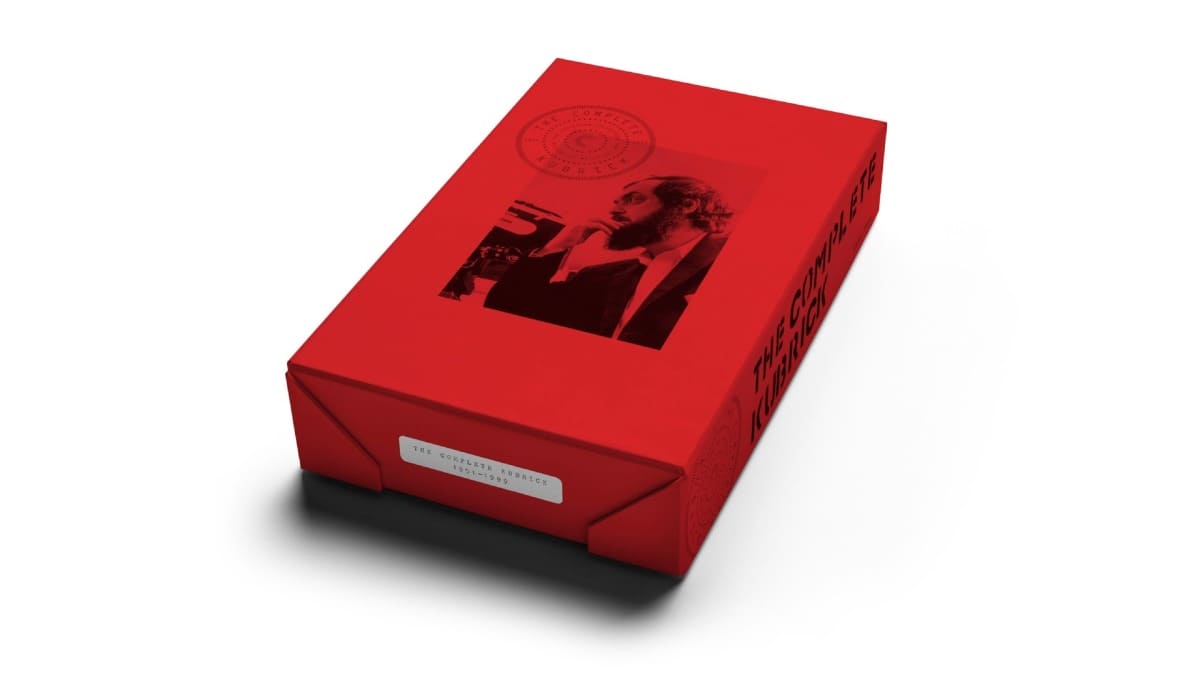
AVC: Let’s switch gears. I saw a featurette where you talk about taking font inspiration from his archives, this sort of military surplus aesthetic, as well as Kubrick’s custom-designed boxes. Was there other stuff from his archive where you were thinking “Oh, I’ve gotta put this in there?”
MC: The art was very collaborative. When they brought me on, my job was to figure out what could these additions be? What would be additive? Because, like we were saying, a lot of these past editions [of these films] are excellent. So it’s like, what else could we add to that? The conversation around the art, we were simpatico. Eric Skillman is co-art director at Criterion, and he brought on Drusilla Adeline to do the graphic work. It was in, maybe the second meeting when we were talking about the artwork and the look of it, and Drusilla said, “Oh, there’s this documentary.” And I was thinking the same thing. “There’s this amazing documentary called Stanley Kubrick’s Boxes by John Ronson. Could we use that as a way in?” I thought it was a great idea.
The other thing too is those Taschen [Kubrick] books have been so influential. When I started working on Eyes Wide Shut, I immediately got in touch with Alison Castle, who is the editor of The Stanley Kubrick Archives book, and she was so helpful, because she was working in the Kubrick archive shortly after it got to the London School Of Communications. She had a lot of material that was very helpful to me, particularly for Eyes Wide Shut, but also for other elements of the box. And I love those books.
Since Stanley’s passing, that’s the way we’ve gotten to know him, is the opening up of the archive. I got to spend some time there, and I got to know the curator, Georgina Orgill, pretty well. It is such a staggering visual account of his working life. So the idea was, well, can we incorporate elements of that into this box? Messy, but at the same time very formal.
I just got the box yesterday, and I hadn’t seen the final version yet. It’s a very beautiful object that has this elevated messiness to it, which is kind of an Army surplus thing. I mean, I think Stanley thought of himself in some ways as a general, making these films. And when you see his boxes with the stenciled letters, it feels like he was running a military campaign to create these aesthetically beautiful things.
AVC: That’s in the script pages that are paired with each of the discs. They’re taped over, they’re scratched out, they’re like collages. You can see the evolution that turns into something super pristine.
MC: You’re getting a taste of it in the box set, but when you’re sitting in the archive and you’re seeing these scripts, it’s iteration after iteration. His hand is all over everything. The script was never a finite thing. It was constantly being worked and reworked to get to where they needed to be. And at some point, like, with Eyes Wide Shut, they totally went off the script when they needed to.
The script, obviously, was the launching point, but Stanley liked to do a lot of rehearsals and he did a number of takes to see, “Can we push this? Can we move this beyond where we are on the page to some other thing that we haven’t or I haven’t thought of?” I hope that comes across, that there is a human element to these perfect, pristine things… Stanley would bristle when people would call him a genius. His wife Christiane would say he hated that. He just hoped he was good.
Stanley wouldn’t talk about his films. That presents certain challenges when you’re doing a box collection. Any other director, you’d find some great interviews, which you could add to the set. Stanley felt like there’s no need for that. One of his quotes was like, “If a film needs an introduction, there’s already something wrong with it.” He felt like these things were kind of perfect in and of themselves, that anything he added or anything he said would only detract from that. He wanted to let the work speak for himself.
AVC: Tapping into your other life as an archivist, you work with archives that are massive and legendary, like Bob Dylan’s and ones that are still in the process of growing, like the Safdie brothers’. How does Kubrick’s compare with the others you’ve worked with?
MC: Obviously we’re talking about two different mediums, but with the Dylan archive and the Kubrick archive, they’re very similar in a lot of respects. Two completely separate fields, but certainly the relationship to fame is very similar. They shunned it. But the thing that shocked me most about the Dylan archive is also present in the Kubrick archive, and it goes back to what we were just talking to: The amount of work is staggering.
This stuff didn’t come to these guys fully born. You’re talking about draft after draft, iteration after iteration. Dylan’s hand is all over his song manuscripts—the stuff in the ’60s probably came to him a little bit quicker, but into the ’90s and 2000s, he’s revising constantly. Even the early stuff, there’s constant revisions. It just shows that whatever talents these guys have, whatever brilliance they have, they definitely met that halfway with the amount of work that they put in.
This interview was edited for length and clarity.


 Keep scrolling for more great stories.