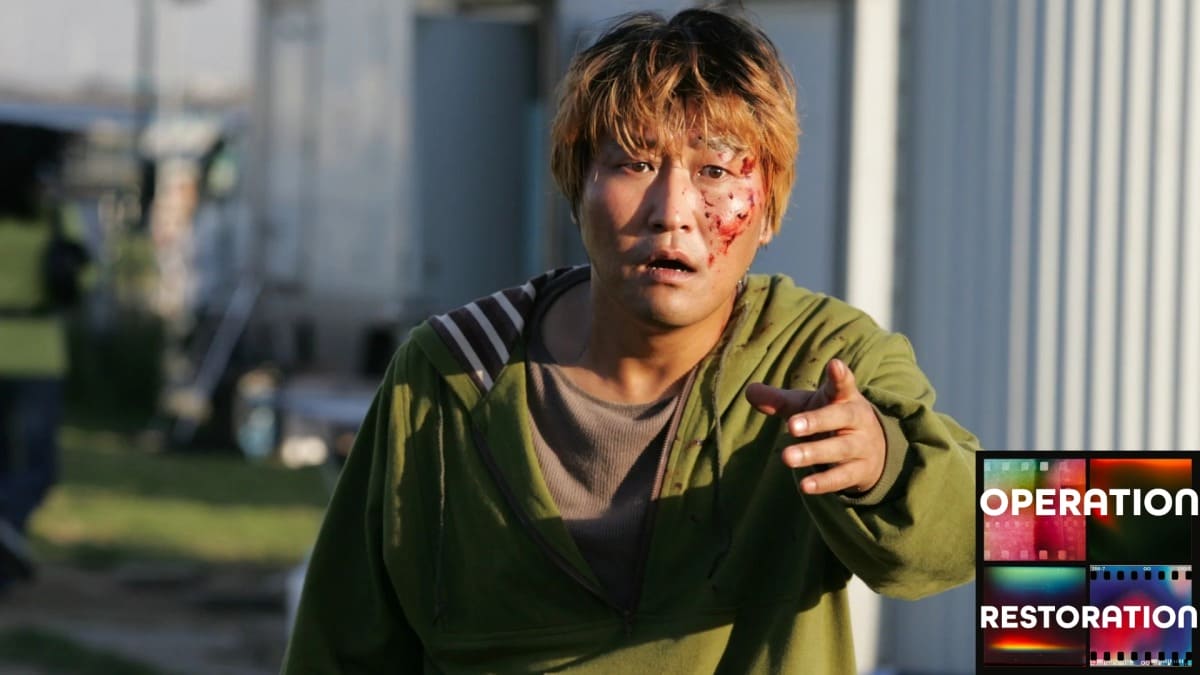
Bong Joon Ho says The Host has taken on a new COVID-era poignancy

As a new 4K restoration hits theaters for its 20th anniversary, the director shared the monster's Fargo connection and its thematic longevity.

Bong Joon Ho says The Host has taken on a new COVID-era poignancy

Before introducing the world to the pillbug-like creatures of Mickey 17 or the adorable beast of Okja, Bong Joon Ho imagined a much more horrifying creature that lurked just out of sight near the banks of Seoul’s Han River. The monster, a product of human pollution, rises out of the murky waters of The Host, wreaking havoc on the area, before kidnapping schoolgirl Hyun-seo (Ko A-sung) as her father, Gang-du (Song Kang-ho), watches helplessly. As he and his relatives launch a rescue mission to retrieve Hyun-seo from the monster’s lair, they must first contend with the government’s buffoonish response to the crisis. 20 years later, The Host‘s insightful look at environmentalism and government disinformation has only grown sharper as humans continue to destroy their planet and the global response to COVID-19 left much to be desired.

For its 20th anniversary, Magnolia Pictures is releasing a new 4K restoration of The Host, supervised by Bong and cinematographer Kim Hyung-ku. When he was revisiting The Host for its restoration, Bong tells The A.V. Club that he intended to keep the film’s original grainy look. “Back in 2006 when the film was released and made, most films were shot and shown in 35mm,” he said. “Nowadays, most films are digital, but the goal of the restoration was to restore that texture of film. It’s ironic that we are doing that process digitally, but nonetheless, that was the goal to restore that feeling of seeing this pristine 35mm print on the first day of release.”

The effect is a sharper image quality without too much polish, which includes the CG creature effects. “Nowadays, many more people have access to that kind of technology,” he says. “You see in personal Instagram accounts, CGI of little creatures. I believe that CGI has just gotten more ingrained in people’s lives now. Even [after] the 20 years have passed, the monster in this movie still looks very weird and strange and quite unique.”

The Parasite director took inspiration from some likely and unlikely sources when imagining his fishy villain. “The idea first came from this deformed fish that I saw in the news where it was found in a polluted river. The fish had a spine, a back that was bent, weirdly bent,” Bong remembers. “Seeing the news, it kind of broke my heart, but at the same time, it scared me. That’s the first idea that I delivered to the creature designer. The story necessitated that the creature was able to run on land. It couldn’t just live inside the water. It wasn’t a monster like in Jaws where the creature could just stay in the water and is essentially trapped inside the water. The creature had to be able to run around the riverbank and knock over people.” 

When looking for a way to characterize the fish monster’s behavior, Bong took inspiration from a Coen brothers movie. “I was quite inspired by Steve Buscemi, especially in Fargo,” he said. “In Fargo, there’s a scene where Steve Buscemi gets accidentally shot in the face, and he’s frantic and angry and frustrated. He has the pieces of tissue trying to stop the blood. That was the kind of feeling I was trying to portray because the creature was supposed to have this kind of sickly feeling—the creature was supposed to be in bodily pain. When you’re in pain like that, you naturally become very angry and annoyed and frustrated. We talked about Steve Buscemi a lot when we were designing the creature, and we actually had a photo of Steve Buscemi on the wall in the design room.” Although Bong finally met Buscemi at the premiere of Mickey 17 in New York, the director has yet to tell the actor about the influence on his career. 

When Bong began writing The Host back in 2004, environmental issues, like the malformed fish, were already on his mind, and have continued to inform his work on movies like Okja and Mickey 17. “It’s becoming increasingly harder to catch up to what’s happening in real life,” Bong says of climate change. “That’s the part that’s very terrifying to me. I have a son, and when I think about future generations, it worries me a lot [about] what’s happening nowadays.” 

The original timing of The Host also coincided with the SARS epidemic, which influenced the film’s storyline about the government’s response. “Very recently we had another virus epidemic, and very recently I had a chance to re-watch the film again, and it felt much more prescient after having gone through the COVID epidemic,” Bong says. “When I was writing the film, it was the SARS epidemic, but it felt differently after going through yet another pandemic.'” 

“After 20 years, the film hasn’t changed, but our perspective of seeing the film has changed. Obviously, history repeats itself and human beings repeat their mistakes, but we’re still here, still surviving. To see the film again, it kind of reminds me that we are also repeatedly trying to prevent our mistakes and trying to get better. I try to be optimistic about it.”

Revisiting the film after two decades also brought Bong a new appreciation for one of the film’s actors, Byun Hee-bong, who played the Park family’s grandfather. “He played a character that was sort of the spiritual leader of the family, kind of like Gandalf in Lord Of The Rings, and he had this exceptional performance in the film,” he says. “I miss him very much re-watching the film. He’s not with us anymore, he passed away three years ago around this time of the year. There are other actors who played smaller parts who are not with us anymore. I just wonder if this is what time does to us. Time is 20 years passing. A lot of people that we loved and cared about leaving us, but obviously, that’s just the course of nature.”

To see more of The A.V. Club’s film coverage, add us as a preferred source on Google. 

 
Join the discussion...
Keep scrolling for more great stories.