In 2010, David Fincher’s The Social Network helped immortalize and mythologize the Silicon Valley success story of Facebook and the messy, dramatic rise to power of Mark Zuckerberg. Aaron Sorkin’s Oscar-winning script was a crucial element in the movie’s success, but in his quasi-sequel The Social Reckoning, Fincher’s stylish craft is sorely missed. Instead, The Social Reckoning looks closer to Sorkin’s TV projects, like The West Wing and The Newsroom, where important people make important speeches, spilling out all their exposition around various tables.
Years after the events in The Social Network, Facebook is now one of the largest social platforms in the world, with over 2.8 billion users in 2019. A member of the company’s civic integrity team, Frances Haugen (Mikey Madison), struggles to raise her questions about the algorithm’s propensity to filter users towards extremist groups. In her frustration, she turns to Jeffrey Horwitz (Jeremy Allen White), the new reporter at the Wall Street Journal covering Facebook. She warns him that something’s wrong, but won’t give him the smoking gun documents or go on the record to substantiate his reporting. After further digging though, Frances discovers even more damning evidence and decides to become a whistleblower. Meanwhile, Zuckerberg (Jeremy Strong) is preparing for a congressional hearing, just as these new reports—which the Wall Street Journal dubs “The Facebook Files”—are about to run.
Instead of The Social Network‘s linear tracing of Zuckerberg’s rise to power, The Social Reckoning uses an onscreen timeline to flit between 2019, when source first meets reporter, to 2021 when the investigative series comes out—not long after the January 6th riots in the capitol, which Sorkin recreates. It’s sometimes distracting how often the timelines switch, especially since Zuckerberg’s segments are the weakest in the movie. The intrigue and dramatic tension of uncovering the story behind Frances and Jeffrey’s suspicions drives Reckoning far better than the odd set-up of Zuckerberg preparing for his hearing alongside harried crisis managers and a former confidant.
This structure sees Sorkin go back to what he knows and has done before, making The Social Reckoning feel, at best, like a punchy two-hour episode of television. It’s a journalism potboiler with dramatically goofy dialogue that wouldn’t be out of place in The Newsroom, and the “all the king’s men” feeling of The West Wing when it comes to the number of handlers now serving as a buffer between Zuckerberg and everyone else. In order to spur more conversations and exposition, Sorkin sprinkles in heated dramatic explainers between Frances and Jeffrey, and between Zuckerberg and his legal counsel Charlie (Bill Burr). The former is a narrative way to lay out how the algorithm has been warping people’s view of the world, and the latter serves as a pretext for Zuckerberg to explain why he’s letting political ads run unchecked, leading to a spike in misinformation. Supporting characters played by Burr, Wunmi Mosaku as Zuckerberg’s beleaguered crisis PR manager, and Betty Gilpin as Jeffrey’s snappy editor add life around the edges of these conflicts, even injecting a few much-needed laughs.
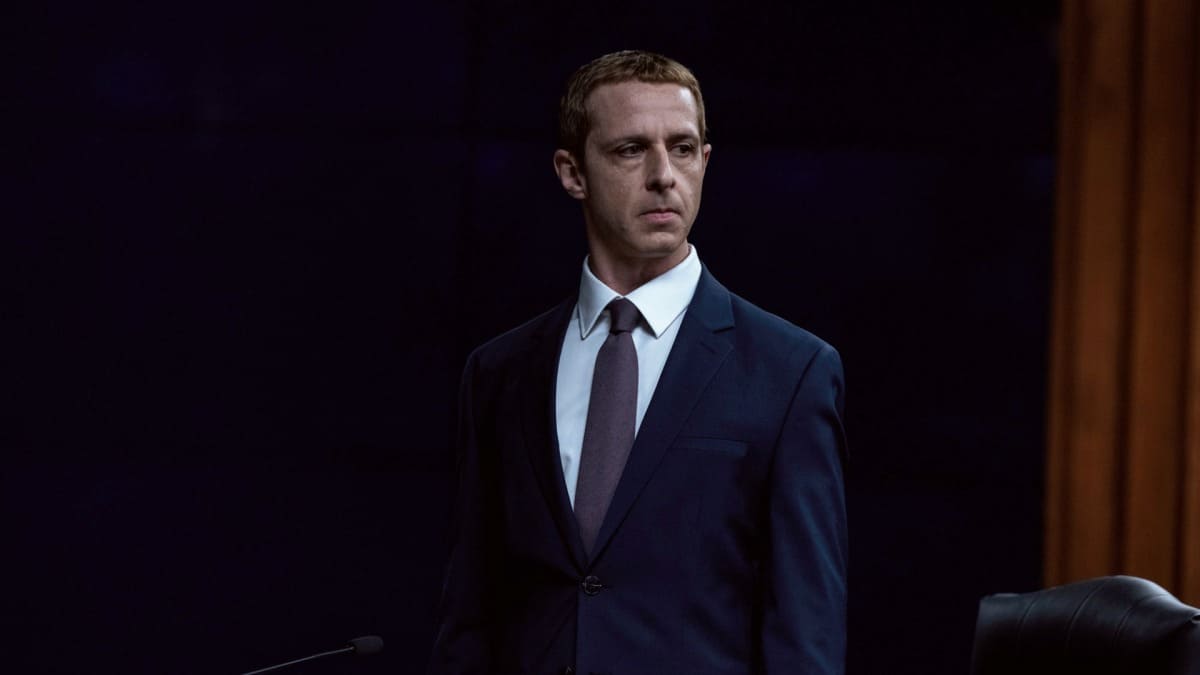
But the characterizations in The Social Reckoning aren’t always fully developed, and in what may be a career-worst performance from Strong, his Zuckerberg seems lobotomized, operating as an automaton with limited responses. Unlike Jesse Eisenberg’s brash performance in The Social Network, Strong looks like he’s been unplugged, uninterested in any aspect of his character’s fiefdom. He takes a hand-off approach to just about anything that isn’t juicing Facebook’s metrics, and it’s reflected in Strong’s sheer lack of presence despite being at the center of a third of the movie.
White, on the other hand, fits in as a laser-focused reporter driving his interns crazy with outsized demands. It’s here where the old-fashioned Sorkin sexism arises, referring to the interns as “intern” and “girl intern” and mounting a weirdly defensive response when Frances chides Jeffrey for mansplaining: “That’s just what women say when they’re losing an argument.” Who knows how long Sorkin has been waiting to lob that line at a female character. For some reason, when visiting Jeffrey at his hotel, Frances decides to dress in slinky dresses as a cover, which I guess is what All The President’s Men was really missing. Madison, to her credit, does an admirable job as the awkward data scientist who loves her company and her work but feels disillusioned by what they’re doing to pursue profits at the expense of their users’ sanity. She gives the most nuanced performance of the film, her character’s internal conflict playing out across her face and residing in her hunched shoulders.
But speaking of his old-fashioned proclivities, Sorkin is so committed to bringing back the past—including fitting in references into old Hollywood musicals like Show Boat—he visually recreates it with cinematographer Jeff Cronenweth. From the black-and-white freeze-frame to the long-winded dialogue scenes that belabour their points to exhaustion, The Social Reckoning is as much in conversation with Sorkin’s larger career as it is with the Wall Street Journal‘s reporting. At best, The Social Reckoning is a tribute to people trying to do the right thing, to journalists fighting one of the largest companies in the world. At its worst, though, the movie is a mess, a film that refuses to say Donald Trump’s name in connection to January 6th, and which overshadows its own damning revelations with dramatic in-fighting—even though the information at the heart of The Facebook Files is just as damning now as it was five years ago.
Director: Aaron Sorkin
Writer: Aaron Sorkin
Starring: Mickey Madison, Jeremy Allen White, Jeremy Strong, Betty Gilpin, Wunmi Mosaku, Bill Burr
Release Date: October 9, 2026


 Keep scrolling for more great stories.