Legend has it that Hollywood starlet Lana Turner got discovered at 15 at a soda fountain. We have it on a daytime janitor’s authority that “Weird Al” Yankovic recorded his first single, “My Bologna,” in a Cal Poly bathroom across from his college radio station. One has been called fate; the other might be viewed as “being in the right stall at the right time.” Still, a bit of dumb luck might be the difference between playing polkas in beer halls on weekends and carving out a nearly 50-year career as the unrivaled (only?) prince of popular music parodies. Yankovic’s singular success does owe a great deal to timing in addition to a knack for novelty, a bizarro brand all his own, and a chameleonic ability as a performer. “Weird Al” blew into town with his accordion just as MTV was exploding in the early ‘80s. Suddenly, young eyeballs were glued to the same songs over and over again, pop stars became global sensations ripe for satire, and music videos created a visual element that a comedian could skewer to promote silly songs. It’s an environment that Yankovic thrived in for the bulk of the ‘80s to the point that fellow artists began considering it an honor to receive the “Weird Al” treatment.
However, by the early ‘90s, it became clear that even an artist like Yankovic, in a genre of one, had to occasionally recalibrate his weirdness to remain relevant. After his first film, UHF—now considered a cult classic—bombed in theaters and fans began using its soundtrack to line their hamster cages, Yankovic found himself in a weird position: hitless for several years. Luckily, 1992’s Off the Deep End restored commercial success by sending up Seattle (“Smells Like Nirvana”), and the following year’s Alapalooza piggybacked on T. Rex’s starring role in Jurassic Park as dinos emerged from extinction to rule pop culture. Despite these successes, both albums felt like “Weird Al” was keeping at least one of his Vans planted in the ‘80s rather than fully stepping into a new decade. In hindsight, parodies of acts like Milli Vanilli, Gerardo, and Billy Ray Cyrus soon felt dated as those artists’ respective stars quickly faded, not aging nearly as well as goofing on icons like Michael Jackson, Madonna, and Kurt Cobain. Go figure.
Yankovic’s record label, Scotti Brothers, also didn’t help him hit refresh, as they embarrassingly flooded record stores with a tidal wave of repackages. A greatest hits box set (fair) and single-disc compilation (still fair) might’ve been warranted after a decade of musical yuks, but even Yankovic cringed as his label grabbed for cash with refried compilations of food and TV songs in 1993 and 1995, respectively. Fair or not, it all added up to “Weird Al”’s act feeling old hat (and not the poodle kind) as he began work on what would become 1996’s Bad Hair Day.
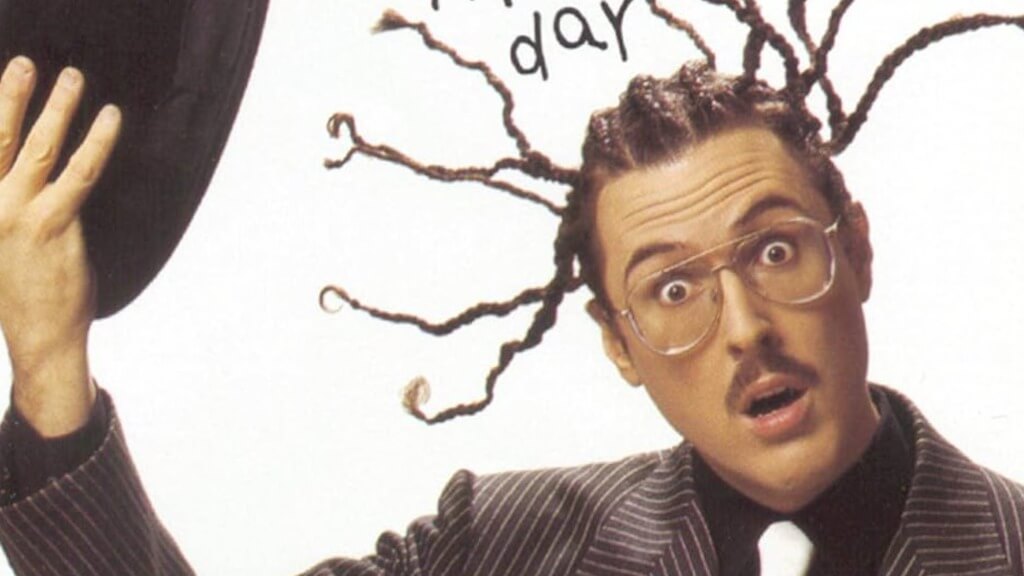
It takes a special kind of weirdness to listen to Coolio’s 1995 hit hood anthem, “Gangsta’s Paradise,” and conclude that the opposite of gangstas are the Amish. And yet, that epiphany would be just what Yankovic needed to thrust himself back into the spotlight. Not since his early days of spoofing “The King of Pop” and “The Material Girl” had all the elements of parody lined up so perfectly. Coolio’s hit gave Yankovic his first serious stab at the booming ‘90s hip-hop genre. By stepping straight outta Lancaster, we learned that “Weird Al” could drop hysterical bars about raising barns and churning butter while creating images that were instantly memorable. Bad Hair Day fully bought into that package with both its title and an album cover showing Yankovic in a pinstripe suit sporting Coolio’s trademark braids. A creature of MTV, Yankovic then merged the visual aesthetic of Coolio’s “Gangsta Paradise” with every Amish gag he could muster for his own iconic video, creating a bearded, finger-wagging Amish MC and a costume change that he still uses in concert today.
Allegedly, a communication mishap between Coolio’s producers and Yankovic regarding permission to do the parody led to some hard feelings on the rapper’s part (yes, “Weird Al” technically had a rap beef), but the damage had already been done. Music’s biggest geek seemed cool again, maybe for the first time since dancing in a fat suit in a subway or singing grunge lyrics with marbles in his mouth.
Like all “Weird Al” albums, the bulk of the attention gets heaped on the direct parodies of popular songs. In the case of Bad Hair Day, “Amish Paradise” definitely could’ve overshadowed Yankovic’s other parodies. Instead, he found success by siccing his silly sensibilities on several songs that still connect us back to mid-’90s radio. On fellow charting single “Gump,” Yankovic recounts the tale of America’s least likely cinematic folk hero through “Lump,” the already-zany hit single from unlikely rock stars The Presidents of the United States of America. Though Forrest Gump had been one of the most beloved films of the young decade, the inspired choice to share a bench with PUSA made Yankovic look in the know rather than simply chasing a trend or chart-watching. On “Syndicated Inc.,” he channel-surfs over to Soul Asylum’s 1995 smash “Misery” to deliver a loving ode to the bounty of ‘90s syndicated television. “Forever I will always be / Glued to my TV,” Yankovic vows over one of the most gorgeous melodies in alternative rock, even adding a poignant accordion solo on the bridge. If couch potatoism usually gets treated like a sickness, “Weird Al”’s tribute makes a case for it being the cure.
Other parodies don’t quite work as well. On “Phony Calls,” Yankovic plays phone police to girl group TLC’s chart-topping smash “Waterfalls.” Even with a Simpsons cameo of Moe threatening Bart with an icepick, the idea of prank calls already felt a bit dated by 1996. However, the further foray into hip-hop and R&B parodies suggested that tapping into these genres more in the future could work for Yankovic, an important evolution that helped ensure he wouldn’t get left behind as trends came and went. The only parody that completely fails to land is “Cavity Search,” a reimagining of U2’s “Hold Me, Thrill Me, Kiss Me, Kill Me” as a trip to the dentist. While Yankovic can be credited for hearing dental drills and other equipment of the trade (not unlike “Like a Surgeon”) in the riffs and electronic elements of U2’s original, the end result, which included bringing in real dentists to drill on real teeth, proved about as funny as an actual root canal.
Yankovic’s polka medleys had already become the stuff of legend by 1996. As he has explained, the tradition gives him the chance to parody a dozen or so hits in a single take. However, no other medley has captured a particular moment better than Bad Hair Day’s “The Alternative Polka.” Equal parts manic polka, crazy parody, and a tribute to Spike Jones’ comedy, the lineup of this medley could have easily been taken from any block of alt-rock airwaves at the time. From the rusty opening strums of Beck’s “Loser” to the stoned final send-off of Green Day’s “Basket Case,” “Weird Al” makes himself right at home in the alternative hits of the Smashing Pumpkins, Alanis Morissette, and Nine Inch Nails, among others. For an artist who had seemed somewhat out of touch in recent years, “The Alternative Polka” placed Yankovic’s pointy finger right back on the pulse of popular music.
After Off the Deep End and Alapalooza, critics and fans alike began defending Yankovic’s originals as often being better than his straight parodies. While the good-riddance doo-wop acapella “Since You Been Gone” gets enough jabs in to earn its ironic punchline (“I feel almost as bad as I did when you were still here”), it’s the fully fleshed-out pastiches (or style parodies) that carry much of Bad Hair Day. The soft-loud dynamics of grunge wannabe “Callin’ in Sick” makes for a funner sing-along than “Smells Like Nirvana,” and the Elvis Costello-inspired putdowns of “I’m So Sick of You” capture the ultimate girlfriend vent with spot-on Attractions backing. If you’re looking for a real prank riot, “I Remember Larry” actually tops the seven-digit mischief of “Phony Calls,” with “Weird Al” showing he can only be pushed so far before snapping. Long after his laundry list of pranks have run out, the song races off into a dizzying denouement, a musical flourish that suggests Yankovic cares more about creating great songs than just cramming in jokes.
However, it’s the bookends of Bad Hair Day, if you lop off lead track “Amish Paradise,” that leave listeners still humming long after the album ends. The suped-up go-kart energy of “Everything You Know Is Wrong” takes us through a slice of “Weird Al”’s life in the colorful, hyperactive style of They Might Be Giants. It’s a runaway tale of rabid wolverines, alternate dimensions, and floating Colonel Sanders noggins that’s full of TMBG Easter eggs and impossible not to sing along to. It’s the type of track that foreshadows an even longer, sillier original like “Albuquerque” in the years to come. If “Everything You Know Is Wrong” plays into the cartoonish side of Yankovic’s personality, then “The Night Santa Went Crazy” taps into the darker side that sits at home alone eating Twinkie weiner sandwiches by lava lamp and dreaming up revenge fantasies of jolly Old Saint Nick going postal. This younger, more-twisted cousin to 1986’s “Christmas at Ground Zero” turns the styles of Soul Asylum into a rampaging Kris Kringle fit for an asylum. Yankovic even later released an “Extra Gory Version” for good, little boys and girls who prefer to see Santa gunned down by the SWAT team rather than merely locked up.
Of course, the saga was still just beginning for “Weird Al” Yankovic. Like Alex Trebek before him, he’d lose the specs, shave the mustache, and grow out the perm following the massive success of Bad Hair Day. The next two decades would see him going full-on Jedi, turning even whiter and nerdier, and partying hard in the CIA. All from the humble beginnings of a college radio station bathroom. Hmmm … Maybe someone will make a movie about it one day. Nah, it’d never work.


 Keep scrolling for more great stories.