When KPop Demon Hunters was released on Netflix in June 2025, conversations almost immediately began in K-pop fan communities about whether the movie’s soundtrack, which is up for an Oscar today, should be considered K-pop. The animated film about a K-pop girl group that moonlights as demon hunters was made in America by a team spearheaded by a Korean Canadian, but it is set in Korea and is rich in Korean cultural detail. In other words, KPop Demon Hunters is a shining example of diaspora storytelling—its soundtrack, too.
Here in the U.S., we have a lazy, racist habit of conflating art from diaspora communities with art from foreign cultures. In 2021, Minari, an A24 film by Korean American director Lee Isaac Chung, was directed toward the Best Foreign Language Film awards category at the Golden Globes. The movie was based on Lee’s life as a young boy in rural Arkansas. It was filmed in Oklahoma and told the story of a Korean immigrant family’s difficulties acclimating to life in the U.S. However, because more than 51% of the film’s dialogue was not in English, it was automatically sorted into a non-English language category. This, despite the fact that a movie like Quentin Tarantino’s film Inglourious Basterds, told predominantly in German and French, was nominated in the Best Film – Drama category in 2010.
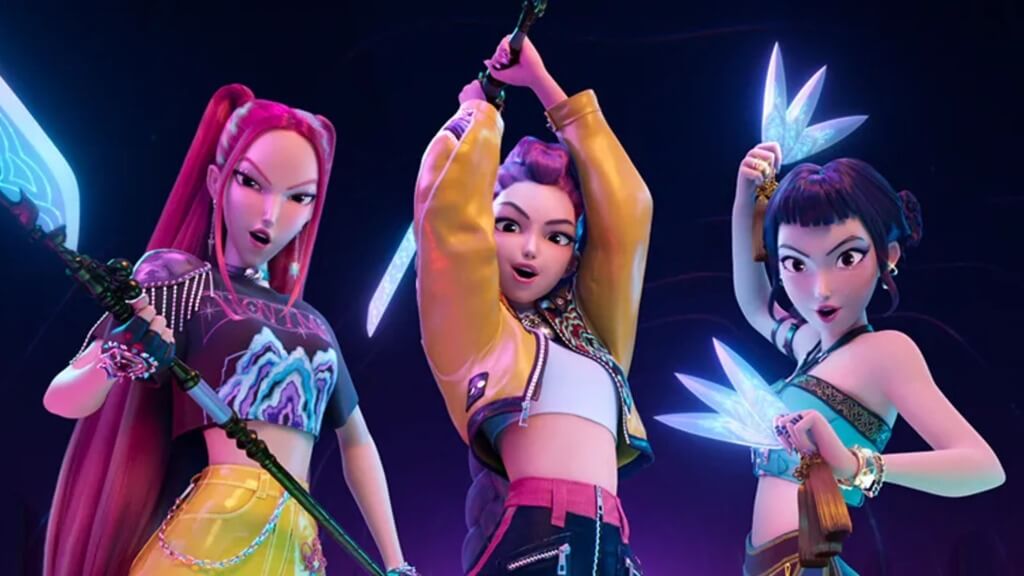
Like Minari, KPop Demon Hunters is a diaspora tale. Originally conceived by Korean-Canadian director Maggie Kang, who moved to Toronto from Korea at age five, the supernatural fantasy film follows K-pop-idol-cum-demon-fighter Rumi. Unbeknownst to her friends, fans, and fellow group members, Rumi is hiding a secret: she is half-demon. “Golden,” a typical “I Want” musical song, is an expression of Rumi’s desire to stop hiding and shine. Later in the movie, after much trial, she is eventually able to share her full identity. It’s a triumph of demon-fighting, fandom, and love—but, most of all, it’s a victory of self-acceptance that becomes community acceptance.
Perhaps because it is told mostly in English, KPop Demon Hunters has not run into the same miscategorization issues as Minari. However, its chart-topping soundtrack tends to be firmly sorted into K-pop, buoyed along by a marketing strategy celebrating its historic success, without much mainstream discussion as to why. When “Golden,” which is up for Best Original Song today at the Oscars, won at the Grammys, it was celebrated in both the U.S. and Korea as a historic victory for K-pop, despite the song being made for an American animated musical film. There is nuance to be embraced here. However, when we categorize the KPop Demon Hunters soundtrack as K-pop, we simultaneously downplay diaspora storytelling and allow American-made media to take up space it shouldn’t have claim to.
To say that the KPop Demon Hunters’ soundtrack is not directly connected to the world of K-pop would be disingenuous. Many of the tracks were written and produced by The Black Label, a South Korean music label that manages K-pop acts including BLACKPINK’s Rosé, BIGBANG’s Taeyang, MEOVV (whose poster is seen in the background of a KPop Demon Hunters scene), and AllDay Project. Teddy, one of the two founders of the Black Label, is a former member of Korean hip-hop group 1TYM and one of the chief producers of BLACKPINK’s discography.
EJAE, who co-wrote many of the songs featured in the film and is also the singing voice of main character Rumi, is a former SM Entertainment trainee. The Korean American singer worked towards being an idol for over a decade before transitioning into songwriting. Prior to her KPop Demon Hunters’ success, EJAE wrote songs for K-pop groups like Red Velvet, aespa, TWICE, and Le Sserafim. TWICE, one of the most successful K-pop groups of all time, has two tracks on the album: an end credits version of “Take Down” and their previously released English-language single “Strategy,” which plays in the background of a scene during the movie.
However, it’s worth noting that the film’s soundtrack is also rooted in American musical theater tradition. Ian Eisendrath, the executive music producer for KPop Demon Hunters, has a background in American musical theater, having previously worked on productions of Come From Away, Diana, and A Christmas Story Live!. “Golden” and much of the rest of the film’s soundtrack, was co-written by Mark Sonnenblick, who grew up as an American musical theater nerd. “These songs are written like musical theatre songs, even if they don’t always sound that way, and they’re very functional,” Sonnenblick told Playbill, emphasizing the dual function of the tracks.
I bring up these different influences because, when Americans talk about K-pop, we tend to think of it as a genre, rather than the industry it is. K-pop refers to “idol music,” which is music and performance produced around young, beautiful artists trained as dancing, singing, rapping superstars. These artists usually debut in groups, are financed by major music companies, and are not necessarily involved in the writing or production of the songs they perform. (Although, increasingly, as K-pop targets Western markets, idols are playing a more active role in songwriting and production.)
Like American pop, Korean pop tends to follow trends that coalesce around certain genres and sounds. But K-pop is not a genre; it is an industry. In the same way that American pop can be as sonically diverse as “Die With a Smile” and “Luther,” K-pop can be as sonically diverse as “Good Goodbye” and “Rizz.” Yes, the KPop Demon Hunters’ soundtrack intentionally sounds like some well-known K-pop songs and groups, but they sound like and were inspired by popular American tracks too. KPop Demon Hunters’ director Chris Appelhans (who directed alongside Maggie Kang) said in a Reddit AMA that other “unexpected” influences on “Golden,” for example, included the Notorious B.I.G.’s “Juicy” and Drake’s “Forever.”
It’s also impossible to divorce K-pop from the fandom at its center. Idol groups aren’t just singers, dancers, and rappers, they are objects of parasocial affection that build and nurture relationships with their fandoms in real time. This is an aspect of K-pop that KPop Demon Hunters depicts so incredibly well, weaving the power of collective fandom into its supernatural worldbuilding. It’s also the aspect of K-pop that tends to be most misunderstood and dismissed in Western discourse. Fandom isn’t a natural result of a successful idol group; it is an inextricable part of the collective performance. While “Golden” and other KPop Demon Hunters songs are performed by fictional K-pop groups Huntr/x and Saja Boys, they do not operate in the way real-life K-pop idols do. They cannot, as they are fictional characters confined to the world of their film.
Though it might not seem like it, K-pop has had a rough go of it in America. BTS, the idol group that first saw sustained success on the Billboard charts through grassroots organizing by their fandom, only made it onto the radio when they collaborated with Western producers for an English-language track. Whether it’s true or not, America’s corporate infrastructure still doesn’t trust that a K-pop group filled with Korean members singing and rapping in Korea can make it in the U.S.—or more likely U.S. executives simply have no motivation to test the theory unless it means profits for their bottom line.
As a result, K-pop companies like HYBE and JYP have teamed up with U.S. companies like Geffen and Republic Records to create groups composed mostly of Western members that are based in Western countries and sing in English to win the market. This is why KATSEYE exists. And it’s not all bad, but it’s not all good either. Because when we celebrate “Golden” or KATSEYE’s “Gabriela” as K-pop success stories, we’re allowing a music divorced and “de-terriorialized” (as professor Areum Jeong described it) from Korea to represent Korean culture.
I hope “Golden” wins the Oscar this weekend. It deserves it. I hope it continues to bring more people to the K-pop music it was inspired by. The film and its soundtrack are a love letter to Korean culture that informs Kang and many other behind-the-scenes creators’ identity and work as storytellers. But, if “Golden” wins, it should be a celebration of diaspora storytelling and transnational creation, not held up as a metric of success for a K-pop industry that deserves a chance to shine in its own right.
Kayti Burt is a working class journalist based in New England with more than a decade of experience covering the world’s most popular stories and songs for outlets including Paste, Rolling Stone, Vulture, TIME, the LA Times, Den of Geek and Polygon.


 Keep scrolling for more great stories.