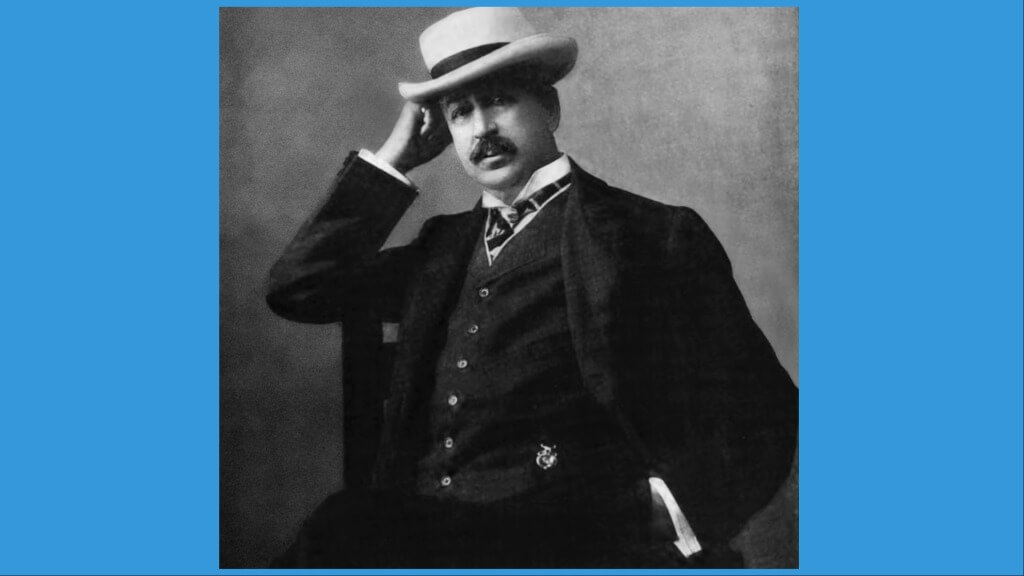
Gillette took the idea and ran with it, creating a carbon steel razor blade that was harder and sharper than its competitors, (the replaceable-blade safety razor was still in its infancy), and most importantly, had a high profit margin. By building a better mousetrap, he engineered a massive cultural shift away from straight razors, and made a fortune selling replacement blades for Gillette safety razors. (His eponymous company sold 51 razors in 1903; 90,884 in 1904; and by 1915, they were selling 70 million blades a year.)
Strangest fact: Razor blades weren’t King Gillette’s only big idea. As mentioned, he was a utopian socialist, but while most 19th-century socialists were all about communal farms and weird sex stuff, the King dreamed bigger. His 1894 book The Human Drift suggested that every company in America should merge into one giant operation co-owned by everyone in America. His 1910 follow-up, World Corporation, went into more detail about the company’s operation, and he went so far as to offer Teddy Roosevelt the CEO position (which he politely declined). Human Drift also suggests that the entire U.S. population should live in a giant city called Metropolis, which got its power from Niagara Falls. (The closest we managed in real life was Buffalo.)
Thing we were happiest to learn: Gillette’s razor blades took the world by storm. Uncle Sam purchased Gillette razors in bulk for soldiers fighting WWI. As the U.S. Army swept across Western Europe, it introduced the disposable razor as it went. King, of course, capitalized, turning down European licensing rights to instead expand his company into overseas markets.
Thing we were unhappiest to learn: Success in razor blades didn’t lead to success in any other area of Gillette’s life. Once his company went public, Gillette feuded with a fellow director, John Joyce, who eventually pushed him out. Gillette lost a lot of money investing in real estate, and his stock in the company lost most of its value in the 1929 stock market crash. He didn’t live long enough for his fortunes to rebound, as he died in 1932 at age 77.
Best link to elsewhere on Wikipedia: We’re actually staying right here, because King Gillette’s page has its own fascinating side story. In 1926, Gillette bought property in the Santa Monica Mountains, and hired architect Wallace Neff, who pioneered the “California style,” to build a Spanish Colonial Revival-style ranch. After Gillette’s death, his wife sold the house to MGM director Clarence Brown, who threw Hollywood parties there for 20 years, before selling it to Bob Hope, who donated the ranch to the Catholic Church.
Gillette’s ranch served as a seminary for another 25 years, until the Church rented the property to Thomas Aquinas College in 1970. The college only stayed for seven years, after which the ranch was sold to the new age Church Universal and Triumphant. They in turn sold it to Soka University Of America. (Soka Gakkai is a Buddhist movement, although the University is officially secular.) Soka’s plans to expand its campus were met with objections from neighbors and environmentalists, and after years of legal battles, moved to a new campus.
Finally, the Mountains Recreation And Conservancy Authority, which had been fighting the expansion, bought the property and converted it to a public park. The house itself has also been used as a filming location for The Biggest Loser, the Netflix series Ratched, and Melissa McCarthy vehicle The Starling.
Further down the Wormhole: King Gillette was raised in Chicago (his family survived the Great Chicago Fire), but he was born in Fond du Lac, Wisconsin. The Badger State is known for its breweries, bitter winters, but above all, dairy. In fact, one local politician was so committed to America’s Dairyland that he (unsuccessfully) tried to ban margarine. We’ll hear about Gordon Roseleip and other quick hit stories next month.


 Keep scrolling for more great stories.