“Happily ever after” has no home in the world of 100 Nights Of Hero, the sophomore feature from writer-director Julia Jackman. Unlike her previous film, the 2006-set gay romance Bonus Track (from a story written by Josh O’Connor, no less), this effort finds Jackman venturing into a mythical, medieval-adjacent fantasy realm that mirrors the most misogynistic leanings of societies past, present, and perhaps future. Even within such a volatile landscape, women stick their necks out for each other—palpable class divides be damned—which amounts to an entertaining ode to the power of sisterhood, storytelling, and sumptuous outfits. Although the heroines at the heart of the story may not succeed in outright toppling the patriarchy, their dogged defiance against its all-encompassing oppression inspires a little rebellion that promises to grow in turn.
Adapted from the 2016 graphic novel of the same name by Isabel Greenberg, which itself is based on the Islamic Golden Age epic One Thousand And One Nights, Jackman’s film employs a similar conceit involving a story told within a story. Here, the storyteller is Hero (Emma Corrin), maid and best friend to Cherry (Maika Monroe), a noblewoman who finds herself suddenly wed to the churlish Jerome (Amir El-Masry). Though the nuptials greatly increase her status in high society, there is virtually no other benefit to the union—to put it crassly, this Cherry has yet to be popped. Jerome refuses to consummate the marriage, meaning that his bride cannot produce an heir to appease the despot Birdman (Richard E. Grant), dooming Cherry to the same deadly fate met by other unfortunate women, succinctly dubbed the likes of Janet The Barren, Sara The Unfaithful, and Nadia The Lesbian.
It’s hinted that Jerome’s preference for men is what’s keeping him from deflowering his wife, which is in part why he offers a perplexing proposition to his womanizing buddy Manfred (Nicholas Galitzine): Should he successfully seduce Cherry over the course of 100 nights while Jerome is away on business, Jerome will give up his bride and sprawling estate. Should Manfred fail, however, Jerome would then seize his grand castle. Either way, Cherry is a pawn in a cruel game she has no idea is being played. This is where Hero steps in and lives up to her name: as each night draws to a close (and Manfred attempts to swoop in), she regales her lady and their boorish guest with a riveting tale about Rosa (Charli xcx, effectively subdued), one of three sisters who secretly defy male-supremacist doctrine by learning to read and write. Each night, Hero unfurls another chapter of the ill-fated fairy tale, her narrative so entrancing that it keeps Manfred from pouncing on an uninterested Cherry.
Funnily enough, Jerome’s same-sex dalliances are reflected by Cherry, who begins to build a more intimate relationship with Hero during her husband’s extended absence. While the source novel depicts Hero and Cherry as lovers even before the marriage and subsequent intrusion by another male outsider, Corrin and Monroe’s incremental chemical connection adds a necessary romantic tension; indeed, the build-up can often be more erotic than the sex itself. However, there is a general disappointing lack of sapphic sex in the film, especially considering that the story boasts the radical potential for “unconventional” love between women—be it sexual, sisterly, or simply rooted in solidarity—which cushions the punch it otherwise hopes to deliver to the patriarchal powers that be.
Much of 100 Nights Of Hero feels steeped in the coming-of-age sensibility of successful graphic novel adaptations like Scott Pilgrim Vs. The World, Ghost World, and Persepolis—loves past and present are conquered; women navigate their place in the world (and rock unique outfits while doing it); sexist regimes are challenged by young women at great cost. We may not get a Blue Is The Warmest Color level of smuttiness, but maybe that’s actually a good thing.
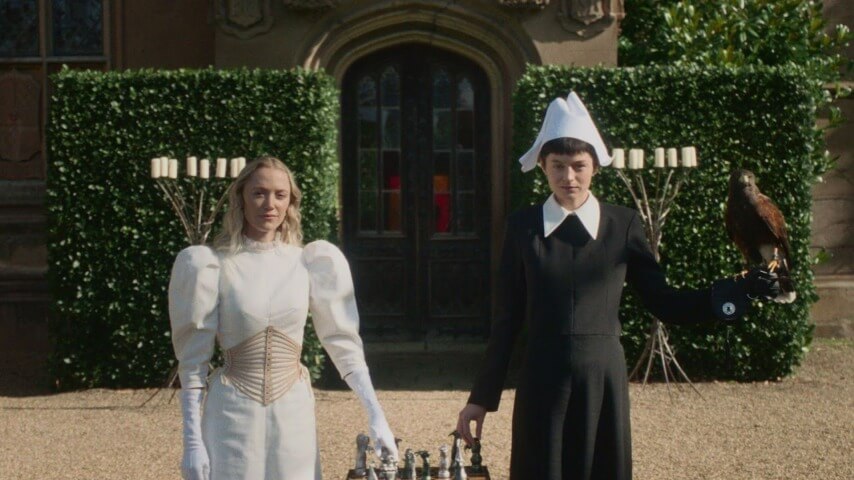
Where the film really shines is in its costume and production design, which is replete with gasp-inducing ornamentation. Three moons hang in a perpetually pink-hued sky, each alluring in its own metaphysical way. Eternally cast in a feminine glow (the phases of the moon long associated with menstrual cycles), these three celestial spheres could easily be seen as representing the three women central to the storyline: Hero, Cherry, and Rosa. Each has her own distinctive style, which costume designer Susie Coulthard tackles with divine clarity. Though Hero is effectively an indentured servant, her pilgrim-esque getup—complete with a razor-sharp pointed collar and a beguiling bonnet-like hat—serves as a point of subversion; there is no chastity here, though she will similarly find herself accused of witchcraft for simply knowing how to wield the power of the written word. Cherry is always donning elaborate garments that, while runway-ready in their hauteness, seem to almost be torturing her. A corset made of curved wood threatens to puncture internal organs, while an ornate collar of large bird plumage recalls the bygone torture of tar and feathering. Meanwhile, Rosa is dressed in layered dresses evocative of a pulpy romance cover. Deep shades of blue and green foreshadow her looming misfortune, though her beauty mirrors the Disney princesses whose tales typically end much differently.
If well-behaved women rarely make history, then even more rarely do they make for compelling characters. Hero understands this, and it’s unclear if Rosa’s story is ripped from the headlines or if she’s merely a feminist figure meant to inspire like-minded rebels. Jackman offers an incisive commentary on the power of folklore not only to preserve cultures, but challenge them. Modern feminists may look down on the likes of Cinderella and Snow White (who end up living “happily ever after” with handsome princes), but at the core of their respective fables are women who refuse to obey. If 100 Nights Of Hero is a critique of the misogynistic societies that cultivated these fairy tales, it is also an intentional embrace of the mythologies—however misguided they may seem—that have prompted women of all walks of life to test the limits of what they can get away with.
Director: Julia Jackman
Writers: Julia Jackman
Starring: Emma Corrin, Nicholas Galitzine, Maika Monroe, Amir El-Masry, Charli XCX, Richard E. Grant, Felicity Jones
Release Date: December 5, 2025


 Keep scrolling for more great stories.