On February 8, Bad Bunny will headline the Super Bowl Halftime Show (or “Apple Music Super Bowl LX Halftime Show,” to go full government). In previous years, he was preceded by Kendrick Lamar, Usher, Rihanna, a group led by Dr. Dre and Snoop Dogg, and the Weeknd. What do those artists have in common? Or, more accurately, what’s missing from that crew? The answer comes quickly to six-string slingers who can provide a detailed list of the differences between a Fender Stratocaster and Telecaster. In short: there’s no rock (unless we’re counting Rihanna’s “Shut Up And Drive”).
There was a time in the not-so-distant past when rock and roll dominated the Halftime Show. (I’m in my mid-30s, so even though TikTok is full of kids making yearning, nostalgia-bait videos about flip-phones and Littlest Pet Shop toys, the 2000s is my “not-so-distant” past.) The first half of the 2000s saw a lot of dual and even group headliners, although not many were themselves rock acts: Phil Collins, Christina Aguilera, and more in 2000; Aerosmith and NSYNC in 2001; Shania Twain and No Doubt in 2003; and a group led by Janet Jackson and a pre-arrest Diddy in 2004.
2005 marked the start of a clear pivot and the reason is obvious. Janet Jackson was part of the previous year’s show, but so was Justin Timberlake. It was the infamous “nipplegate” performance, where Timberlake tore off a piece of Jackson’s outfit and exposed her breast to millions of viewers on live television. The cultural implications of this moment were immense. Everybody from Democratic senator Zell Miller to Spike Lee spoke out against the stunt. Timberlake introduced the term “wardrobe malfunction” into public consciousness while apologizing at the 2004 Grammys. YouTube co-founder Jawed Karim later said the idea for the internet video platform stemmed from the difficulty he faced finding videos of the 2004 Halftime Show (and of a tsunami in Asia from the same year) online.
Naturally, after that mess, the NFL had a clear desire to play it safe (musically, not with the CTE-inducing brutality of football) the following year. So, they went with Paul McCartney. “People may have concerns of another wardrobe malfunction, but I can safely tell you that I won’t,” the former Beatle said ahead of his performance, adding: “We will pretty much get up there and just use the time allotted to rock.” And that’s exactly what he did. He and his band ran through a four-song set of Beatles and Wings songs, with McCartney making good on his word to not show his silky Liverpudlian skin.
Continuing to exercise caution in 2006, the NFL got another classic and recognizable rock figure to play: The Rolling Stones. The league remained understandably sensitive, so much so that ABC put the performance on a five-second tape delay and censored a couple potentially objectionable lyrics: “You make a dead man come” from “Start Me Up” and “Once upon a time, I was your little rooster / Now am I just one of your cocks” from “Rough Justice.” A band representative later described the censorship as “ridiculous.” Outwardly, though, the performance was another Halftime Show without headline-level issues.
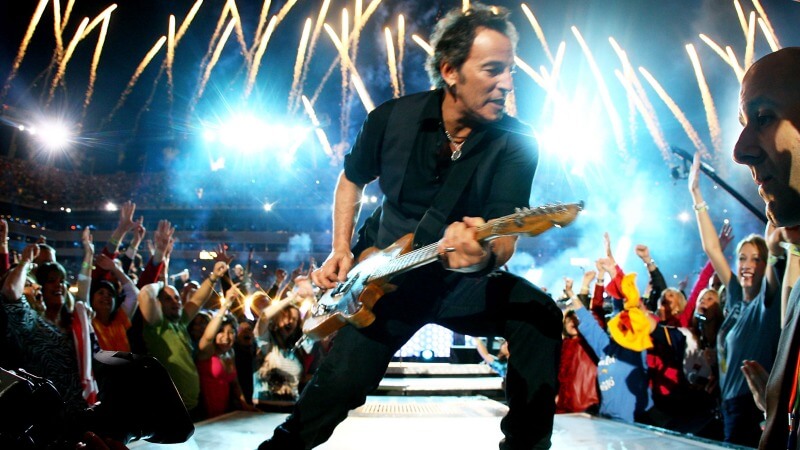
The NFL just kept busting out rocker after rocker from there. The run hit a high point with Prince in 2007, who delivered an epic, rain-drenched performance that is now considered one of the greatest Halftime Shows ever. Rock was clearly working, so that’s where the NFL’s head remained in 2008. The league reportedly had its sights set on Bruce Springsteen, which failed to pan out, then the Eagles turned down the gig, so it ended up going to Tom Petty and the Heartbreakers. Springsteen and his E Street Band performed in 2009, breaking down and saying yes after first being asked to play the big game as early as 1975. (Continuing to ask after 30-plus years of rejection should be considered harassment, but I digress.)
By 2010, the NFL was firmly in its classic rock era when they tapped the Who, who had a farewell tour in 1982 but still performed here and there. Rolling Stone rounded up online comments about the show shortly after it aired: alas, reception was mixed. Most of the positivity seemed to come from the band’s devoted, likely older fans (“I’ve seen them 28 times over the last 25 years and last night at the ripe age of 65 and 64 they were unreal”), while others had more measured takes (“The Who were an amazing band, but you gotta face the fact that they really didn’t sound good”). Retrospectively, the publication’s Rob Sheffield ranked every Halftime Show in 2024 and the Who was in the bottom portion of the list: “They showed up even more shoddily prepared than the Colts, fumbling a medley of classics—sad to think of all the kids out there first hearing ‘Won’t Get Fooled Again’ or ‘Baba O’Riley’ in this sorry condition.”
Critics were surely relieved when the Halftime Show was under new management in 2011, when the broadcast moved from CBS to Fox. In an interview, Fox Sports President David Hill was asked if the next halftime performer would be under 60 years old and he gave an enthusiastic, “Oh, please God yes,” before adding: “I’m watching [the Who] going, ‘Oh no, please.'” These are not the words of a man likely to book Van Halen or Kiss anytime soon. Under Hill’s purview, pop would return to the Super Bowl in a huge way with the Black Eyed Peas, making Fergie the first female co-headliner since Janet Jackson. It was a statement booking: the group was fresh off a run of hits that included “Boom Boom Pow,” “I Gotta Feeling,” “Imma Be” (all #1 singles), “Rock That Body,” and “The Time (Dirty Bit).” The league didn’t look back from there; the next four headliners were Madonna, Beyoncé, Bruno Mars, and Katy Perry.
How has rock fared since that run? Not great, Bob! The closest things to a rock Halftime Show since the Who were Coldplay in 2016 and Maroon 5 in 2019. These are massively successful artists who thrive in their own ways, but they’re “rock” like a pizza Lunchable is pizza. So, when is “real” rock coming back to the Super Bowl? Unless Bad Bunny flashes something more objectionable than a boob on international television this year and the NFL retreats into booking Billy Joel for 2027, it likely won’t be for a long while, if ever.
McCartney, Springsteen, and the Who weren’t hit contemporary artists when they performed, but the appetite for rock music was stronger in the 2000s than it is today. Even if data put together by this Reddit user a few years ago isn’t completely accurate, it seems well-considered and strong enough to be appropriately illustrative in this informal context. They compiled a year-by-year list of all the “rock” songs that made the Top 10 on the Billboard Hot 100 chart since 2001, using, in their words, “a fairly inclusive definition of rock.” From 2001 to 2009, every year had at least five rock Top 10s, with 2002 having 12 such songs. Those numbers diminished in the early 2010s and from 2016 to 2024, just four songs made the cut: Imagine Dragons’ “Believer,” Olivia Rodrigo’s “Good 4 U” and “Bad Idea Right?,” and Benson Boone’s “Beautiful Things.” Hell, if you exclude “Beautiful Things” (go ahead, I won’t put up a fight), 2024 had more Top 10 singles name-dropping Nintendo than Top 10 rock songs.
Artists like Geese, Wednesday, Hayley Williams, and Turnstile had some of 2025’s most critically beloved albums, but they’re better suited for a Tiny Desk Concert than the Super Bowl Halftime Show (with apologies to how influential Paramore was and continues to be for generations of rock and rock-adjacent musicians). With a lack of a strong rock presence in contemporary mainstream music, it’s hard to imagine a classic performer making sense for the Halftime Show, especially when the slot could instead go to a proven modern star making music in more relevant genres. (Fleetwood Mac might be the best candidate, given their internet-fueled resurgence in recent years, but a reunion seems unlikely following the death of Christine McVie in 2022.)
When McCartney took the stage in 2005, it was a new direction. Given, it was one motivated by caution, but the league is continuing to experiment today. Bad Bunny and Shakira/Jennifer Lopez were the first Latin acts since Christina Aguilera and Enrique Iglesias in 2000. The two recent performances featuring Kendrick Lamar (guesting in 2022, headlining in 2025) were the first Halftime Shows with a focus on hip-hop since Diddy and Nelly were part of the Jackson/Timberlake debacle in 2004. Mainstream rock Halftime Shows might be dead, but what they initially represented—the NFL changing gears—is still alive and kicking.
If you want to grasp at some straws: Jay-Z and Roc Nation pick the talent for the Halftime Show these days, and given that Jay once made a collaborative remix EP with Linkin Park (2004’s Collision Course), maybe he still has a soft spot for rock. The genre isn’t in an awful place right now: Geese and the aforementioned others show it can still be exciting, while A-list stars like Olivia Rodrigo are unafraid to push a guitar-driven sound. But unless something drastically changes, the days of the dominant rockstar are over. The Halftime Show will likely never again be dominated by rock music like it was during that run from 2005 to 2010… unless at his upcoming performance, Bad Bunny decides to do a set of AC/DC covers or bring Rihanna out for “Shut Up And Drive.”


 Keep scrolling for more great stories.