Not long after, in The Bone Temple, we see what happens after Spike runs headlong into a prophet of a very different faith: Sir Lord Jimmy Crystal (Jack O’Connell) and his servants known as the Fingers. Jimmy’s worldview was birthed in the primordial violence of the initial outbreak, and his warped outlook forms the centerpiece of a cult of personality. Styling himself as the son of Satan himself and dressing like British TV personality and notorious pedophile Jimmy Savile, Sir Lord Jimmy initiates Spike into his world by immediately forcing him to fight one of his disciples to the death. For Jimmy, who watched his father, a priest, give himself over to the infected as a boy, survival is built on all-encompassing power. This stance has allowed him to grow a small following who buy his entire narrative because, like him, they were either kids when the outbreak happened or they’ve never known anything except this world. It makes perfect sense to them that Jimmy is the Devil’s representative on Earth, because he’s so good at killing things, so at home amid the chaos. They respond to his strength and his apocalyptic imagery, so when one of his underlings spots the Bone Temple, Jimmy sees an opportunity, not a place of reverence.
Meanwhile, Kelson’s focus has pivoted even more towards the living, particularly Samson (Chi Lewis-Parry), the massive “alpha” who stalks the woods around the temple. Kelson’s constant experimentation with the pharmaceuticals he’s managed to scrounge up points to a potential future where someone like Samson could finally be free of their rage—and, because he’s making progress, when he sees Jimmy he decides to capitulate. Jimmy needs a proving ground where he can flaunt his Satanic power, and Kelson simply needs Jimmy to go away.
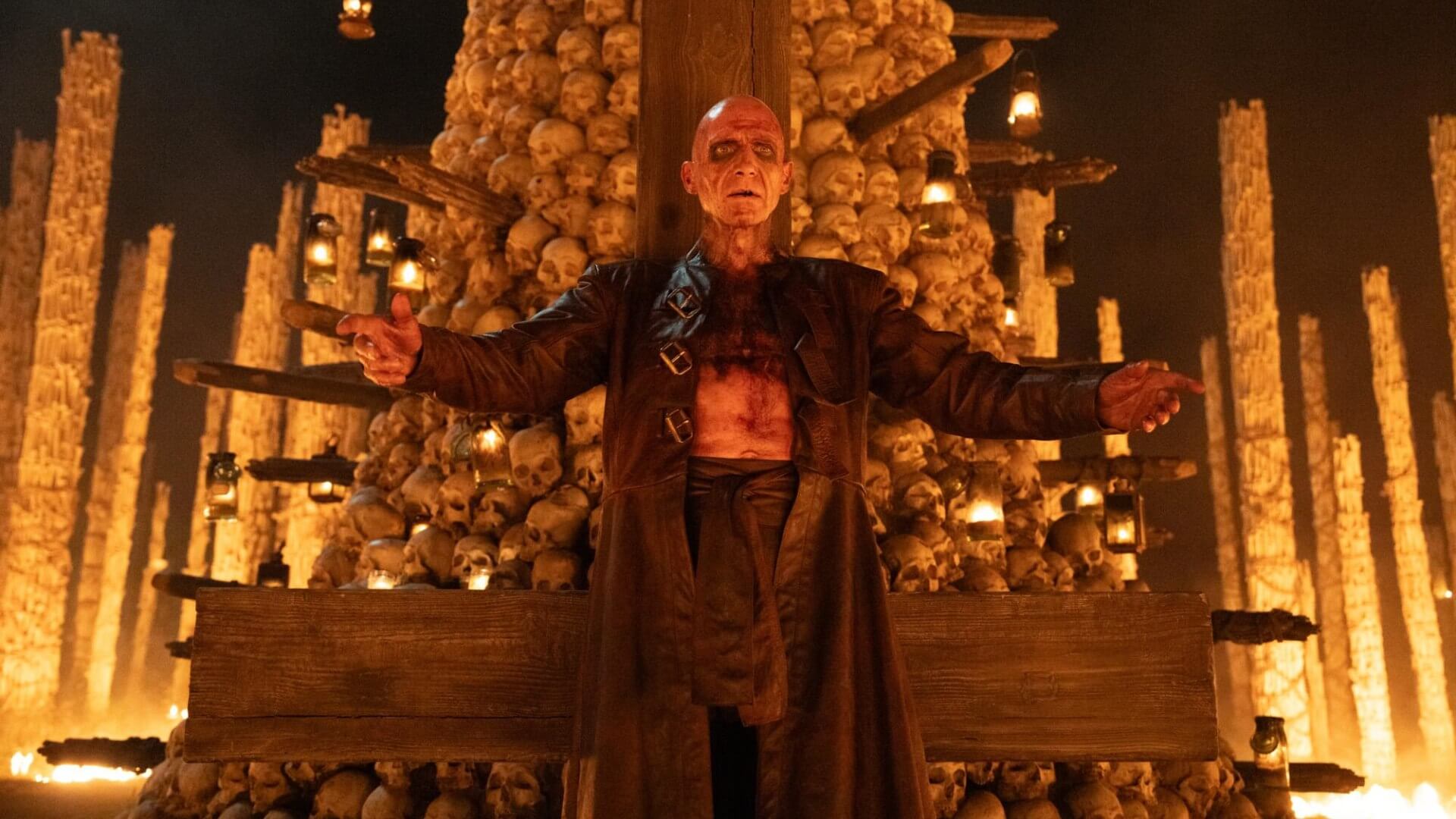
These are the two forces colliding in the film’s unforgettable set piece, as Kelson kicks his flair for the dramatic into high gear, lip-syncing Iron Maiden’s “The Number Of The Beast” before Jimmy’s hallucinating cultists, playing at Satan—advocating for their leader’s power while harnessing some of his own. One of the great joys of post-apocalyptic fiction is seeing the past with new eyes, and that includes beloved songs, stories, and, in the case of 28 Years Later, poems. Kelson harnesses the true metal mayhem of Iron Maiden, dialing up the theatrics with buckets of fire and black paint around his eyes bolstering his demonic persona. Coupled with the hallucinogens he breathes into the faces of Jimmy’s cultists, the scene becomes a sweaty, madcap ritual that taps into something the Bone Temple was never intended to be a part of. It’s a perversion of everything the Bone Temple previously stood for, and yet for Kelson, it is the most direct route to progress.
It is also the most direct collision of symbols in the film. If the clearest metaphorical extensions of 28 Years Later‘s story are rooted in the isolationism of Brexit, then The Bone Temple is a film about fascism, freedom, and survival in the face of nightmarish cruelty. Jimmy is not interested in reason, or even in protecting his flock, who all share his name and haircut. Jimmy is only interested in Jimmy, and so has styled himself as a dictator with a direct line to the Devil, a shot at salvation for anyone willing to listen. He responds only to strength, violence, and bootlicking.
Kelson, meanwhile, has cloaked himself in humility just as he’s coated his body in iodine. His monklike existence, and his passion for what he does, suggests a faith not in himself, but in humanity’s ability to recover and grow beyond what he’s built. It’s why he’s so drawn to Spike, and to Samson. He sees them as the twin prophets of the future, the boy who desires the wider world and the man who wants to live again.
The Bone Temple arrives as the most prominent political figure in the world, with his own predatory history and connection to infamous pedophiles, insists on strength and terror alone as the forces to guide humankind. His thugs run wild in the streets, spreading chaos and violence. Like Jimmy, he is driven entirely by selfish, id-fueled agendas; all cultural markers, all cartoons and memes and references, are simply symbols upon which to project this ideology. The Bone Temple proposes another, selfless path forward. Kelson’s performance and his subsequent effort to convert Jimmy’s followers—to flip the script on the Satanists—don’t fully pay off, leaving him to become a martyr, even though it’s Jimmy who winds up on the cross. He puts himself in harm’s way to save Spike and Samson, to give them a chance at a better tomorrow. Samson, seemingly cured of the virus, thanks Kelson, while Spike says his tearful goodbyes and moves onward. Remember the past, but look to the future. It’s what Kelson preached, and it’s how Spike decides to live after his stint under Jimmy.
The future of the franchise also has this kind of opposition to fascism on its mind. The film ends by having the franchise’s original protagonist, Cillian Murphy’s Jim, expound upon the strongmen of World War II, and the international response it took to shut those men down. Even amid an apocalypse, a similar kind of response is needed for the new strongmen who would rise up to take up their place. For Jim and his daughter, this starts with something simple: Helping someone else.


 Keep scrolling for more great stories.