Heel offers a possible solution to the problem with young men, the ones born kicking and screaming into social media, who struggle with empathy after years of interpersonal contact experienced only through a screen, who don’t view women as people, who hurt others because it will get them more likes. In one scene of Polish director Jan Komasa’s Heel, Chris (Stephen Graham) shows Tommy (Anson Boon) a video that Tommy once uploaded onto TikTok, which chronicles the delinquent 19-year-old driving under the influence and crashing his car, flaunting the damage and his survival for his followers. Tommy proudly remarks on how many views the video attracted. It calls to mind the real-life incident of young YouTuber Jack Doherty, who crashed his $200,000 McLaren while texting, driving, and livestreaming in 2024.
No one quite knows what to do about young men like this. Is it raising them differently? Is it rehab? Is it banning them from Reddit? Is it turning them on to different podcasts? Heel considers an alternative: Kidnap them, chain them up, and train them to behave better, like an unruly animal picked up from a shelter. That’s what Chris aims to do when he swipes Tommy off the streets of London after what is clearly a regular night out for the young man, a night of binge-drinking, club-hopping, cocaine-snorting, fist-fighting, girlfriend-cheating—only to end up staggering alone on an empty street.
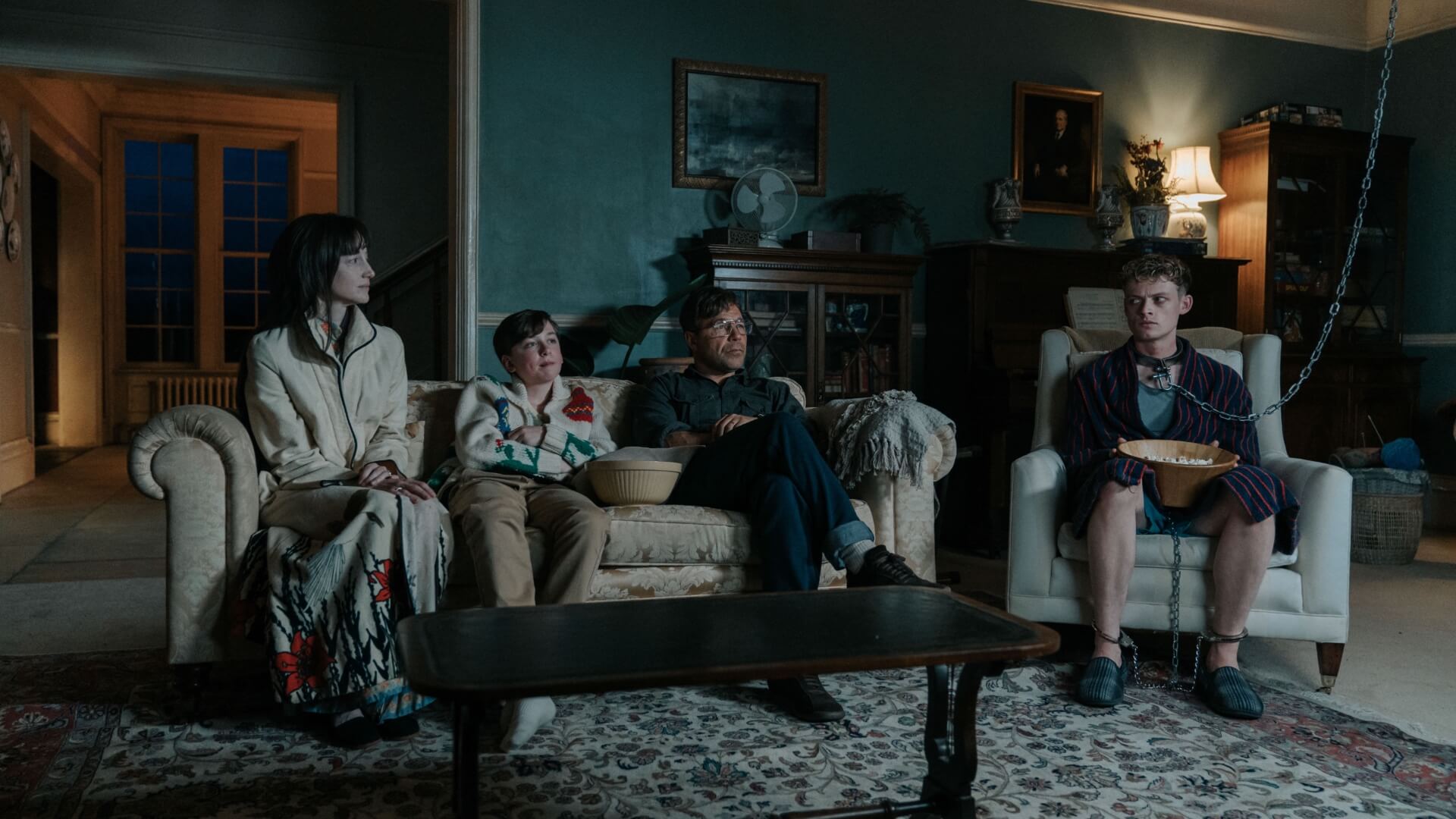
Chris, the man who kidnaps Tommy, is a family man. He’s married to Kathryn (Andrea Riseborough), who’s introduced draped in robes, her long black hair as limp as her personality. Together, Chris and Kathryn have a bright, happy young son named Jonathan (Kit Rakusen), whom they occasionally refer to by the nickname “Sunshine.” They live in a large, stately countryside home, and they’re entirely sustainable—”zero waste,” as Chris explains to their new immigrant housekeeper Rina (Monika Frajczyk). Rina has a shady former employer she’s trying to run away from, and an immigration status that hangs in limbo. So, when Chris openly introduces Rina to Tommy’s squalid, involuntary quarters in their cellar, he has plenty of ammunition to keep her from running away or going to the police.
Graham’s acting career has been defined by his masculinity. He has a rugged face you’d see before getting shaken down in an alley, more specifically an alley from 100 years ago—his credits are peppered with countless period drama. Last year, he took these bullish depictions of manhood in a different direction, playing a grief-stricken father suddenly forced to wrestle with how he raised his teenage son in the miniseries Adolescence. In Heel, Graham initially appears to similarly be playing against type; in reality, it’s a weaponized version of his usual displays of masculinity. Chris is a squirrely patriarch in creeper spectacles, but his demure persona conceals intimidation tactics deployed when he needs them.
The dynamic of the family in Heel defies convention, and the restraint that writers Bartek Bartosik and Naqqash Khalid display in giving full elucidation to their situation gives Heel a playful, even humorous ambiguity. Jonathan is fully aware of Tommy’s existence in their home, to the extent that Jonathan occasionally visits him with Chris, even cooking meals for him. But it’s Kathryn who’s the entire reason Tommy is there. Chris kidnapped him for her. Her despondency is a direct result of the absence of someone named Charles, and Tommy has been brought in as Charles’ replacement. But it remains vague exactly who Charles was to the family, and what happened to him. Was he their son who died? Another kidnapping victim who escaped? Probably the latter, but the unanswered questions in Heel maintain its unique atmosphere, which blends unease with a charming eccentricity—for better and for worse.
Boon is phenomenal as Tommy, a character so obnoxious, abhorrent, and callous that his suffering is welcome. That’s part of the point, and there is immense pleasure in seeing him berate Rina for her immigration status, only to receive the beatdown of a lifetime from Chris while he calls Tommy a “bad boy.” It’s a cycle repeated ad nauseum until, lo and behold, Tommy begins to slowly change, with Chris and Kathryn granting him more privilege and freedom that Tommy appears to accept happily while secretly planning his escape. But the excessive violence isn’t just restricted to Tommy’s misbehavior, and the punishment that Chris and Kathryn don’t hesitate to inflict upon their own son keeps the audience from feeling too comfortable in their world. Still, it muddies the characterization of Jonathan’s character as well as the tonal implications of the film. Heel wants to have its cake and eat it too, to present this darkly comic absurdity while dipping back into reality only when it suits the film.
Komasa isn’t a flashy director, but he’s steady, assured, and keeps a tight rhythm. But the tonal inconsistencies of his film, and its half-baked conclusion, prevent Heel from ascending to greatness. Heel and Adolescence both explore the culpability of the nuclear family in creating monsters out of young men. Heel seems to think that the solution lies in having a family who cares about you, a conveniently simple sentiment brought into sharper relief by Tommy’s side of the plot. But it’s more complicated than that, as evidenced in Adolescence: Even a child from a loving and attentive home can find their way into dark corners of a world eager to corrupt them.
Director: Jan Komasa
Writer: Bartek Bartosik, Naqqash Khalid
Starring: Stephen Graham, Andrea Riseborough, Anson Boon, Kit Rakusen
Release Date: March 6, 2026


 Keep scrolling for more great stories.