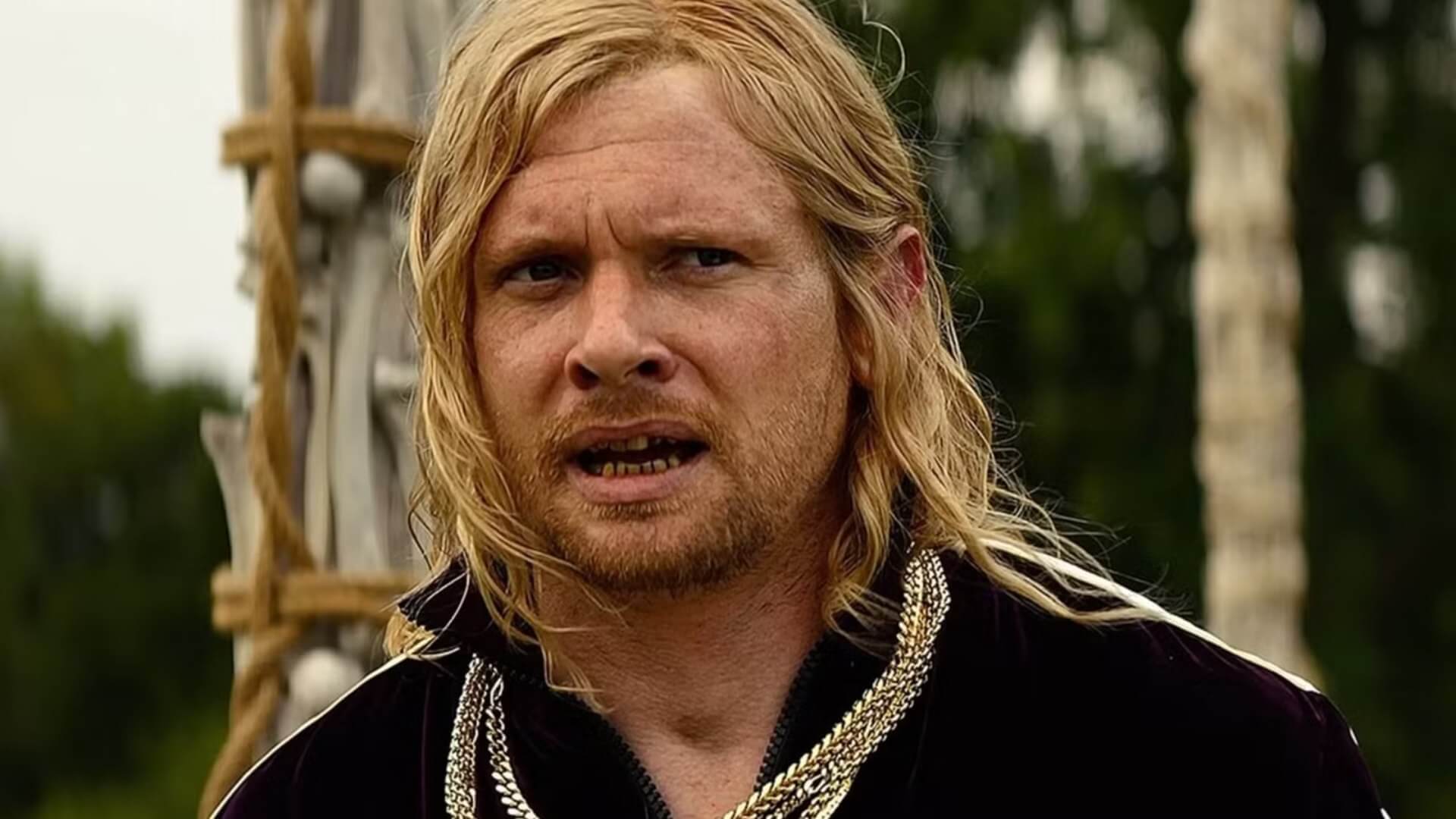
Sir Lord Jimmy Crystal (Jack O’Connell) arrived in a postscript cliffhanger to last summer‘s 28 Years Later dressed in the tacky, eyesore garb—tracksuit, wig, and plastic jewelry—instantly recognizable to British audiences as an homage to Jimmy Savile, the media personality and philanthropist who was exposed as one of Britain’s most prolific sexual predators after his death in 2011. This completely unpredictable coda—a promise of what was to come in 28 Years Later: The Bone Temple—triggered a flurry of surprised, confused, and aghast reactions, and also demarcated which audiences knew about Jimmy Savile and which didn’t. But, disappointingly, The Bone Temple undercuts the months of theorizing and speculation about the narrative and symbolic significance of modeling a cult on a disgraced child sex offender celebrity.
Throughout The Bone Temple, Sir Jimmy and his followers, or “Fingers” are never compared to Savile, nor does the leader share any insight into Savile’s cultural status in a world where he was presumably eaten alive years before the public learned of his crimes. (My own theory, that Jimmy’s Highland upbringing meant they were some of the very few who knew the truth about Savile, proved incorrect.)
O’Connell’s performance isn’t an impression of Savile. Rather than adopting Savile’s nasal tone, he speaks in the posh Scottish accent of his childhood. But Jimmy does adapt one of Savile’s catchphrases (“How’s about that, then?”) into a priest-like call-and-response (“How’s that?”), usually to mark another rapturous and gnarly bout of ceremonial violence committed in the name of “Old Nick” (or as it sounds in Sir Jimmy’s Scottish accent, “Auld Nick”). Aside from being a strange, incongruous relic of an estranged pop culture (like Jimmy’s continued references to the Teletubbies, who witnessed the worst moment of his young life), the potency of dressing a murderous, post-apocalyptic cult in such a fashion is reduced to a nasty, uncomfortable joke: a plain-faced and provocative irony about something that seems innocent and friendly merely acting as a thin façade for unimaginable abuse and evil.
But irony cannot be sustained without being challenged, and The Bone Temple squanders the chance to continue 28 Years Later‘s reflection on Britain’s history of self-soothing but hollow symbolism. It tees up a digression into thorny, ugly, and hyper-specific territory, only to sub out Savile for Satan. Savile was considered a national treasure, gladly uplifted by audiences, politicians, and charities who were also complicit in suppressing his victims’ voices. He wasn’t just a monster hiding in plain sight, but someone who used his public image as leverage to abuse vulnerable people. If responsibility for Savile’s perceived innocence fell on society’s shoulders, how would such a legacy be affected by the disintegration of society into a world of literal horror, where the kindest, most devoted people in your lives could turn into bloodthirsty killers in a matter of seconds? Would the institutional complicity that aided Savile suddenly become meaningless? Would monsters like Savile feel rewarded in a world of no laws or justice?
These troubling, in-your-face questions float freely in your mind for about half of The Bone Temple, but not because the film invokes them. Rather, it’s because the provocative imagery raises an expectation that they will be worked into the subtext. But extended exposure to Jimmy and his Fingers confirms that these concerns are mostly irrelevant. Instead, Alex Garland’s script settles for more well-trodden explorations of demented cult leaders and more trivial material about the righteousness of violent men in a world gone mad.
The note that 28 Years Later left audiences on was strange and sinister, but didn’t exactly promise immediate, miserable peril; in the opening of The Bone Temple, Sir Jimmy watches from a makeshift throne as Spike (Alfie Williams) must duel a Finger to the death for a place in his tribe. Spike is fighting an uphill battle, but manages to nick an artery. His opponent promptly bleeds to death. It’s a nice note of blind luck to begin his tour of ugly, meaningless suffering, but it’s one of Spike’s only consequential moments in a story that demotes him to a bafflingly static, secondary perspective. With Spike no longer the engine driving the film’s emotional arc, the task of taking the story to a new, interesting place rests on Jimmy’s shoulders.
But despite O’Connell’s game performance, his character is too rigidly entrenched within the confines of a familiarly sadistic post-apocalyptic villain mold. His therapeutic encounter with Dr. Kelson (Ralph Fiennes), hinges on the promise that, at any point during this clinical assessment, the troubled patient could maul his shamanic psychologist to death. And it’s still the high point of the film, if only because it interrupts the tired march of his conquest and demands that the character explain himself to an enigmatic outsider. The Bone Temple relies on the complexity of 28 Years Later‘s best character to shake a one-note villain out of monotony.
The point of trauma from which Sir Jimmy unraveled was the last time he saw his vicar father on the day of the outbreak. As seen in 28 Years Later, Jimmy’s father greeted the Rage Virus with an ecstatic fervor, convinced it was the “day of judgment,” a Revelation-style rapture that only faith could protect them from. This disturbing message, twinned with the sight of infected consuming his father, has gotten more perverted over the years. Now Jimmy communes via psychosis with his true father, Satan. When this is teased out, it’s incremental and disturbing in a way that satisfies; viewed as a whole, though, this backstory is rote and tired, and the film swiftly moves on to a rushed power struggle between a cult leader at risk of losing his believers and a rational man of medicine who must perform for his life. Even in the riotous, metalhead final showdown between Sir Jimmy and Kelson-as-Satan, The Bone Temple evokes a late season of a post-apocalyptic TV show; we follow the immediate next steps of the characters with the intention of stumbling onto something worthy and productive down the line.
That Jimmy offers so little of substance makes O’Connell’s villain an unfortunate cousin to his strange, seductive, and monstrous turn as Sinners‘ Remmick. Both villains spectacularly and suddenly enter our characters’ worlds when they’ve already got a lot on their plate, doling out a nasty but supposedly freeing alternative worldview that they impose on their prey until they submit. But Remmick’s corny, country friendliness and his inverted mantra of assimilation juxtaposes with his cold, throat-sucking thirst in a more productive way than the bright outfits and cheery candor of Sir Jimmy. Remmick is more menacing because of dramatic irony, because we hear his friendly, egalitarian preaching after learning how sinister he is—because he actually tries to convince the Black characters of the legitimacy of his hunger, even though he’s happy to attack them to get what he wants.
Sir Jimmy, by contrast, is an inert force. He already has acolytes, his sadism is never a secret, and there is no suggestion that anybody is legitimately tempted by his cause. He is in dire need of Remmick’s thematic complexity—Sir Jimmy is an attention-grabbing premise on the hunt for a unique and specific meaning, fated to gradually disappoint audiences just as he eventually loses his disciples.
The acute Britishness of 28 Years Later is directly connected to its director and writer. Danny Boyle is nearing 70 and Garland is in his mid-50s, and when called to envision a country living with long-term horror, they imagined an intergenerational blend of brutality and compassion with an ordinary GP transformed into a shamanic cleric whose proximity with death led him towards enlightenment. But the British symbols in that film—Olivier’s Henry V, portraits of Queen Elizabeth II, Ruyard Kipling’s poetry—possess a cross-border potency that non-Brits could recognize as evidence of how the former empire engaged with itself. Savile’s recency and specificity must have felt, for filmmakers keen to get a second 28 Years Later movie bankrolled alongside the first one, too alienating for a mainstream horror film.
The choice to ignore the Savilian subtext has nothing to do with the change in director, and more to do with the topic being lost on the film’s not-yet-guaranteed wide audience. The power of 28 Years Later was not just its boldness, but its earned and potent conclusion—its idea that, virus or no, Brits live in a country that’s unsure how to remember itself. Because The Bone Temple ultimately rejects his association with Savile, nothing about Sir Jimmy implicates the other characters, or the country at large, making this novel post-apocalyptic world feel sparse and anonymous. In 28 Years Later, survival became existential; because of The Bone Temple‘s villain, it is blandly literal.


 Keep scrolling for more great stories.