So far, the most notable thing about A Knight Of The Seven Kingdoms, HBO’s latest adaptation of the works of George R.R. Martin, is its patience. There are two possible explanations for its ambling gait. The cynical one is that, with The Hedge Knight, the first of three novellas following the exploits of Ser Duncan The Tall and his squire Egg, the network is quickly running out of A Song Of Ice And Fire material, which wrought the juggernaut Game Of Thrones and its prequel spin-off House Of The Dragon, and is slowing things down to luxuriate in Martin’s generously detailed Westeros. (After all, it’s better to meander than risk another late GOT-level misfire.)
The more charitable and narratively satisfying explanation is scale. The adventures of Dunk and Egg are modest compared to Thrones, focusing exclusively on just two characters instead of the saga’s morally shifty coterie of kings, queens, brothel purveyors, and Hands. Set over ninety years before Bran Stark was pushed from a Winterfell tower, their story has a long road to travel before brushing up against dragons, direwolves, and White Walkers. In structure and cadence, A Knight Of The Seven Kingdoms more resembles medieval morality plays or samurai epics in the key of Lone Wolf And Cub, or, judging by the series’ Morricone-tinted soundtrack, a western. And not to be impolite, but here’s another explanation: Dunk is an exceptionally large fellow, overcautious about bumping into things (though bump into them he does) and therefore in no great hurry for realm-decimating battles.
That unhurried ease is established immediately in the premiere, “The Hedge Knight,” with an impromptu burial under a gnarled tree and heavy rainfall. Manning the spade is Peter Claffey’s wonderfully humble Ser Dunk, laying to rest his mentor Ser Arlan of Pennytree with naught but three horses to bear witness. It’s a dramatic enough start—we’re seeing a squire ascend to his ser’s station, even if his knighthood leaves room for doubt (see the stray observations below)—but there’s no fanfare, not even a septon to give a final blessing. (Perhaps wary of the unchecked grandiosity that came before, the episode cheekily eschews Ramin Djawadi’s soaring theme for a torrent of diarrhea.) The burden of carrying the series and farewells falls to Dunk. In a delightful break from the franchise’s loquacious lords and ladies, eloquence is not his forte.
We never meet Ser Arlan (Danny Webb) except in Dunk’s comic recollections, which are unflattering—he was fond of drink and cuffing his squire in the ear—but not unkind. Arlan looms large in Dunk’s formation; later, he encounters a young stable hand named Egg (an adorably inscrutable Dexter Sol Ansell) and threatens the boy with a clout for his insolence. Claffey delivers the threat without a hint of promise behind it. Arlan may have knocked his squire around, but he paradoxically instilled in him a sense of decency. A hulk like Dunk could have grown into a brute under the wrong teacher. Instead, his courtesy, especially when met with discourtesy, marks Dunk as a decent man in a cruel world. He even balks at the thought of selling Arlan’s horses for a proper meal; after all, how long would the coin last? “That road ends in outlawry or beggary,” he huffs. So which road will it be?
The one that leads to a lord’s service, a circuitous journey that begins with Ashford Meadow in the Reach, where a tourney is to be held. It’s a hungry ride, broken by a stop at an inn where a feast of lamb and ducks (Dunk orders both, to the innkeeper’s delight) is forestalled by a drunk’s ominous ramble. “I dreamed of you,” he drools, producing what appears to be a dagger of Valyrian steel (again, see the stray observations below). “You stay the fuck away from me.” So far, hospitality in the Reach is a mixed bag. Dunk catches insults even in the stables, where Egg critiques his knightly attire. (“Your belt is made of rope!” he squeaks.) Despite Dunk’s grim aura—a bath later on fails to banish his stench—Egg is eager to follow him to the tourney as his squire. “You look like you need one more than most!” Dunk says no, of course; it’s storytelling law that heroes must first reject their future companions. So he ventures into Ashford alone, towering over the knights yet diminished by their wealth, status, and pomp.
There, Dunk visits the master of the games and gives him the spiel about his knighthood, that Ser Arlan bade him serve the realm with all his might. The master responds with phlegmy disinterest; he either doesn’t believe Dunk’s story or simply doesn’t care, what with all the princes and wannabe warriors about. Either way, Dunk is charged with finding a landed knight to vouch for him by the next day, or his dreams of joining the lists are kaput. Ser Manfred Dondarrion (Daniel Monks), whose father was once served by Ser Arlan, might remember him. “By scent alone, no doubt,” is the master’s reply.
Dunk’s meeting with Manfred will have to wait; two helpful back-alley Sallys inform him that the knight is sleeping off a case of the gout. They also give him a blunt accounting of his station. If Dunk is anything at all, he’s a hedge knight (“Like a knight, but sadder,” one observes), stagless, rizless, and one mishap from that life of outlawry he so wants to avoid. A despondent walk past the practice yard introduces him to the Fossoways: Raymun (Shaun Thomas), currently being thrashed by his cousin Ser Steffon (Edward Ashley), who challenges Dunk to a scrap. But the time for fights is later. “The Hedge Knight” is still busy with introductions—and foreshadowing.
There’s the Sallys’ mock funeral before the night’s feasts, and a live poem (performed by a puppeteer played by Tanzyn Crawford) details a man of honor who fights a dragon and “must keep a truth concealed.” Then there’s the Laughing Storm, Lyonel Baratheon (a disarming Daniel Ings), who brings Dunk into his orbit and seems less compelled by violence than he is in revels. And yet Westeros, regardless of era, remains fraught with dangers; even if “The Hedge Knight” is setting a lighter, more spirited tone than Thrones or Dragon (check out Dunk mixing it up with Lyonel on the dance floor), the realm’s brutal living, entrenched power structures, and the violence that stems from both are certain to blight both men. This foreboding is best articulated, surprisingly, by poor Dunk, who brings up Lyonel’s lifetime of training with the finest masters-at-arms compared to his meager training from Ser Arlan. Size and strength aside, what chance does he really have against the realm’s privileged? Baratheon is blunt: “No chance.”
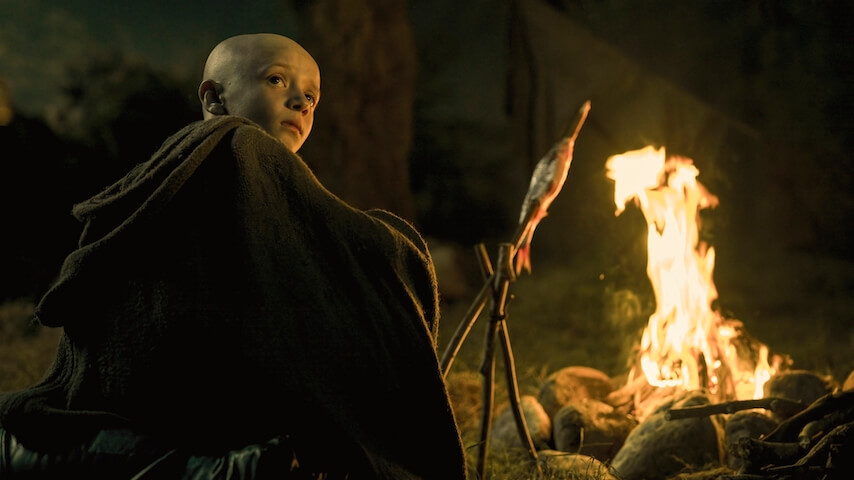
Another omen arrives when Egg appears at Dunk’s camp, once again insisting on squiring, swearing that Dunk would have to drag him all the way to King’s Landing if he wants to be rid of him. The exchange stirs something inside Dunk: “Are you from Flea Bottom?” “No,” Egg smirks. The next day promises fresh headaches, and Dunk, drunk and humbled (“Be gone,” was Prince Manfred’s parting shot), is done with puzzles, content to let Egg remain in his humble pavilion under a lonely tree. Before sleep takes them, they spot a falling star, and Egg says it’s good luck. Tonight, the knights and princes of the tourney dream under silk ceilings, but they have the sky. With a little help from that star, tomorrow will be better for Ser Duncan The Tall.
Stray observations
- • *While I’ll avoid the novella’s story developments in these recaps, Ser Dunk’s dubious status as a knight—hedge or otherwise—is an important character detail to draw attention to. Also worth noting is the absence of a flashback concerning his dubbing, especially with all the clouts we see Arlan give Dunk throughout this week’s episode.
- • For those keeping score: the Dunk And Egg stories begin during the reign of Daeron “The Good” Targaryen, who was married to Myriah Martell of Dorne. Their offspring are still on their way: Baelor, Daeron’s son and Hand, is awesome; Maekar, his eldest, is another story, though his kids should make things interesting.
- • *We did meet one of Maekor’s sires this week: that drunk at the inn outside of Ashford is none other than Prince Daeron “The Drunkard” Targaryen (Henry Ashton). His dreams of Dunk could be clairvoyance—some Targaryens, as Game Of Thrones and House Of The Dragon have proven, have the power of foresight—or just ale-fueled ramblings. Time will tell.
- • Also good to note: Maekar is the father of Aemond Targaryen, who, at the time of this story, is learning to be a maester at the Citadel in Oldtown. You’ll remember Aemond; he served at Castle Black with Jon Snow.
- • The lovely woman who regales the audience with the dragon’s tale is Tanselle, whom you can count on seeing again. Her poem about dragons might also be significant.
- • “Rotten to the core; knock the seeds out of ‘im; the senior branch of the apple tree.” Raymon’s crafty turns of phrase hint at his family’s standard, and the bifurcation of its houses. There’s the “good” Green Apple Fossoways and the “sour” Red Apple Fossoways. It’s pretty clear which Apple might spoil the tourney, though why the Fossoways were torn in two is a story beat that remains to be told in live action.
Jarrod Jones is a contributor to The A.V. Club.


 Keep scrolling for more great stories.