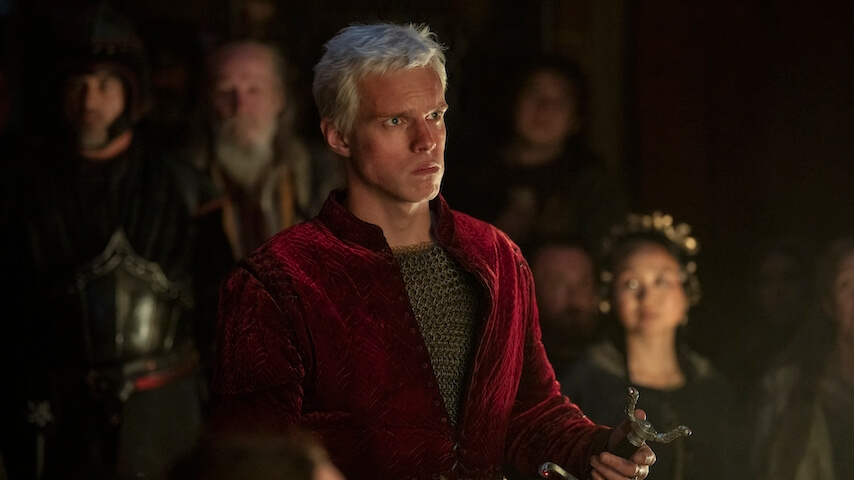
Well, he never claimed he wasn’t Aegon Targaryen. For Ser Dunk (Peter Claffey) and his squire Egg (Dexter Soy Ansell), one fateful choice leads to another. This furtive yet tempestuous little boy who ingratiated himself into Dunk’s life stands revealed as Aegon V Targaryen, son of Maekar (Sam Spruell), grandson of the king, and, most relevant to the moment he makes this confession, younger brother to Prince Aerion (Finn Bennett), whose cruelty forced Dunk’s hand and compelled Egg to finally crack his shell.
This revelation comes after a rewarding episode of bonding between the hedge knight and his squire. Over an immaculate egg-sandwich breakfast (see the stray observations below) and more of their mutual appreciation for the lists (where Dunk, like a try-hard unc, lets Egg sip some ale), Dunk and Egg further settle into their retrospectively unlikely partnership—one Egg’s admission will inevitably unsettle, at least in the short term. After all, Dunk isn’t typically one to nurse a grudge; as we saw this week, after he threatens Egg with a fist, ser immediately softens and instead teaches his squire the fineries of the whipstitch. (Also, his fist ultimately knows where it’s supposed to go.) Their friendship, we’re being shown, is secure. It’s Dunk’s continued well-being that remains an open question.
All this candor throws a spotlight on a question that A Knight Of The Seven Kingdoms is uniquely suited to explore: the true status of Ser Dunk’s knighthood, the other Big Secret the HBO series has made little effort to fully conceal. Dunk’s fake-it-til-you-make-it strategy—ambling into Ashford Meadow with just enough confidence to unhorse an anointed knight and ride off with the ransom—has drawn welcome and unwelcome attention, naturally inviting scrutiny of his supposed anointment. It’s why Plummer (Tom Vaughan-Lawlor) seeks him out, exploiting Dunk’s ambiguity to enlist his help in ensuring that Lord Ashford’s indomitable son, Ser Androw, convincingly throws his next joust for a healthy profit. “I believe we are both men of honor,” Plummer says. As Dunk ponders the ethics of this request, Plummer tosses in some unsolicited advice: “Mind your pride.”
With “The Squire,” the broader darkness of Westeros presses in on this modest, offbeat saga. There’s that disturbing moment with the soothsayer, who foretells Egg’s fate as the realm’s true king. “You will die in a hot fire…and all who know you shall rejoice in your dying.” (That’s something to explore in a future recap.) Right after Plummer’s shady visit with Dunk, a horn heralds the first joust of vicious Prince Aerion, who promptly drops his lance clean through Ser Humphrey’s (Ross Anderson) horse. The gathering storm clouds over the ensuing mob outrage—Aerion takes a rock to his fearsome dragon’s helm—serve as a grim reminder that, in this world, life’s pleasures always come at too high a price and justice comes in short supply. What happens when good men like Dunk blunder into highborn men like Aerion? Ask Ser Humphrey’s horse.
Thanks to Game Of Thrones and House Of The Dragon, we’ve become well-acquainted with the brutes and tyrants of Westeros. The smallfolk, who pray to the Seven for little more than a good harvest, are often presented as cannon fodder. Here, the smallfolk come into sharper focus, and, as Egg says, have a life that he believes is honorable and worth defending. That little bit of cultural criticism Egg engages in with Dunk midway through the episode, where he interprets the bawdy song “Alice With Three Fingers” as a story of dignity rather than debauchery, cogently sums up Egg’s worldview: Worth is not conferred by birthright, and anyone, even an unfortunate girl in a brothel, can enrich the world simply by giving more than is asked. “Is this not the act of a dogged spirit? ‘The whole arm bone,’ as it were,” Egg asks thoughtfully.
This philosophy explains why Dunk’s humility matters so much to Egg. Threats of clouts on the ear aside, Dunk represents the good the boy wishes for the realm, a world where smallfolk aren’t governed by fear of their betters, like his family. As Raymun Fossoway (Shaun Thomas) puts it to Dunk over a cup of good cider, the Targaryens who conquered Westeros centuries ago have only grown madder over time, a nod to their zeal for incest. The mighty dragons that won their rule are now dead, and Targaryen power has since waned. This partially explains why Aerion reacts so harshly to Tanselle’s (Tanzyn Crawford) puppet show, which recounts the saga of Serwyn of the Mirror Shield, who slew the dragon Urrax through clever trickery. As Aerion snarls before breaking Tanselle’s finger, “the dragon ought never lose.” A diminished house is an anxious one, and anxiety can easily fester into something worse.
Egg’s revelation, done to protect Dunk and Tanselle and wipe that sneer off his brother’s face, offers a glimpse of what his future service to the realm might look like in whatever form it takes. It shows us that underneath that Targaryen banner, for all the madness and fire it represents, cooler embers can still prevail. “The Squire,” written by Hiram Martinez, Annie Julia Wyman, and Ira Parker and directed by Sarah Adina Smith, opens on a sweet note, with Dunk snoozing under his elm pavilion as Egg quietly regards him. With a horse’s snort, he resolves to be better—to earn his place beside the knight he believes in. So, he takes Thunder and Ser Arlan’s sword and sets about mastering the unglamorous work of a squire, coaxing horse and self into readiness. The Targaryens are famous for the chaos they’ve unleashed on Westeros; this week, we watched a little dragon try, in his own careful way, to put out some of their fires.
Stray observations
- • Daeron remains out of the picture, drinking deep and dreaming his dark dragon dreams.
- • Egg’s training session is interrupted by a lone stranger who speaks strangely and wears a steel eyepatch: Ser Robyn Rhysling (William Houston), the maddest knight in the Seven Kingdoms. “When it is madness bid, it is madness delivered,” Ser Robyn tells the child, which, given what we know about the boy’s lineage, is yet another foreboding line for the kid to chew on.
- • That old adage attributed to W.C. Fields, that one must “never work with children or animals,” clearly never reckoned for an actor like Ansell or a horse like Guaracha, who plays Thunder. What a great little scene.
- • Egg’s whittling song tells the tale of the First Blackfyre Rebellion—thirteen years before the tourney at Ashford Meadow. Very short version: Daemon Waters, bastard son of Aegon “The Unworthy,” mounted an uprising against his older half-brother Daeron (Egg’s grandad) to claim the Iron Throne and failed. It’s a fun tune, but Egg should be more careful with that knife.
- • Egg cracking open a giant goose egg for his breakfast: another fine example of uncomplicated foreshadowing that this series so far excels at.
- • Do sandwiches exist in Westeros? George R.R. Martin writes often about “the trencher,” a flat piece of bread that soaks up all the juicy goodness from a cooked piece of meat and other fixin’s, kind of like an open-faced sammie. Ser Dunk has clearly refined this approach. HBO Max can start an “Unreal Egg Sammie” hub on its platform, building from this and Birds Of Prey (And the Fantabulous Emancipation Of One Harley Quinn).
- • There’s a terrific bit of social commentary from Raymun, who gives Dunk an earful about this opinion on the Targaryens. It hints at the larger political situation in Westeros at this point in history, that there are many houses in the realm that quietly toast to the death of dragons.
Jarrod Jones is a contributor to The A.V. Club.


 Keep scrolling for more great stories.