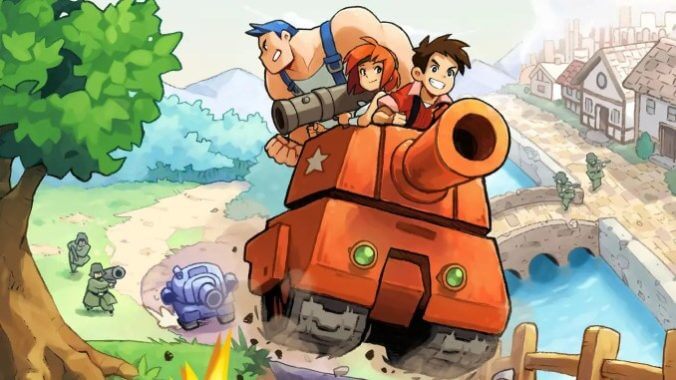
The major problem is tone. Advance Wars is too cheery. It’s a war being fought by cute, silly cartoon characters, who should probably be a little bit less cute and silly about, y’know, war. There’s no blood or gore, but presumably people are dying out there on those fields. When my squad of 10 infantry units is waylaid by a Medium Tank and wiped out in a single strike, my commanding officer shouldn’t immediately smile it off while launching sarcastic barbs at the enemy leader. Even with a sci-fi story and futuristic aesthetic, Military Madness is more serious than Advance Wars. It’s not grim, it’s not leaden, it’s not self-serious, but it also doesn’t present war as a big fun game for COs to joke about as their soldiers die left and right.
Advance Wars’ tone is especially odd given Intelligent Systems’ other big turn-based series. The same studio is responsible for the Fire Emblem games, which are better than Advance Wars in almost every way. Fire Emblem is also far more popular in America, so the Advance Wars series can clearly learn something from it. Fire Emblem games have their fair share of fun and lightness, but they also take their battles seriously. They’re not presented as a glorified game played by nameless, faceless, expendable grunts, but as life-or-death struggles between established characters who can die permanently at any moment. I’m not saying the units in a turn-based strategy game like Advance Wars should have names and personalities like in Fire Emblem; that’s impractical and unnecessary. But the other characters in Advance Wars, the commanding officers sending them into battle, should treat their sacrifices with at least some dignity and respect and not just brush them off with light-hearted banter.
Even more than Fire Emblem, SEGA’s tactics game Valkyria Chronicles shows how you can treat war with gravitas while still having time for charming, humorous character interactions. Chronicles’ fictional take on World War II juggles warmth, humor, and personality with intense battles, shocking deaths, and a surprisingly sensitive depiction of mass internment and genocide. Those heavy topics make the game’s lighter moments land with more impact than the carefree folly of Advance Wars.
As hollow as it makes the games feel, it’s understandable why Nintendo would go this route with them. By turning Advance Wars into a cartoon and greatly distancing it from a realistic depiction of war Nintendo hopes they can distance themselves from controversy. That’s not a big concern when your war game is set in a fictional fantasy setting and fought with swords and axes, as in Fire Emblem, and so Intelligent Systems is free to take those games more seriously. Nintendo is so worried about controversy over a game with machine guns, fighter jets, and tanks that they delayed the release of the recent Advance Wars 1+2 Reboot Camp by a year due to the war in Ukraine. As much of an overreaction as that might have seemed at the time, it honestly makes sense that they would want to do that, as the fundamental problem with Advance Wars is that it trivializes war. It’s possible to inject Nintendo’s trademark sensibilities into this type of game with the right amount of subtlety and nuance, but Advance Wars is as subtle as a missile strike to the face.
Senior editor Garrett Martin writes about videogames, comedy, travel, theme parks, wrestling, and anything else that gets in his way. He’s on Twitter @grmartin.


 Keep scrolling for more great stories.