Given the cultural ubiquity of Animal Crossing: New Horizons, it’s easy to say that the series was always destined for big things. For context, New Horizons was the highest-selling game release of 2020 (about 32 million sold that year) and is now one of the best-selling games of all time (almost 50 million copies to date). Its formula of letting players live out idyllic days in a sleepy town full of cute humanoid animal companions (where home loans don’t have interest) is so alluring that it feels events couldn’t have gone any other way. The reality is that the series wasn’t an instant mega-hit; it took multiple decades for it to go from a region-locked, late-stage fifth-gen console release to something known in the broader culture for celebrity sightings and political meet-and-greets.
Dōbutsu no Mori (Animal Forest in English) came out exclusively in Japan in 2001 as Nintendo’s final release for the N64. However, even though titles released late in a console’s life cycle are often overshadowed by the glitzy appeal of upcoming hardware (in this case, the GameCube, which came out a few months later), it proved enough of a success in Japan to justify an English-language version (around 200,000 copies sold). Localized as Animal Crossing in English, this first entry would prove similarly successful overseas, eventually hitting total sales of around 2.5 million. While there were great numbers relative to the GameCube, that console was almost entirely overshadowed by the blockbuster success of the PS2, which remains the highest-selling game console ever. In short, Animal Crossing was quite well-known at the time by Nintendo loyalists and those plugged into gaming culture, but Tom Nook wasn’t a household name.
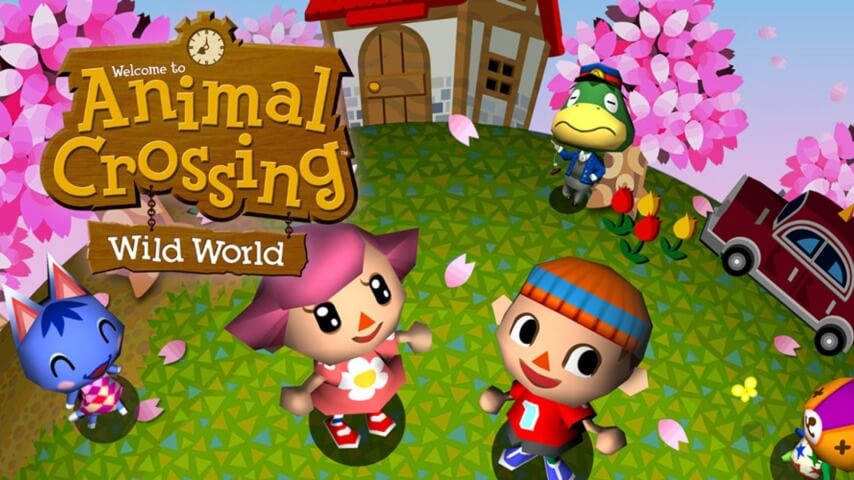
That would begin to change in a big way with Animal Crossing: Wild World, which launched exactly two decades ago in North America for the Nintendo DS. Like other games in the series, you play as a new homeowner in a randomly generated town who is largely left to their own devices; while there’s a vague goal of paying off your home debt to Tom Nook, you can also not do that, instead spending your days chatting with villagers and generally hanging out. Or you can capture bugs, go fishing, and sell fruit to scrape up the bells (the series’ currency) needed to appease this tanuki, all so you can expand your house and start this repayment process over again. You mingle with neighbors, buy furniture, plant trees, collect freaky little gyrating fire hydrants, and generally go about a simulated little life. It’s very pleasant. Meanwhile, the in-game clock syncs with your Nintendo DS, causing days to pass in real time; the seasons shift and your town with it.
As for what was new with Wild World, in some ways, not much. There were additional buildings like the town hall, where you could check your account balance and town rating (features that were present but located elsewhere in the original); a salon where you could change your character’s appearance; The Roost, which hosted the beloved canine musician K.K. Slider and his Vocaloid bops; an observatory that let you draw constellations; and more. There were new items like the watering can and slingshot. The DS’ touchscreen could be used to quickly organize items, and so on.
At the same time, though, there were almost as many removals or trade-offs as fresh features. Localized holidays like Christmas were removed in favor of fictional festivals to help ease localization woes—these have their own appeal, like the abundant compliments of Yay Day or Acorn Festival and its creepy harbinger Cornimer, who looks like an escaped critter from Halloween III: Season Of The Witch, but it’s understandable why some were a bit annoyed they couldn’t celebrate Turkey Day and whatnot. Fresh villagers that could live in your town were added, but around 170 were removed (the Japanese release of the GameCube game had 284 villagers while Wild World had 150). And perhaps the biggest loss of all: the impressive library of NES games was no longer playable (presumably so Nintendo could sell you these games elsewhere).
Despite this, there were two elements that Wild World introduced which would prove pivotal to the series’ eventual smash-hit success: the introduction of online multiplayer and the switch to handheld. For starters, the transition to the DS was essential to these games’ increasing popularity. While the series would later receive its second (and last) home console-only release with Animal Crossing: City Folk for the Wii in 2008, it didn’t sell nearly as well as many of its peers—City Folk‘s 4.3 million sold was sandwiched between Wild World’s 11.75 million and Animal Crossing: New Leaf’s 13 million. In other words, it was the jump to Nintendo’s popular line of handhelds that coincided with these games fully taking off. This chalks up to more than the large install base of the DS and 3DS: while City Folk came out on the Wii, which sold over 100 million units, New Leaf sold three times as many copies while on the eye-straining 3DS, which shipped around 76 million.
One explanation for why Animal Crossing resonated so much more on handheld is that it provided the satisfaction of always having a life-sim game at your fingertips. The low-key, lackadaisical pace of these games is particularly well-suited to the stop-and-go nature of handheld gaming; if you’re interrupted or distracted, it won’t lead to a costly in-game death. When many envision Animal Crossing, they likely recall playing during travel, while sharing the TV with friends, family, and loved ones, and so on—it’s a bit like those Nintendo ads that overenthusiastically but somewhat accurately stress the appeal of on-the-go gaming.
Another draw of having Animal Crossing on handheld comes from being able to fit this idealized, simulated world in your pocket, a more readily accessible salve from daily stresses, and so on. It’s like a more advanced Tamagotchi, but significantly less stressful. While the Switch broke down barriers between handhelds and home consoles, it’s probably no coincidence that Animal Crossing found an extra gear on a portable system.
Beyond this, Wild World introduced another crucial element to the series: its multiplayer features. While very rudimentary compared to modern online games, you could add friends via a code and then visit each other’s villages over the internet or while on local wi-fi. Up to four players could be present in a world at the same time, letting you fish together or torment villagers by hitting them with a bug net in unison.
There was also the Tag Mode, which was positively crucial for bolstering a spirit of interconnectivity and community that’s always been fundamental to these games. With this enabled, you could get messages from other players, receive traveling villagers from other players’ towns, and more. While the implementation of directly traveling to other players’ home turf was very clunky, when combined with the Tag system, it created the sense of a wider world that changed in response to more than just you. There were even more reasons to beautify your village or check back in to see what had happened recently.
Admittedly, going back to Wild World in 2025 is a bit awkward. Its previously mentioned multiplayer features were unceremoniously murdered by Nintendo, undermining the sense of interconnectivity that’s one of the game’s core appeals. Beyond this, it generally feels like a weaker first draft compared to what would come after; New Leaf is a richer, more aesthetically realized take on the same ideas, while New Horizons takes those lessons and pivots with more of a focus on village customization (arguably too much) and a love of speculative turnip trading. Meanwhile, the original retains its own charms thanks to its relative simplicity and interesting place in gaming history (and it also lets you play Excitebike, which is pretty rad).
Still, there’s no denying that Wild World established a blueprint that future games in the series would follow, eventually culminating in New Horizons’ cultural tour de force. It was a crucial turning point in a series that would become increasingly important for not only Nintendo but for gaming in general. In the years since, life-sims have exploded in popularity, and while Animal Crossing can’t claim full credit for that (Harvest Moon and many others would like a word), it’s not an exaggeration to say these games, and this second installment in particular, played a significant part in getting there. Nintendo may have taken Wild World back behind the barn when it shut down the game’s online features, but that doesn’t diminish how its sense of connection changed this series for good.


 Keep scrolling for more great stories.