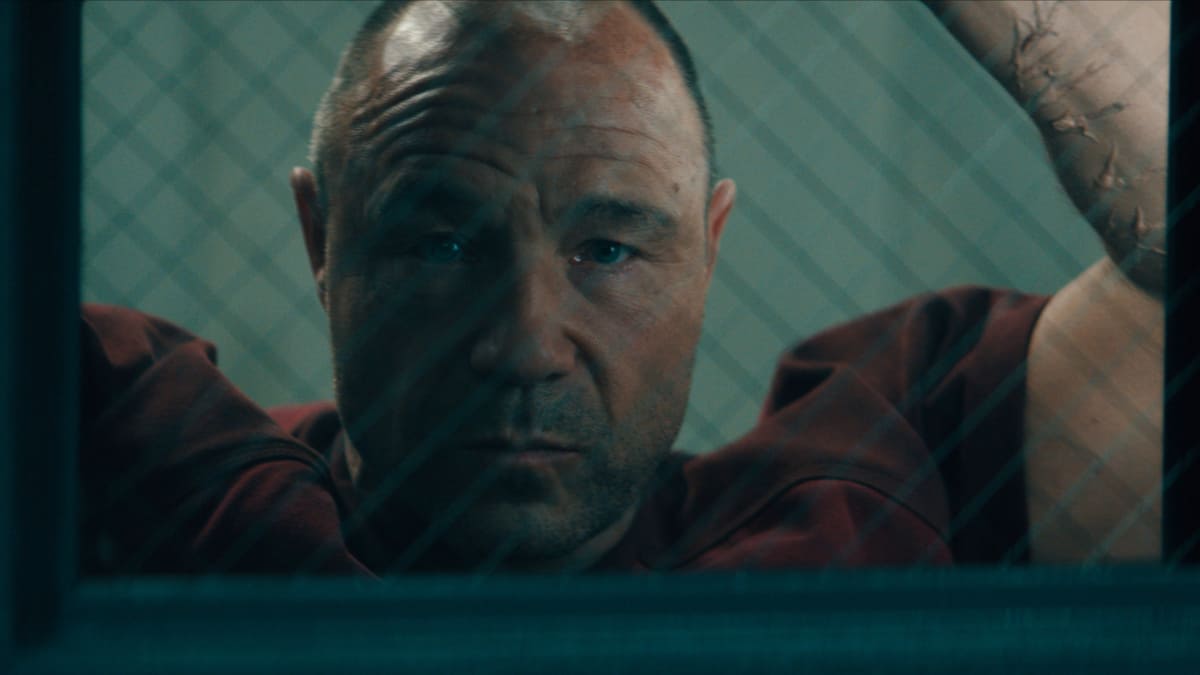
At the center of Apple TV’s superbly disturbing thriller Nocturne lies calculating murderer Jurek Walter (Stephen Graham), who has lived in solitary confinement at a maximum-security psychiatric facility for three years. Not that this stops him from unleashing new waves of mayhem: The series opens with Jurek verbally manipulating the man in the neighboring cell—communicating with him through their respective toilets—into committing an act of violence. It’s the show’s way of immediately stating that it, and Jurek, mean business.
When alleged Jurek victim Michael Frost (Landon Valentin)suddenly finds his way home, it reopens the case, resurfacing old wounds for retired detective Jonah Lynn (Liev Schreiber) and his FBI agent goddaughter, Saga Bauer (Zazie Beetz). As they find themselves trapped by Jurek’s mind games once more, Nocturne develops a pulsating, edge-of-your-seat suspense (at least in seven of 10 episodes provided for review).
Adapting the Scandinavian noir novelsLazarus and The Sandman—by Swedish husband-wife writers Alexander Ahndoril and Alexandra Coelho Anhndoril (who publish under the pen name Lars Kepler), creator Rowan Joffe retains the books’terrifying scope while shifting the setting from icy Stockholm to the suburban town of Fairhaven, Pennsylvania. The effectively claustrophobic production design—especially the clinical design of Jurek’s cell and the dimly lit police station bullpen—and a score by British duo Toydrum amplify the dread. But it’s Graham’s performance that truly dials up Nocturne’s creepy factor. With pointedly chilling expressions and a thinly veiled smile that harkens back to Anthony Hopkins in Silence Of The Lambs, Graham (who’s had a busy couple of years on TV with Adolescence and A Thousand Blows) anchors yet another intense drama.
The actor is matched by an equally compelling ensemble boasting Bill Camp, Poorna Jagannathan, Rory Culkin, Gary Carr, and Chrissy Metz. Schreiber and Beetz form the show’s turbulent emotional core; Jonah and Saga have been scarred by Jurek such that revenge and rage fuel their actions. While trying to nab the maniacal killer in the past, Jonah’s cop partner/Saga’s father died, and Saga’s stepmother vanished. Jonah blames Jurek for those crimes and is also certain that—despite being securely locked up at Riverside Psychiatric Hospital—Jurek is responsible for 12-year-old Michael’ reappearance in Fairhaven. Their troubles increase when Saga goes undercover at Riverside in the guise of Esther, an unstable criminal, hoping Jurek will open up to her about Michael’s still-missing 17-year-old sister. In the process, Beetz deftly juggles two distinct characters with ease: the determined officer who Saga actually is, and the frazzled “patient” she’s pretends to be— who may or may not become another victim of Jurek’s manipulations for real.
Nocturne’s intriguing puzzle pieces—including the mystery of why people close to Jurek start to disappear and his unpredictable friendship with his naive caretaker Karl (Culkin)—could have turned into a labyrinthine or exposition-heavy affair. But in the hands of directors like Tim Van Patten and Anu Menon, as well as writers like Joffe and John Hlavin, the plot progresses at a breathless pace and the character dynamics feel naturally lived-in. The longstanding connection Jonah shares with Saga and Sheriff Ellison (Camp) is as natural as his newfound partnership with FBI head honcho Quinn (Jagannathan), who rolls into town to help with the case.
Mercifully, Nocturne doesn’t waste time on detective-drama clichés like the various cops arguing with each other over jurisdiction or the right steps to take. It’s not interested in exploring the inner workings of the force. Jonah and his colleagues all team up to bring down Jurek, only to face targeted attacks that elevate the tension and allow Nocturne to dive into its serial killer’s unsettling psyche. Jonah and Jurek, in particular, share a venomous relationship sends aftershocks across every other storyline. Nocturne’s priority is building an enthralling suspense with everyone caught up in Jurek’s web. That list of people includes Karl, who becomes an unwitting pawn between Jurek and the detectives in a way that will certainly leave you concerned for his mental and physical well-being.
Nocturne becomes a show greater than the sum of its moving parts—parts that include Metz’s arc as Michael’s distressed mom, Saga’s shaky romance, and Jonah’s own tragic family life—because of how it elegantly integrates larger themes of grief, parenthood, and what it means to let go into its central mystery. A solution to the case feels preordained, but much like its page-turning source material, the journey is an addictive ride to that destination.
Saloni Gajjar is The A.V. Club‘s TV critic. To make sure you’re seeing more of her writing, add The A.V. Club as a preferred source on Google.


 Keep scrolling for more great stories.