The direct-to-video movie has a bad reputation, and direct-to-video sequels have it even worse. DTV horror sequels might be the runt of the litter; those cruddy videotapes and DVDs we gawk at on a Goodwill bargain shelf or in one of the last heroic video stores in the world look awfully grim compared to their big-screen forebears. However, if you’re one of the brave few who prefer a little jank in their movies, who embrace the cheapie charms of a sequel made on a microscopic budget, and who accept (even love!) the B-, C-, and D-listers who come in to house-clean franchises that refuse to die, you know that direct-to-video horror sequels have such sights to show us.
Every self-respecting horror franchise has at least one direct-to-video sequel made for dubious and/or legitimately creative reasons. And sometimes, though very rarely, the DTV sequel transcends its limitations and surprises us by bringing something new or, failing that, something interesting to the franchise it’s either contributing to or prolonging. They accomplish this by either experimenting with the formula, taking their creeps, monsters, and slashers to new frontiers, or embracing what worked so well in the past and giving it a fresh coat of bloody red paint. We pay tribute to these maverick movies, 13 direct-to-video horror sequels that convinced us to dread not the dreck, during this most freaky Horrors Week.
Sleepaway Camp 2: Unhappy Campers (1988)
With a sinister wink at the growing number of slasher villains in the mid-to-late ’80s, 1988’s Sleepaway Camp 2: Unhappy Campers gives the series’ knife wielder, Angela (The Boss’ sister Pamela Springsteen), the charisma to play in the big leagues. As Angela Baker, the tortured, gender-dysphoric killer, Springsteen brings confidence and humor to this proto-Camp Miasma slasher comedy. Springsteen revels in the silliness of the campfire-killer subgenre with fresh kills and a wicked sense of humor. Now a counselor trying to keep her horned-up staff in line, Angela mows them down with trashy glee that leans hard into the original’s John Waters-inspired campy comedy while delivering on the gore. It might not carry the same fiendish cult and critical adulation as Sleepaway Camp, but Unhappy Campers leaves viewers smiling. [Matt Schimkowitz]
Bride Of Re-Animator (1990)
Folks who either caught its recent 4K remaster or its 1990 video release know that BrideOfRe-Animator isn’t aiming for the same obscene heights as its predecessor but something more absurd and untamed. What new director Brian Yuzna (taking over for pal Stuart Gordon) replaces the seamier stuff with is a hoot and quite shocking in its own way. Powered by practical-effects maestro Screaming Mad George and KNB EFX Group, Bride fuses its shock delights with moments of comic-terror inspiration, like the finger-creature that invades a tense police interview, or when the film cuts away from Dan (Bruce Abbott) and Francesca’s (Fabiana Udenio) sex scene just to watch Dr. Herbert West (Jeffrey Combs) tickle the feet of a severed leg. And don’t let’s forget Angel, The Dog With A Human Hand! Castigate it for not being Re-Animator if you must; Bride leans all the way into Dr. West’s extreme mad science. Look to the final moments, when “The Bride” (Kathleen Kinmont) literally pours her heart out to Dan, exasperated and infuriated by his fuck-boy wishy-washiness: “What do you waaaannnt?” The series’ macabre torment of reanimation—and, indeed, relationships—remains quite alive. [Jarrod Jones]
Maniac Cop 2 (1990)
It might not be the best direct-to-DVD horror sequel ever made, but it sure comes close. (And to say nothing of its iconic tagline: “You have the right to remain silent… forever…again!) Maniac Cop 2, William Lustig’s artful follow-up to the grimy original, approaches the expressionistic highs of Universal Soldier: Day Of Reckoning—high praise in the DTD community. The sequel punches way above its weight, with atmospheric lighting, explosive action scenes, and a deep bench of character actors, including Robert Davi, Claudia Christian, Michael Lerner, Clarence Williams III, and Charles Napier, to fill out the cast. Taking a supernatural swerve that would go too far in Maniac Cop 3: Badge Of Silence, this revenge-based sequel sees the zombified Matt Cordell (Robert Z’Dar) rising from the grave to round up the inmates who killed him in prison. One look at it, and it’s clear why Nicholas Winding Refn wants a crack at remaking the series. [MS]
Critters 3 (1991)
The vicious little furballs of Critters only had three chances to hit the necessary sequel tropes before running out of food. Critters 2 gave them a holiday to terrorize, and the ratking Gremlins knockoff wouldn’t make it to space until Critters IV. But Critters 3 took them to the big city, allowing them to Take Manhattan, so to speak. Like many before and after, Critters 3 fails to take advantage of its new locale, inviting these tumbleweeds of terror to roll down flights of stairs and through laundry chutes of a single apartment building but not much else. Plot-wise, things haven’t changed: The Crites menace a new family who ignore Charlie (Don Keith Hopper) and Ug’s (Terrence Mann) warnings—this time stowing away in the luggage of a vacationing family returning home to Los Angeles. Best known for its Growing Pains-era Leonardo DiCaprio, Critters 3‘s main course is a supporting turn from perpetually elderly character goddess Frances Bay, who pops up as an axe-wielding nice old lady in between stints in Twin Peaks. [MS]
Amityville 1992: It’s About Time (1992)
There’s no question the horde of crummy Amityville sequels, spinoffs, and ripoffs has diminished the franchise, and Amityville1992: It’s About Time likely gets written off more than it should. The dopey title certainly doesn’t help. But should you gamble on this peculiar sequel from director Tony Randel (Hellbound:HellraiserII, Ticks), you’ll find it pushes past its deceptive DTV haunted-house trappings. When a distracted father (Stephen Macht) returns from a work trip with a strange antique, the clockwork rhythms of his family unit—his punky, tormented son (Damon Martin), his sweet daughter (Megan Ward), and former lover turned put-upon family friend (Shawn Weatherly)—come to an abrupt halt. The shift is so sudden and violent that their suburban facade cracks, revealing the cruelty, viciousness, and hatred that polite family life otherwise obscures with dismissive smiles and knowing silence. Their story fragments, reality splits, time ceases to have meaning, and the movie shifts into a freaky, frothy fusion of sleaze, Yuzna flesh, and Italo-horror strangeness that ultimately transcends its brand. Time to check it out. [JJ]
Children Of The Corn III: Urban Harvest (1995)
Like LeprechaunInTheHood took Warwick Davis to the city for a change of pace, ChildrenOfTheCorn heads to metro Chicago for its third DTV installment—a bananas-pants high school fright-fest that’s short on character but big on inventive corn-centric kills. Eli (Daniel Cerny), the franchise’s latest puritanical mush, and hunky adoptive brother Joshua (Ron Melendez) are brought in by a yuppie couple (Jim Metzler and Nancy Lee Grahn) who try to modernize their duds and mindsets with comfort and wealth. Eli will have none of it. Soon, he’s planting corn, raising stalks, and provoking his Catholic school bishop (Michael Ensign), bringing new acolytes into his fold and gathering strength for He Who Walks Behind The Rows. Speaking of, for all the hype this series puts into HWWBTR (who looks like the Dark Overlord Of The Universe from HowardTheDuck, if he were a corncob), watching it ham it up in the movie’s go-for-broke finale is quite satisfying, given how B-movie ridiculous it is. Here’s a demented, hopelessly silly, and very MTV-brained sequel that expands the franchise’s scale while protecting its shocking, blasphemous creativity. There’s one death you won’t see coming, and when their jaw drops at the suddenness of their demise, we promise yours will, too. [JJ]
Tremors II: Aftershocks (1996)
Burrowing deeper into the sci-fi schlock of its predecessor, Tremors II: Aftershocks returns the series to its natural, direct-to-video habitat where it overachieves. Without Kevin Bacon around to give the slug-based creature feature legitimacy, it’s up to Fred Ward, series mainstay Michael Gross, and Gross’ elephant gun to clear a Mexican oilfield of these sharp-toothed, ever-evolving graboids. Released on VHS in 1996 and directed by series creator S.S. Wilson, Aftershocks became a cable staple, endearing itself and its surprisingly solid effects, courtesy of Tippett Studios, to cable watchers during No Class Movie Daze on USA, particularly youngsters enamored by Earl (Ward) and Grady’s (Gross) RC car-based explosives. Aftershocks never reaches the highs of the original, but with a strong returning cast, prepared, as always, to get a little dusty, the series wormed its way to several more sequels and the ever-present threat of a reboot. [MS]
Hellraiser: Inferno (1996)
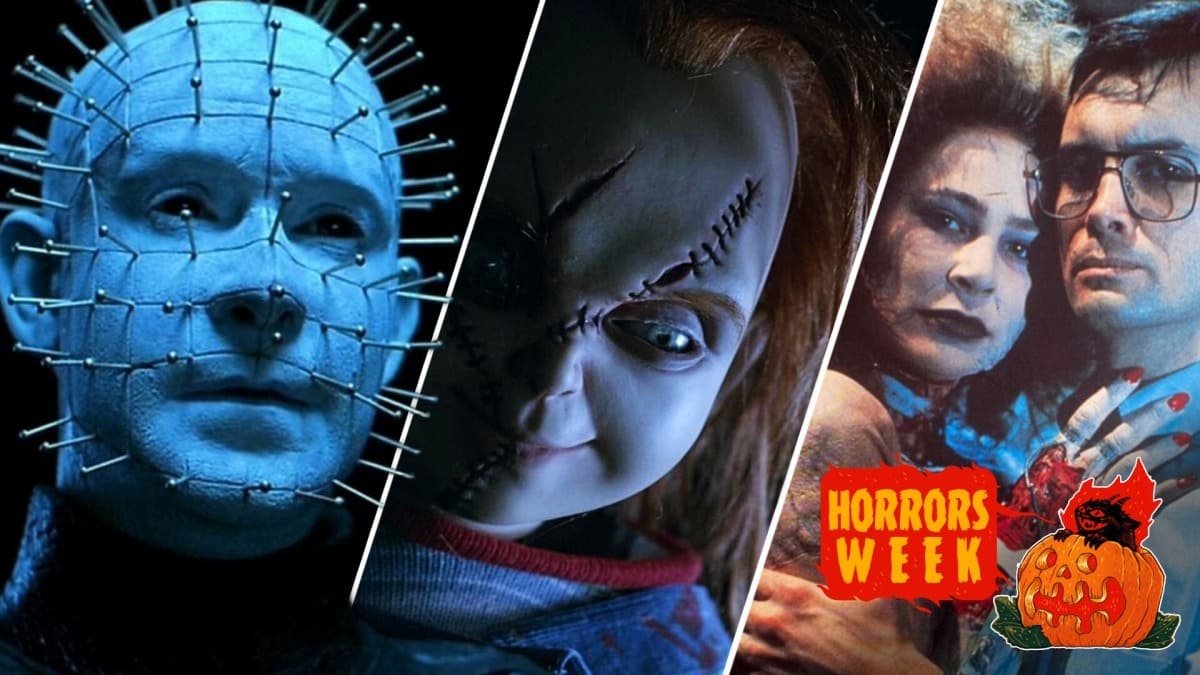
Scott Derrickson’s Inferno has the dubious honor of being both the first DTV Hellraiser sequel and the last halfway decent one. It’s a grimy, sullen, lurid affair that, strangely enough, is content to accumulate symbols, patterns, and meaning rather than go completely bug-nuts with Cenobite carnage. That’s a plus in my book. Of all the Hellraisers that followed Clive Barker’s 1987 film, Inferno is the one installment that echoes its themes of desire sought at the cost of great pain. In fact, Derrickson’s film is so withholding of its horror violence that some have suggested it wasn’t originally meant to be a Hellraiser film but a supernatural cop movie that eventually adopted the brand. Sussing out whether that’s true or not sounds like great fodder for another feature; until then, as Hellraiser‘s stab at noir detective horror, it gets the job done. Edgy police detective Joseph Thorne (Craig Sheffer) indulges his every whim—snorting cocaine, cheating on his wife (Noelle Evans)—until a mysterious puzzle box appears during one of his murder cases. And while Inferno is notably reluctant to let Doug Bradley’s Pinhead cut loose once the puzzle box is opened, Derrickson’s deliberate edging toward Thorne’s admirably dopey fate is what gives the movie its sleazy, dime-store paperback charms. [JJ]
From Dusk Till Dawn 2: Texas Blood Money (1999)
The follow-up to 1996’s vampire bar fest From Dusk Till Dawn featured almost no returning actors except for Danny Trejo (whose character name changed from “Razor” Charlie to “Razor” Eddie), but the chaotic overnight premise more or less repeats itself. This time, a bank robber tries to get the old gang back together, stopping at the El Coyote Motel and the adjoining bar, the Titty Twister, where the first movie’s carnage took place. In the sequel, the bloodthirsty vampires aren’t just confined to the bar; now they fly into the motel to bite unsuspecting guests or into the vents of the bank to pull off a robbery. Because even vampires still have one more heist to do. While From Dusk Till Dawn 2: Texas Blood Money lacks the sleekness of Robert Rodriguez’s vision, it’s a goofy last stand with a high body count, true to the original’s bloody premise. [Monica Castillo]
Wishmaster 2: Evil Never Dies (1999)
No horror sequel list would be complete without the wily strangeness of Andrew Divoff, whose sinister smolder made 1997’s Wishmaster and its three sequels as memorable as they are. Of the bunch, EvilNeverDies does the most with its evil-genie premise, setting Demerest loose in a federal penitentiary to grant the general population its heart’s desires and drawing the ire of a hulking prison guard played by Tommy “Tiny” Lester, Jr. Naturally, the genie must fulfill its world-conquering prophecy, which the film details through Morgana (Holly Fields), a goth-babe museum thief who accidentally awakens the djinn during a heist gone wrong. Through it all, there’s just enough trashy, idiotic monkey’s paw action to keep viewers engaged—and let’s not forget the joys of watching Divoff devour every scene with but a slight baring of his teeth. [JJ]
Leprechaun In The Hood (2000)
There comes a time in every horror franchise’s existence when its marquee mayhem-maker turns its gaze to new horizons. As Jason Voorhees eventually took Manhattan (and space) and Chucky ran amok in a military school, so too does Warwick Davis’ Leprechaun venture into the high-stakes world of gangland hip-hop in LeprechaunInTheHood, film no. 5 in the horror series. Barely tolerating its porno-cheap production and predictably lousy attitude toward a trans sex worker character is your entry fee; however, patient viewers are eventually rewarded with idiotic kills and indulgent rhymes, both courtesy of Davis, who takes the characters’ Etrigan-like meter and elevates it perilously close to trash art during the movie’s farcical closing rap sequence. But the most fun one might have during Lep’s Rap Reign is his interactions with Ice-T’s Mack Daddy O’Nasses, who introduces the monster to the wonders of the sticky-icky. InTheHood might not be the best example of the Leprechaun franchise—it might not have one—but few who’ve watched it can say it’s not at least its funkiest. [JJ]
BloodRayne: The Third Reich (2010)
The third BloodRayne movie from Uwe Boll isn’t exactly good (okay, it’s not even close), but it is much more enjoyable than either the original or the Wild West porn parody antics of BloodRayne 2: Deliverance. Abandoning nearly all the set-up of the original, The Third Reich further tries to situate its heroic half-vampire into a history-hopping mythology. It’s more energetic and better-lit than Deliverance, which means you can more clearly see its heroine’s even lower-cut outfit. But the real draw isn’t anything so titillating. The Third Reich is a bad-taste carnival ride led by ringmaster Clint Howard, who plays a Nazi scientist rarin’ to go full Renfield. It’s so silly and inept that it quickly strays into so-bad-it’s-good territory, with dialogue, accents, and delivery styles that’ll leave you just as incredulous as its venture into softcore bisexual vampire smut. It’s truly trashy, just like its video game source material. But watching Howard snivel out the film’s barely-English script is a unique pleasure, one he’s made a career of in bad (and good-bad) DTV films. [Jacob Oller]
Curse Of Chucky (2013)
In one of the rare cases of VOD sequels, creator of the Chucky franchise Don Mancini stayed on to write and direct its sixth chapter, Curse Of Chucky. The killer doll returned (with some bizarre painted-on eyebrows, but we digress) almost a decade after he was killed at the end of Seed Of Chucky, haunting a new family that quickly loses many members of its family due to poisoning, decapitation, and whatever other bodily harm this murderous doll can manage. The film’s main character, Nica, is played by Fiona Dourif, daughter of the voice of Chucky, Brad Dourif, and who many viewers today may recognize from The Pitt. This installment was so successful, Nica has since become a recurring character in the long-running horror franchise. [MC]


 Keep scrolling for more great stories.