In documenting Avedon’s career, Howard makes ample time to delve into the photographer’s ideology. As a boy, Avedon grew up in the Bronx and became friends with James Baldwin at school. The two later collaborated on the photograph book Nothing Personal, which of course, was quite personal. Baldwin wrote the text to accompany Avedon’s pictures, which captured both moments of everyday joy in the lives of people of different races, but also their anguish in illness. He photographed Martin Luther King Jr. and Malcolm X for the book at the height of the Civil Rights Era, giving them the respect and space that many magazines were afraid to. In Nothing Personal, Baldwin wrote of the tumultuous times but ended on a note of cautious hope for a brighter future for all: “For nothing is fixed. Forever and forever and forever. It is always not fixed. The earth is always shifting…”
By this point in Avedon’s career, he was already an established, in-demand artist. To get so political was risky, and derided by critics at the time. One of the most personal aspects of the work is Avedon’s photographs of mental health patients at Bellevue Hospital. The people in these photographs had been placed in a facility away from the public so they wouldn’t be seen, but Avedon took their pictures “…so that we pay attention.” The topic was deeply personal for Avedon, as his sister Louise, often credited as Avedon’s first model, died in a catatonic state in a mental institution. His style of photography always sought honesty, and found it in the faces of people who never hid who they were.
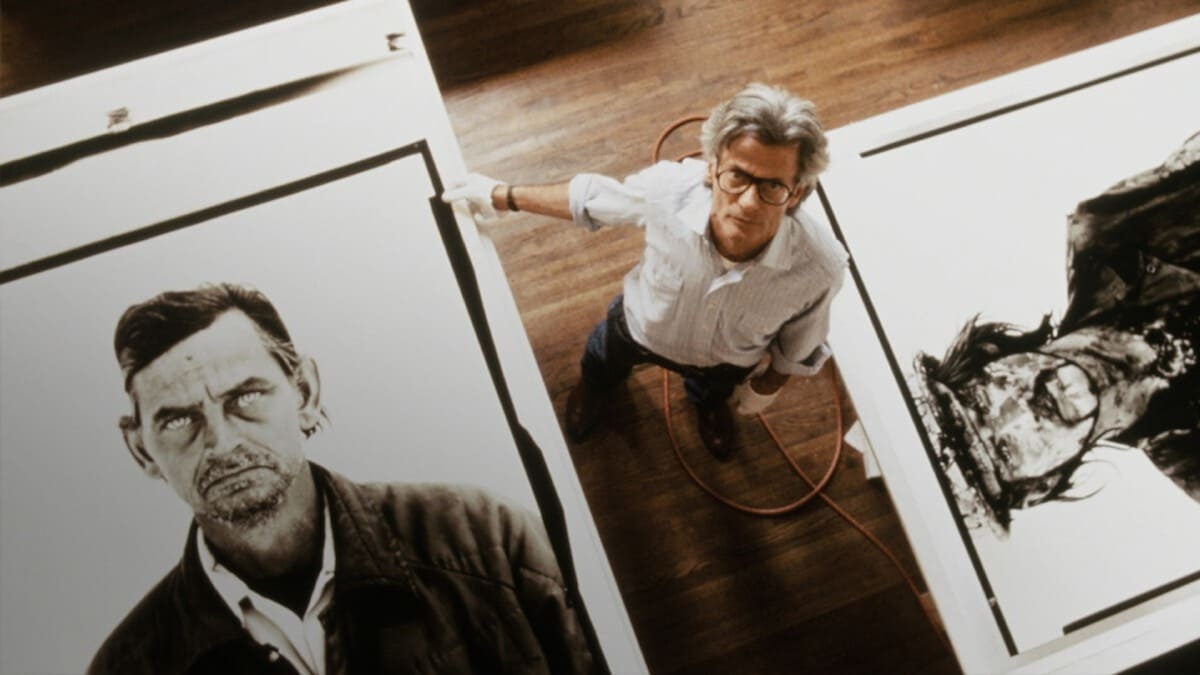
Howard balances Avedon’s famous glamour with his underappreciated political output, allocating the same amount of time and commentary from Avedon’s contemporaries, gallerists, curators, assistants, and his son, John, to illuminate the photos that didn’t see the cover of magazines. Howard does so in part by digging into Avedon’s creative process, illustrating sides of the artist that weren’t as widely known as his role as a photographer to the stars.
When profiling the Chicago Seven during their trial, Avedon lined them up against his signature white backdrop, looking simultaneously like a crowded fashion photo shoot and a police book. The accused stand in a loose assembly of differing ideals and convictions, brought together by their charges to incite a riot outside the 1968 Democratic National Convention. Howard uses a taped audio recording of the session, complete with outtakes, to reimagine Avedon’s process of making these political boogeymen appear human once again. Avedon would return to this visual concept many more times throughout his career, like when photographing different representatives of the Vietnam War, crowding together the nameless bureaucrats responsible for the atrocities opposite the portraits he took of scarred Vietnamese survivors.
It’s all the more affecting because of Howard’s willingness to approach his subject from different perspectives—something he’s more comfortable doing in documentaries than in his less-robust biopics, which sand down the complexities of these stories for more streamlined, easy times at the movies. But a subject like Richard Avedon benefits from exploring the artist’s full body of work, much like Howard’s previous documentary Jim Henson: Idea Man covered the puppeteer’s early experiments. Howard doesn’t shy away from anecdotes from Avedon’s story that aren’t as laudatory, like the photographer’s obsession with work, the way he used it to escape his troubles, and his familial absence when he relocated to live in his studio. Avedon is a richer film for diving into these complexities—making the photographer’s political dedication as much an achievement as his fashion spreads, and honestly unpacking the fallout from his workaholic tendencies—while casting a new light on his more recognizable photos. With Avedon, Howard opens himself up to messier portraits of humanity, taking in their contradictions and flaws as something worth celebrating, rather than leaving on the cutting-room floor.


 Keep scrolling for more great stories.